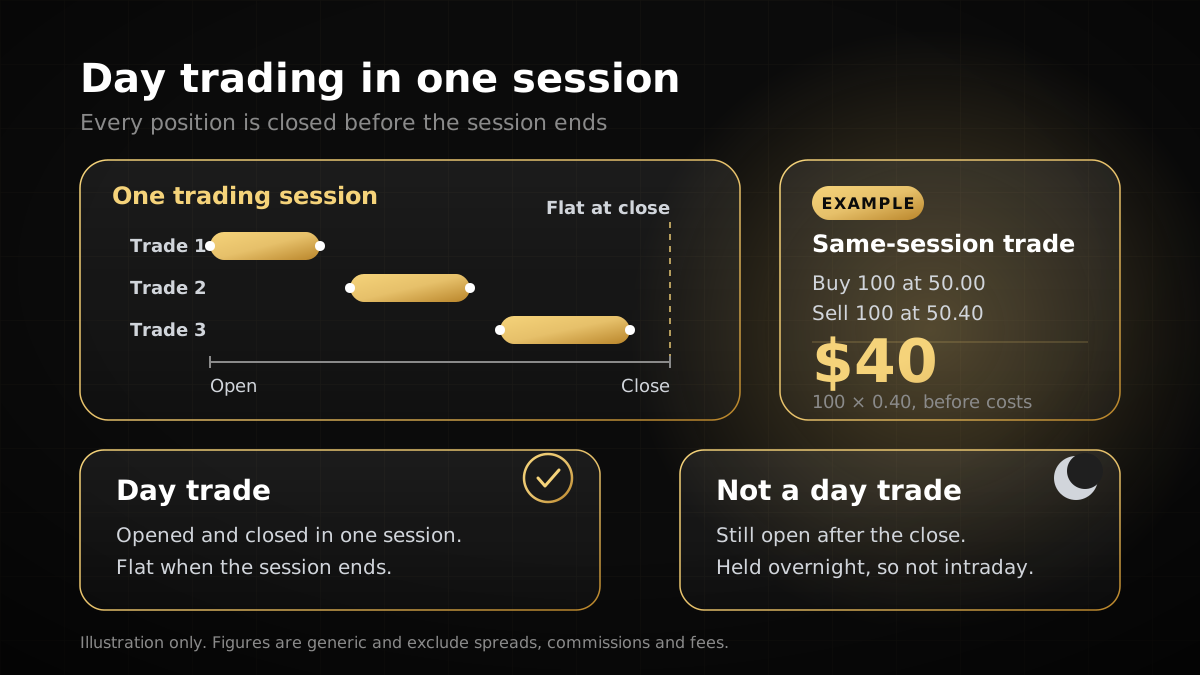
Day trading is a style used in liquid markets such as forex, indices and stocks. A day trader enters a position, manages it and closes it before the session ends, so the account is flat when the day finishes. This guide explains what day trading means, how a single trade works, which costs and risk controls matter most, and how prop firm loss limits change the way a day trader has to plan. The examples are hypothetical. They show the arithmetic, not a result.
What day trading means
The holding period is the time between opening a position and closing it. For a day trader, that period stays inside one trading day. A day trader may open several positions in a session, or none on a quiet day. What defines the style is the timing, not the number of trades. A trader who opens and closes three positions before the close is day trading. A trader who opens one position on Monday and closes it on Thursday is not.
The session is the window the trader chooses to trade. In forex, sessions overlap and their times depend on your time zone, so our forex market hours guide sets them out. In stocks, a day usually means the exchange’s regular hours. A clear definition helps when you read rules or compare firms.
What is intraday trading?
“Intraday” simply means within the day, so intraday trading is any buying and selling that opens and closes within one trading day. The two phrases are labels for one style, and this guide uses them interchangeably.
The labels are not used consistently. Many forex and prop firm sites say day trading, while some brokers and educational sites say intraday. Some brokers also apply a different margin requirement to positions closed the same day, so check the broker’s margin page before you rely on one. The label does not change the style, but the rules attached to it can.
How a day trade works
Every day trade follows the same sequence, whether the trader is fast or slow. The plan comes first, and the trade is only the last step.
- Choose the market and the session. Pick one instrument and the hours you will watch. Trading many instruments at once makes it harder to track risk.
- Set the plan before you enter. Write the entry condition, the stop loss, the profit target and the size. The size follows from the stop, never the other way round.
- Manage the position. Watch the stop, the target and the floating result, because an open trade carries risk until it closes.
- Exit by a rule. The trade closes at the stop, at the target, or at a time set before the session ends.
- Review the result. Record the entry, exit, size, costs and whether you followed the plan.
Worked example: one day trade in numbers
Take a hypothetical $10,000 account trading a USD-quoted pair on a USD account, where one pip on a standard lot is worth $10. The trader risks 1% per trade, which is $100. The stop loss is 25 pips away from entry.
- Amount at risk: $10,000 x 1% = $100.
- Risk per standard lot: 25 pips x $10 = $250.
- Position size: $100 / $250 = 0.40 lots.
The planned profit target is 40 pips. Each outcome below assumes the position is closed at the level shown. The spread allowance is a hypothetical 1 pip paid on entry, which is 1 x $10 x 0.40 = $4. Real spreads, commissions and slippage vary, so use your broker’s figures.
| Outcome | Price move | Gross result | Spread allowance | Approximate net |
|---|---|---|---|---|
| Stop loss hit | 25 pips against | -$100 | $4 | -$104 |
| Profit target hit | 40 pips in favour | +$160 | $4 | +$156 |
| Closed at session end | 10 pips in favour | +$40 | $4 | +$36 |
The planned payoff is $160 against $100 at risk, a ratio of 1.6 to 1. That ratio describes the plan, not the outcome. It says nothing about how often the target is reached. A trader can have a good ratio and still lose money if the stop is hit more often than the target, or if costs take a larger share than expected. The session-end row matters too. Many day trades do not hit either level, so the close price at the end of the session decides the result.
Day trading compared with scalping and swing trading
Day trading sits between two other styles. Scalping uses very short holds, and swing trading holds for days or weeks. The table gives the general pattern. Individual traders vary, and the rules of each firm may limit certain styles.
| Style | Typical holding period | Trades per session | Main pressure |
|---|---|---|---|
| Scalping | Seconds to minutes | Often many | Costs and the speed of fills |
| Day trading | Minutes to hours, closed before the session ends | A few, or none on some days | Intraday volatility and sticking to the plan |
| Swing trading | Days to weeks | Few, often none in a given session | Overnight and weekend price gaps |
If you are weighing a short-hold approach, read our scalping guide. For a longer hold, the swing trading comparison covers the trade-offs in more detail. Check the current rules page for scalping, news and weekend rules before you pick a style for a funded account.
Markets, costs and sessions
Day traders work in forex, indices, stocks, commodities and crypto. Each has its own hours, liquidity and reaction to news, so choose a market whose hours fit your schedule. Costs come out of every trade, and they matter more when trades are short and frequent. The main ones are:
- Spread: the difference between the buy and sell price. You pay part of it each time you open and close a position.
- Commission: a fee some brokers charge per trade or per lot. Check whether it applies to your account type.
- Swap or financing: a charge or credit for holding a position past the broker’s daily rollover.
- Slippage: the gap between the price you expected and the price you got. It is more likely around news releases and in fast markets. Our slippage guide explains how it happens.
Risk controls that matter most
Risk controls keep one bad trade from becoming a bad week. They matter more than any entry method, because every trader takes losing trades.
- A fixed amount at risk per trade. Choose a percentage of the account and size each position from it. The position size guide shows the formula.
- A stop loss set from the chart. A stop is a plan, not a guarantee. In a fast market the fill can be worse than the stop level, so size the trade for a gap as well as a clean exit.
- A daily loss stop. Decide the maximum loss for the day before you start, and stop trading when you reach it. Many traders set it well inside any firm limit.
- A cap on trades per session. A limit on the number of entries stops the session from turning into a series of impulsive trades.
- Respect for leverage. Leverage magnifies gains and losses alike, so a large position leaves little room for a normal move.
- A written journal. Record each trade and the reason for it. Our trading plan template is a starting point.
The most common control failure is chasing. After a loss, a trader may increase size or take a weaker setup to win the money back. That is how one bad session becomes several. Our guide to FOMO in trading covers the pattern in more depth.
Day trading on a prop firm account
A prop firm adds its own limits on top of the market risks. The Yo Pips figures in this section come from the Yo Pips rules page. Checkout and promotion terms take precedence, and rules can change, so confirm the current version before you buy. Under the Yo Pips rules page, the daily loss limit is 4% for 1-Step Pay Later, 5% for 2-Step Pay Later and 3% for Instant Funding, and the maximum loss limit is 8%, 10% and 6% respectively.
The rules that matter most for a day trader are these:
- Floating losses count. Under the Yo Pips rules page, the daily loss figure includes closed and floating profit and loss, commissions and swaps for the current day. An open losing trade counts before you close it.
- The day resets at UTC. The daily figures reset on UTC time, so work out which day a late session falls into in UTC, not in your local time.
- Overnight holding is allowed. Under the Yo Pips rules page, holding a position overnight is not a breach by itself; for weekend holding, check the current rules page. A day trader may still choose to close, because the plan calls for it.
- Automation has limits. Expert advisors and indicators are allowed unless they break a prohibited-practice rule. Latency arbitrage, high-frequency or feed-delay exploitation, account or device sharing, and strategies built to exploit the simulated environment are prohibited.
- Some styles have their own rules. Check the current rules page for scalping, news and weekend rules. Do not assume a style is allowed because it is common elsewhere.
Here is what the daily limit means for the trade above. Treat $10,000 as the base for the 4% daily loss limit on 1-Step Pay Later, which gives $400 of room. That base is an assumption for illustration, and your dashboard shows the base that applies to your account. A full stop loss of $104 uses about 26% of the room before any other trade. Two full stops take about 52%. Floating losses count from the moment they occur, so an open trade that moves against you uses room before it closes.
Yo Pips challenges run on MetaTrader 5, on a simulated account. Practise the plan on the free trial before you apply it to an evaluation.
Is day trading right for you?
Day trading suits people who can give the session their full attention, accept that losses will happen, and keep a written process. It does not suit someone who needs steady income from trading or who feels pressure to win back losses. Ask yourself a few plain questions before you start:
- Can I watch the market during the session I plan to trade, without distraction?
- Can I accept a loss of the amount I risk on a trade, and then take the next trade on the plan?
- Do I have a written plan with a daily loss stop?
- Can I pay for the attempt, and for any losses, without changing my life?
Whether day trading is a skill or a gamble depends on the process, the risk limits and how the trader behaves after a loss. Our guide on whether day trading is gambling covers that question in depth.
Common mistakes new day traders make
- Trading without a stop loss. An open position with no exit plan can grow into a loss far larger than the one you planned.
- Increasing size after a loss. Trying to win back money in one session is one of the quickest ways to reach a daily limit.
- Overtrading out of boredom. Each extra trade adds costs and risk, and few of them are part of the plan.
- Ignoring costs. Spreads, commissions and slippage reduce every result, so a trade that looks flat on price can still lose money.
- Treating a simulated result as proof. A good run on a simulated account shows that the plan can work in that setting. It does not show how the trader will behave with real money under pressure.
Frequently asked questions
01What is intraday trading, and is it the same as day trading?
02Do day traders have to close every position before the session ends?
03Is day trading legal?
04Can I day trade on a prop firm account?
05Does day trading guarantee an income?
06How do I start day trading safely?
Risk disclosure: Trading leveraged products such as forex and CFDs carries a high level of risk, and most traders lose money. Prop firm challenges are evaluations on simulated accounts; passing one does not guarantee account activation, profits or a payout. Nothing on this page is investment advice. Always read the current rules and terms before you buy or start a challenge.