Scalping in trading means holding a position for a very short time and aiming for a small move, often many times in one session. The style appeals to traders who want quick feedback and small, frequent results. It is also the style where costs matter most. Spread, commission and slippage can take a share of every trade, and when the target is only a few pips, those costs can decide the outcome. This guide defines scalping, shows the arithmetic with a worked example and explains how prop firm rules treat it. Read those rules before you trade this way.
What is scalping in trading?
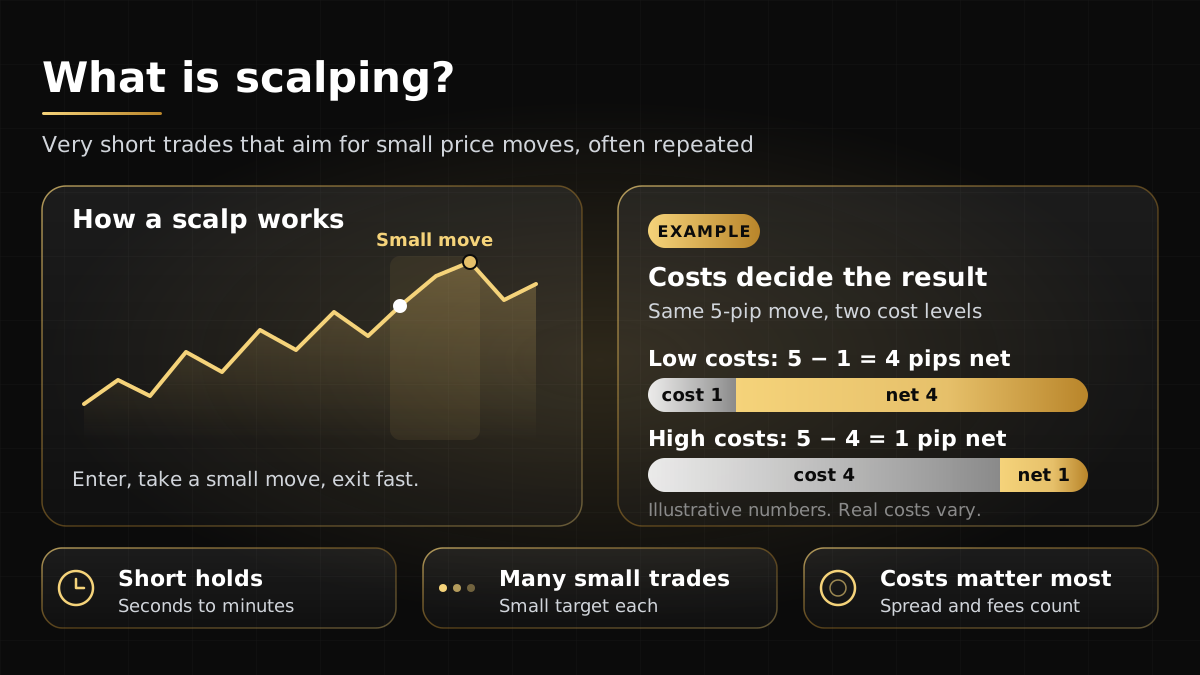
Scalping is a trading style built on speed and frequency. A scalper looks for a small, short-lived price move, enters, and exits, often within minutes and sometimes within seconds. The aim is to collect a modest amount on each trade and repeat the process many times. A single scalp might target five pips. A session might contain dozens of them.
The term covers several methods. Some scalpers trade a one-minute or five-minute chart. Others read the order book, watch price ticks or follow the flow of orders. The common thread is the holding period. Scalping describes how long a trade stays open, not a specific indicator or chart pattern, so two scalpers can use entirely different tools.
In practice, a scalp usually has these features:
- A very short hold, from seconds to a few minutes.
- A small profit target, so each win is modest in size.
- A tight stop, so each loss is kept small.
- Many trades in one session, sometimes dozens.
- Heavy dependence on execution quality, since fills and costs shape the result.
Scalping compared with other styles
Scalping sits at the short end of a range of holding periods. The table compares it with two other common styles. The descriptions are typical patterns, not rules, and individual traders differ.
| Style | Typical holding period | Typical trade count | Main cost exposure |
|---|---|---|---|
| Scalping | Seconds to a few minutes | Many per session | Spread and commission on every trade, so costs repeat constantly |
| Day trading | Within one session | A few to several per session | Spread and commission, with fewer trades to pay them on |
| Swing trading | Days to weeks | A few per month | Overnight financing, wider stops and larger moves to capture |
For the difference between the two intraday styles, read our guide to day trading. For a method that counts price ticks rather than time, see the tick scalping guide.
Why costs decide most scalping results
Every trade has a cost before the price moves. The spread is the gap between the buy and sell prices, so a trade opens slightly in the red. Some accounts also charge a commission per trade or per lot. Slippage adds a third cost when an order fills at a worse price than the one you asked for, which is more likely in fast markets and around news. Swaps apply if a position is held past the daily rollover, and most scalps are closed well before then.
A longer trade can absorb a cost. A scalp cannot. If the target is five pips and the combined spread and commission come to 1.5 pips, a winning scalp keeps 3.5 pips. A losing scalp that hits its five-pip stop costs 6.5 pips. The ratio of win to loss has to be strong enough to cover that gap across many trades, and in most cases the cost assumption is the first thing to test. Our slippage guide explains why fills can differ from the price on screen.
Worked example: 20 scalps on a $10,000 account
This is a hypothetical example, labelled EXAMPLE, and it is not a forecast. Assume a $10,000 account, a position of 0.5 standard lots on a USD-quoted pair, so one pip is worth $5 (0.5 x $10). Each trade has a 5-pip target and a 5-pip stop. The assumed cost is 1.5 pips per trade, combining spread and commission. Ten trades win and ten lose, and each trade is closed at its target or stop.
| Item | Per winning trade | Per losing trade | Ten winners and ten losers |
|---|---|---|---|
| Gross move | +5 pips = +$25 | −5 pips = −$25 | +$250 and −$250 = $0 |
| Costs at 1.5 pips | −1.5 pips = −$7.50 | −1.5 pips = −$7.50 | 20 trades x $7.50 = −$150 |
| Net result | +3.5 pips = +$17.50 | −6.5 pips = −$32.50 | +$175 and −$325 = −$150 |
The steps are simple. A pip is worth $5 at this size, so the gross result is $250 from winners and minus $250 from losers, which nets to zero before costs. The costs add up to $150 across twenty trades. The account ends $150 down, from a result that was flat before costs. Nothing in the price action changed. The only difference was the cost on each trade.
Now apply a prop firm loss limit. On the 1-Step Pay Later programme under the Yo Pips rules page, the daily loss limit is 4%. Taking 4% of the $10,000 starting balance gives $400 for illustration. Each losing scalp in this example costs $32.50. Twelve losing scalps in a row total $390, which is still inside the limit. The thirteenth takes the day to $422.50, past the $400 limit. Under the Yo Pips rules, a floating loss counts straight away, so a scalp still open and moving against you uses up the daily room before it closes.
How prop firm rules treat scalping
Prop firms are not uniform. Some rules cover minimum or maximum hold times, minimum trade counts, trade size, news periods and the strategies a firm accepts. A rule that suits one firm can be a breach at another, so do not assume that what worked on one evaluation applies to the next. Figures in this guide that come from Yo Pips are taken from the Yo Pips rules page; checkout and promotion terms take precedence, and rules can change.
On Yo Pips, the scalping rules are on the rules page. Check the current Yo Pips rules page for scalping rules before you trade this way, and do not rely on a summary, including this one. The table below shows the kinds of rules to find for any firm.
| Rule type | What to check | Where to look |
|---|---|---|
| Hold time | Whether a minimum or maximum hold applies to any trade | The firm’s rules page or terms |
| Trade count | Any minimum or maximum number of trades in a phase or day | The firm’s rules page |
| Permitted strategies | Whether scalping, news trading or automated strategies are allowed | The rules page and the prohibited-practices section |
| Loss limits | How floating profit and loss, commissions and swaps count | The daily loss and equity definitions |
| Daily reset | Which time zone the daily figures use. Yo Pips uses UTC. | The rules page |
| Checkout terms | Anything that overrides the rules page for a given purchase | The checkout summary |
Strategies that are prohibited
Some short-term approaches are off limits regardless of how the trade is labelled. Under the Yo Pips rules, the prohibited practices include:
- Latency arbitrage. Profiting from small delays between a price feed and the platform’s execution.
- High-frequency or feed-delay exploitation. Using speed advantages or stale prices to trade against the feed.
- Strategies built to exploit the simulated environment. Approaches that depend on quirks of the simulated account rather than on the market.
Scalping itself is not on this list because the rules page and the rulebook PDF describe it differently. Check the current rules page for the scalping rule before you trade this way.
A scalping method that depends on any of these is not a valid approach on Yo Pips, even if it looks profitable in testing. Expert advisors and indicators are allowed unless they break a prohibited-practice rule. The rules page has the full list, so read it before you run any automated scalping tool.
Risk controls for short-term trading
Scalping puts risk controls under pressure, because a trader makes many decisions in a short time. Build the controls in before the session starts.
- Size from the stop, not the target. Set the stop from the chart, then work out the lot size. Our position size calculator guide shows the arithmetic.
- Add up the open trades. Several scalps open at once can float against you together. On Yo Pips, the sum of floating losses counts toward the daily limit.
- Set a personal daily stop inside the firm’s limit. This is a choice you make for yourself and it is separate from the firm’s rules. Stop for the day when it is hit.
- Allow for slippage. Fast markets and news times can fill orders away from the requested price. Trade smaller size in those windows, or avoid them if your plan does not cover them.
- Stop after a run of losses. Scalpers often increase size or trade more to recover a bad session. That is one of the fastest routes to a daily limit.
Yo Pips challenges run on MetaTrader 5. Check the symbol specification, the tick value and the minimum volume step before you size a scalp, because a lot size that works on one symbol may not be accepted on another.
Frequently asked questions
01What is scalping in trading?
02Is scalping the same as day trading?
03Why do costs matter so much for scalpers?
04Are scalping strategies allowed on Yo Pips?
05Can a scalper use an expert advisor?
06Does scalping guarantee a profit?
Risk disclosure: Trading leveraged products such as forex and CFDs carries a high level of risk, and most traders lose money. Prop firm challenges are evaluations on simulated accounts; passing one does not guarantee account activation, profits or a payout. Nothing on this page is investment advice. Always read the current rules and terms before you buy or start a challenge.