A position size calculator answers one question before you place a trade: how many lots should you open so that a stop loss hit costs only the amount you decided to risk? A single oversized loss can erase several good weeks of gains. A lot size calculator for forex turns the decision into arithmetic. You enter the account balance, the risk percentage, the stop loss in pips and the value of one pip, and you get a size you can justify. This guide explains the formula, shows worked examples with the maths, and shows how position size fits inside a prop firm daily loss limit.
Position size calculator
Use the calculator below to test your own numbers. The default values are a worked example: a $10,000 account, 1% risk per trade, a 25-pip stop, $10 per pip for a standard lot and a 4% daily loss limit, which matches the 1-Step Pay Later figure under the Yo Pips rules.
Calculate your lot size
Amount at risk
100.00
Balance x risk per trade
Position size
0.40 lots
Stepped down to the 0.01 lot grid. Risk per lot: 250.00
Units
40,000
Lots x 100,000 for a forex standard lot. Other symbols differ.
Losing trades of this size before the daily loss limit
3
Daily limit amount: 400.00. Floating losses count too.
Formula: lots = (balance x risk %) / (stop loss in pips x pip value per lot). This is a planning aid for a single trade, not a recommendation of any size or trade.
The calculator always steps the lot size down, never up, so the planned risk is not exceeded. Change one input at a time to see how the result responds. A wider stop loss or a smaller risk percentage always produces a smaller size.
The position size formula
Every forex position size calculator, including the one above, runs the same three steps. First, work out how much you can lose on the trade. Second, work out what one lot loses over your stop loss distance. Third, divide the first figure by the second.
- Amount at risk = account balance x risk per trade (as a decimal). For $10,000 at 1%, that is $10,000 x 0.01 = $100.
- Risk per lot = stop loss in pips x pip value per lot. For a 25-pip stop and $10 per pip, that is 25 x $10 = $250.
- Lots = amount at risk / risk per lot. That is $100 / $250 = 0.40 lots.
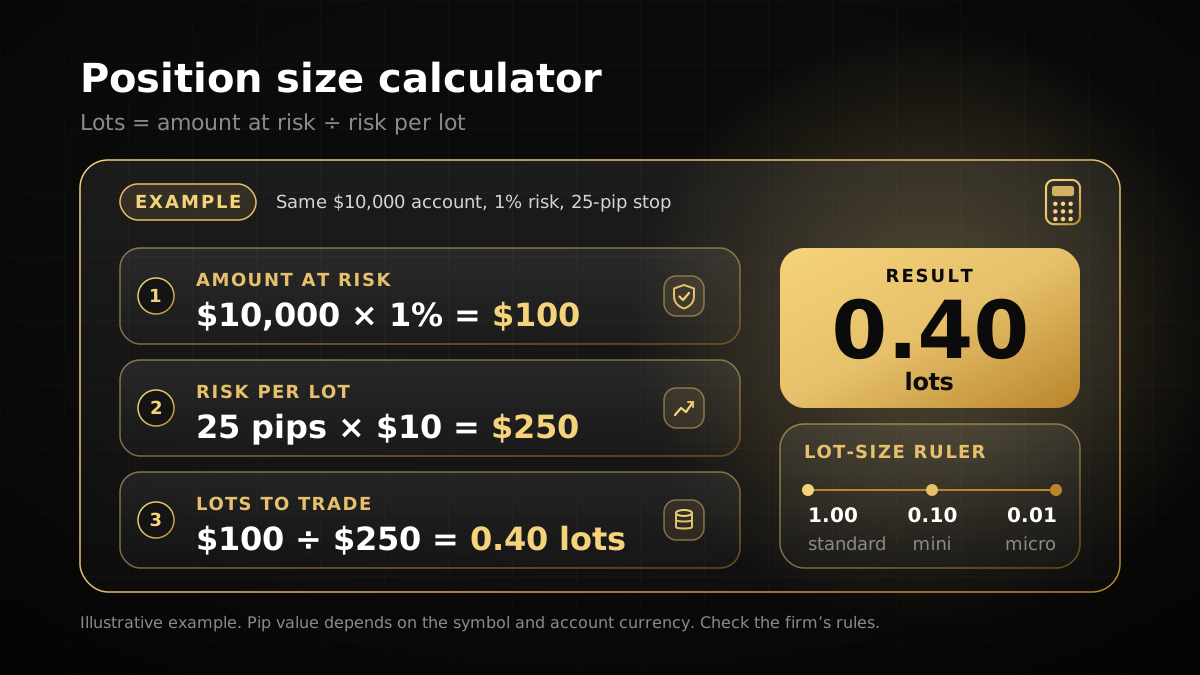
Round the result down to the nearest 0.01 lot. Rounding up can push the real loss above your planned percentage. Many platforms accept volumes in 0.01 steps, but each symbol has its own minimum volume and volume step, so check the specification before you place the order.
Units follow directly from the lot size. For forex, one standard lot is 100,000 units of the base currency, so 0.40 lots is 40,000 units. The calculator shows this figure so you can compare it with the exposure your platform displays. The stop loss itself should come from your analysis, such as a level below a swing low, and never from the size you want to trade.
Worked examples
EURUSD on a USD account
EURUSD is quoted in US dollars. On a USD account, one pip on a standard lot is worth about $10, because the pip is 0.0001 and 0.0001 x 100,000 units = $10. Using the example above, a $10,000 balance at 1% risk with a 25-pip stop gives 0.40 lots. If the stop were 40 pips instead, the risk per lot would be 40 x $10 = $400, and the size would be $100 / $400 = 0.25 lots. A wider stop means a smaller size for the same risk, which is the whole point of the formula.
USDJPY and other JPY-quoted pairs
For JPY pairs, the pip is 0.01 rather than 0.0001, and the pip value is set in yen, so it has to be converted into dollars at the current rate. On a standard lot, one pip is 100,000 x 0.01 = 1,000 yen. At a USD/JPY rate of 150.00, that is 1,000 / 150 = $6.67 per pip per lot. The value moves as the price moves, so a pip value that was right last month may be wrong today.
Take the same $10,000 account at 1% risk with a 25-pip stop. Using the exact pip value, 25 x (1,000 / 150) = $166.6667 per lot, and $100 / $166.6667 = 0.6 lots exactly. Using the rounded $6.67, the risk per lot is $166.75, the size works out at 0.5997 lots and rounds down to 0.59 lots. The gap is small, but it shows why the pip value should be entered as precisely as your platform shows it.
Gold and other instruments
Pip definitions for metals, indices and crypto differ by broker and platform. Gold is often quoted to two decimal places, and a “pip” can mean a one-dollar move, a one-cent move or a point. Do not assume. Open the symbol’s Specification window in MetaTrader 5 and read the contract size and tick value. If the contract size is 100 troy ounces, a $1.00 price move is worth $100 per lot. A $5 stop would then cost $500 per lot, so you would enter a stop of 5 and a pip value of 100 into the calculator, and the result would be the lot size for that dollar distance.
Risk inside a daily loss limit
Sizing one trade is only half the job. A prop firm also sets a loss limit for each day, and a run of ordinary losses can reach it before any single trade looks wrong. Under the Yo Pips rules published on the rules page, checked 7 November 2026, the limits on each programme are:
| Yo Pips programme | Daily loss limit (%) | Maximum loss limit (%) |
|---|---|---|
| 1-Step Pay Later | 4% | 8% |
| 2-Step Pay Later | 5% | 10% |
| Instant Funding | 3% | 6% |
On the rules page, maximum loss is measured on equity, not just closed balance. The rules page’s compliance list says trailing drawdown applies. The page does not state the base for the percentage limits, so check the base shown on your dashboard. Checkout and promotion terms take precedence over the rules page, and rules can change, so confirm the current version before you trade. The daily figure includes closed profit and loss, floating profit and loss, commissions and swaps for the current day, and the daily reset uses UTC. Instant Funding measures the daily limit on current-day equity, so an open trade that moves against you counts before you close it. For the full programme comparison, see the prop firm challenge guide.
For illustration only, take a $10,000 account and treat $10,000 as the base for a 4% daily limit. The limit would be $400. At 1% risk, each full stop loss costs $100. Three full losses take the day to 3%, and a fourth reaches 4% itself, which is a breach. So the calculator counts three losing trades before the limit, not four. These figures assume each loss equals the stop-loss amount. Spread, commission and swap add to each loss and to the daily total, so leave a buffer. The table below repeats the count at other risk levels and for three limits: 3% (Instant Funding), 4% (1-Step Pay Later) and 5% (2-Step Pay Later).
| Risk per trade | Amount at risk on $10,000 | Full losses before a 3% limit | Full losses before a 4% limit | Full losses before a 5% limit |
|---|---|---|---|---|
| 0.5% | $50 | 5 | 7 | 9 |
| 1% | $100 | 2 | 3 | 4 |
| 2% | $200 | 1 | 1 | 2 |
Floating losses make the position worse than a count of closed trades suggests. A trade that is floating $80 down on a $10,000 account has already used $80 of the $400 daily room on a 4% limit, which is 20% of that room, before it closes. Some traders set a personal daily stop well inside the firm’s limit, such as half of it, so that one bad session does not end the account. Your own daily stop is a rule you choose; it is separate from the firm’s rules.
Lot sizes explained
Brokers and calculators use three common lot sizes. A standard lot is 100,000 units of the base currency, a mini lot is 10,000 units and a micro lot is 1,000 units. Pip values scale in the same proportion. The table below shows values for a USD-quoted pair such as EURUSD on a USD account.
| Lot size | Units of base currency | Pip value (USD-quoted pair) | Loss on a 25-pip stop |
|---|---|---|---|
| 1.00 (standard) | 100,000 | $10.00 | $250.00 |
| 0.10 (mini) | 10,000 | $1.00 | $25.00 |
| 0.01 (micro) | 1,000 | $0.10 | $2.50 |
Yo Pips challenges run on MetaTrader 5, where volume is entered in lots. Check the volume step on the symbol before you size a position. A calculated figure such as 0.37 lots is only useful if the platform accepts that exact volume.
Common sizing mistakes
- Sizing from the target. Picking a lot size first and then placing the stop wherever the size allows. The stop should come from the chart, and the size should follow from it.
- Using the same lot size whatever the stop. A 50-pip stop at 0.40 lots risks twice as much as a 25-pip stop at 0.40 lots. The size has to change when the stop changes.
- Assuming $10 per pip on every symbol. JPY pairs, crosses, metals and indices use different pip definitions and values.
- Treating correlated positions as separate trades. Two long positions on closely related pairs can lose at the same time, so the real risk is the sum of both.
- Rounding up. A calculation of 0.406 lots rounded up to 0.41 risks more than planned.
- Increasing size after a loss. Trying to win back a loss in one session is one of the fastest ways to reach a daily loss limit.
Frequently asked questions
01What is a position size calculator?
02How do you calculate lot size in forex?
03Is 1% risk per trade safe with a prop firm?
04Does the daily loss limit include open trades?
05What is the pip value for gold?
06What lot size should a beginner use?
Risk disclosure: Trading leveraged products such as forex and CFDs carries a high level of risk, and most traders lose money. Prop firm challenges are evaluations on simulated accounts; passing one does not guarantee account activation, profits or a payout. Nothing on this page is investment advice. Always read the current rules and terms before you buy or start a challenge.