Instant funding is one of the quickest routes to a funded trading account. Instead of passing an evaluation first, you pay once and start trading a funded account. An instant funding prop firm works differently from a challenge mainly in its loss limits and its fee structure. This guide explains how the model works, what you give up for speed, and how to read the rules before you pay.
The examples use the Yo Pips Instant Funding rules, which are published on the rules page and in the public rulebook. They were checked on 7 November 2026. Checkout and promotion terms take precedence over general rules, and rules can change, so confirm the current version before you buy.
What an instant funding prop firm is
Instant funding means a prop firm gives you access to a funded trading account without an evaluation. You do not have to show a strategy on a challenge account first. You buy access, complete identity and payment checks, and then trade capital that the firm provides. Any profit you make is shared under the firm’s profit split. If you have searched for a no challenge prop firm, this is the model you are looking at.
Two features set the model apart from a challenge. First, the account is simulated. Yo Pips states that all of its accounts are simulated, so you trade the firm’s capital and not your own money in a live account. Second, the firm sets the loss limits and the payout conditions, and those are where most of the practical differences lie. An attractive headline offer with unclear loss rules can cost more in practice than a plainer one with clear terms.
How an instant funding account works, step by step
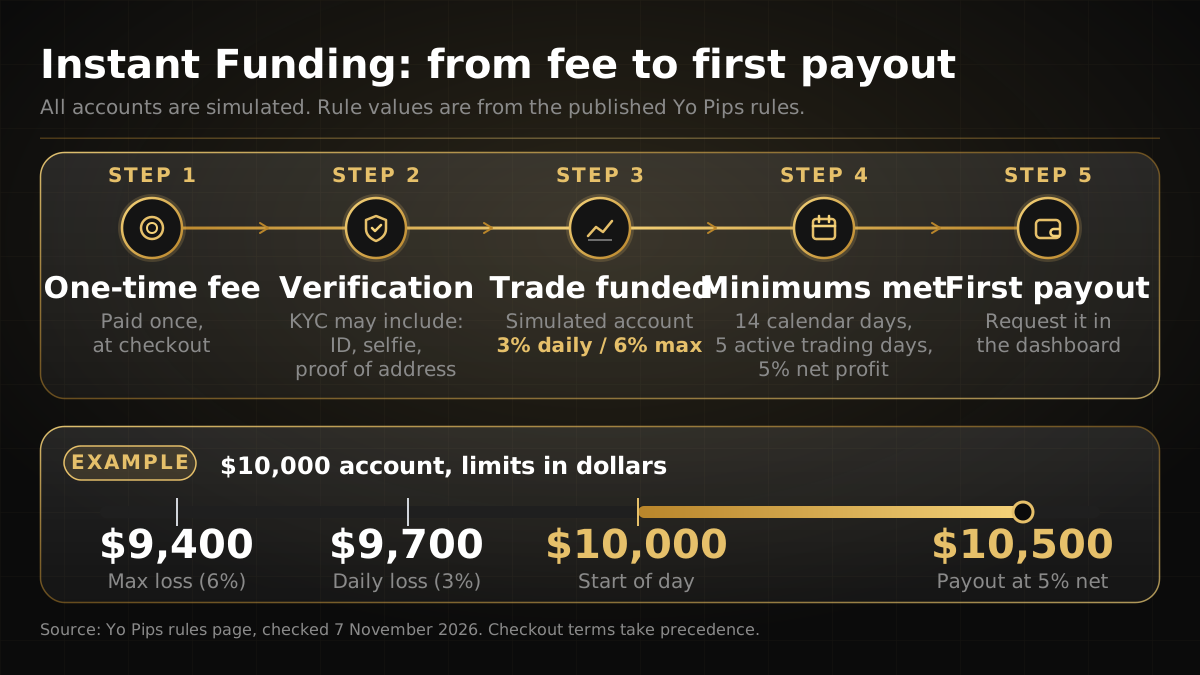
The exact steps depend on the firm. On Yo Pips, the process for Instant Funding runs in six stages.
- Choose a size. Instant Funding is offered at 2K, 5K, 10K, 25K, 50K and 100K.
- Pay the one-time fee at checkout. Read the checkout summary and the terms before you confirm, because the fee is the main cost of the account.
- Complete verification. KYC may include a government ID, a selfie or liveness check, proof of address, payment verification and tax information.
- Trade the funded account. The 3% daily loss limit counts closed and floating P/L, commissions and swaps for the current day, and the 6% maximum loss limit is measured on equity. Trading runs on MetaTrader 5.
- Meet the payout conditions. Work through the minimum days and profit set out in the rules section below, with no breach on the account.
- Request a payout. Payouts are requested in the dashboard. The account must be in profit and KYC must be approved. Approved payouts are typically processed within 1 to 3 business days.
Watch two counting rules closely. A trading day only counts when you open and close at least one trade in it. The daily reset uses UTC, not your local midnight, so convert the reset time to your own time zone, and re-check it when daylight saving time changes. Plan your session around the UTC clock.
The trade-offs against a challenge
Speed has a cost: instant funding shortens the path to a funded account and leaves less room for error. The table compares Yo Pips Instant Funding with the two Pay Later models, using only the figures in the Yo Pips rules.
| Feature | Instant Funding | 1-Step Pay Later | 2-Step Pay Later |
|---|---|---|---|
| Evaluation | None, no profit target | 10% profit target | Two phases |
| Daily loss limit | 3% | 4% | 5% |
| Maximum loss limit | 6% | 8% | 10% |
| Fee structure | One-time fee at checkout | Small starter fee at checkout, remaining fee after pass | Small starter fee at checkout, remaining fee after pass |
| Profit split | 70% on 2K, up to 85% on 50K–100K | 80% on 5K–25K, 85% on 50K–100K | 80% on 2K–25K, 85% on 50K–100K |
| First payout timing | 14 calendar days and 5 active trading days, plus 5% net profit | 14 calendar days after funded activation and 5 active trading days | 14 calendar days after funded activation and 5 active trading days |
Three differences count most in practice.
- Tighter loss limits. On a $10,000 account, a 3% daily limit means a loss of $300 or more in a day breaches the account, against $400 on a 4% limit and $500 on a 5% limit. The maximum loss line sits at $600 on Instant Funding, $800 on 1-Step and $1,000 on 2-Step.
- A different fee shape. Instant Funding asks for one payment at checkout. The Pay Later models ask for a starter fee first and the remaining programme fee only after you pass, within 7 calendar days of pass confirmation unless the dashboard states another deadline. Refunds and fee credits apply only where a plan advertises them, so under the current rules a breached instant account is not eligible for a refund of its fee.
- Different splits on a 2K account. On 2K, the Instant split is 70% and the 2-Step split is 80%. The Instant split rises from 70% on 2K to 85% on 50K–100K, so check the rules page for the size you plan to trade rather than the headline range.
If you are weighing the models side by side, the challenge guide covers the evaluation stages in more detail, and the pricing page lists the current plans.
Yo Pips Instant Funding rules
Under the Yo Pips rules published on the rules page, checked 7 November 2026, Instant Funding works as follows. Checkout and promotion terms take precedence, and rules can change.
- No evaluation and no profit target.
- A daily loss limit of 3%. The daily figure includes closed profit and loss, floating profit and loss, commissions and swaps for the current day.
- A maximum loss limit of 6%, measured on equity.
- A breach is immediate when a loss limit is hit. Breached accounts are closed and are not eligible for a payout or refund unless a published promotion says otherwise.
- A first payout only after at least 14 calendar days, 5 active trading days and at least 5% net profit without a breach.
- A profit split from 70% on the 2K account up to 85% on the 50K and 100K accounts.
- A platform of MetaTrader 5.
- Thirty consecutive calendar days with no trading may lead to the account being archived or closed.
Eligibility also applies. You must be 18 or older and not located in a restricted or sanctioned jurisdiction, and the list of restricted places can change. Read the full terms before you pay.
Worked example on a $10,000 account
Take a $10,000 Instant Funding account and work through the limits in dollars. The example assumes the day starts at the full $10,000, so each limit is a simple percentage of that figure.
| Item | Calculation | Amount |
|---|---|---|
| Daily loss limit (3%) | 3% × $10,000 | A $300 loss in the day breaches the account |
| Maximum loss limit (6%) | 6% × $10,000 | $600, so equity must stay above $9,400 |
| First payout threshold (5% net) | 5% × $10,000 | $500 net profit, with no breach |
Now a day when things go wrong. Suppose the day starts at $10,000 and an open trade shows a floating loss that takes equity to $9,650. That is a $350 loss, or 3.5%, which is over the 3% daily limit. The breach is immediate. It does not matter that the trade might have recovered later in the session, because the rule is applied when the limit is hit.
Now a payout. Suppose that after 16 calendar days and 7 active trading days the account shows $620 of net profit with no breach. That is 6.2% of $10,000, which clears the $500 threshold. The account can then request a payout, provided KYC is approved and nothing is unresolved. The published split for a 10K Instant account is 80%, so the trader’s share of $620 would be $496, with the remaining $124 kept by the firm.
Who instant funding suits, and who should take a challenge
A trader with a written plan, a tested strategy and daily risk small enough to live inside a 3% limit may find instant funding a reasonable fit. It may also appeal to someone who understands that the one-time fee is the main cost, and that a breach ends the account without a refund under the current rules.
A challenge is usually the better fit for a newer trader. The evaluation has no time limit, so you can show consistency at your own pace, and the Pay Later loss limits are looser: 4% daily and 8% maximum on 1-Step, and 5% daily and 10% maximum on 2-Step. If your normal trading habits would break a 3% day, that is a signal to choose a looser model. You can also practise on the free trial, which runs on a simulated account and needs no payment details.
Whichever model you choose, size positions against the daily limit before you trade. The position size guide shows how to test a lot size against a daily loss limit. For more on what the model means for a trader’s money, read our funded account guide.
Red flags when comparing instant funding offers
Use the same caution you would apply to any prop firm. These are the warning signs that deserve a closer look before you pay.
- The fee is not shown clearly before checkout, or the total cost only appears after several steps.
- Loss limits are described as flexible without a percentage, or without saying whether they are measured on balance or on equity.
- Payout conditions appear only in a chat or social post, and not in the rules page or the terms.
- The profit split is quoted only as “up to” a figure, with no breakdown by account size.
- Promises of guaranteed payouts, high pass rates or easy money. No firm can promise that you will profit or get paid.
- The rules on a sales page differ from the rulebook, and nobody explains which one applies.
- Countdown timers or limited-spot pressure before you have read the terms.
Our checklist for checking a prop firm before you pay walks through these checks in order.
Frequently asked questions
01Is instant funding the same as a free funded account?
02Does Yo Pips Instant Funding have a profit target?
03What happens if I break a loss limit on an instant account?
04Is an instant funding account a real trading account?
05How long do instant funding payouts take?
Risk disclosure: Trading leveraged products such as forex and CFDs carries a high level of risk, and most traders lose money. Prop firm challenges are evaluations on simulated accounts; passing one does not guarantee account activation, profits or a payout. Nothing on this page is investment advice. Always read the current rules and terms before you buy or start a challenge.