A funded trading account lets you trade a prop firm’s capital instead of your own savings, and share the profit with that firm. The idea is simple, but the details decide whether a funded account suits you: how you get one, which loss limits apply, how payouts work and what happens when a rule is broken. This guide covers each point in plain English, using the published Yo Pips rules as the worked reference.
What a funded trading account is
A prop firm makes this account available for you to trade under its rules. You place trades in the normal way, but at retail firms such as Yo Pips the balance you trade is the firm’s simulated balance, not money you have set aside as trading capital. Loss limits, result tracking and payout decisions all sit with the firm. You bring the trading process and the discipline to follow the rules.
Two points are often confused. A funded account is not a loan, and it is not a promise of income. Loss limits come from the firm, and you carry the consequences of your own trading inside them. Many firms earn from evaluation or account fees as well as from the share of trader profits they keep, so it pays to read the firm’s rules before you spend anything. For a wider view of the model, see our guide to what a prop firm is.
Three routes to a funded account
Many prop firms offer more than one way in. The three routes below are the common ones. Under the Yo Pips rules published on the rules page, checked 7 November 2026, they work like this.
Swipe sideways to see every column.
| Route | How it works | What you must do | Suits a trader who |
|---|---|---|---|
| Challenge (Pay Later, 1-Step or 2-Step) | Trade a simulated account against a profit target and loss limits. A small starter fee is paid at checkout. | Reach the profit target without breaching a loss limit. The remaining program fee is due after you pass. | Wants to show consistent results before the firm funds the account. |
| Instant funding | No evaluation and no profit target. A one-time fee is paid at checkout. | Stay inside tighter loss limits and meet the first-payout conditions. | Accepts tighter limits in return for skipping the evaluation. |
| Free or referral offers | A free trial on a simulated account, or Refer and Earn rewards. | Read the conditions on each offer page. Referral rewards depend on successful direct referrals. | Wants to test the rules before paying anything. |
A challenge and an instant account reach the same place by different roads, and both carry a fee at checkout. A Pay Later challenge asks for a starter fee at checkout, with the rest due after you pass. Instant funding skips the demonstration and asks for a one-time fee at checkout instead. Neither route is a shortcut past the rules, because each programme keeps its own loss limits once the funded account is active. For the fee timing, see the Pass First, Pay Later page.
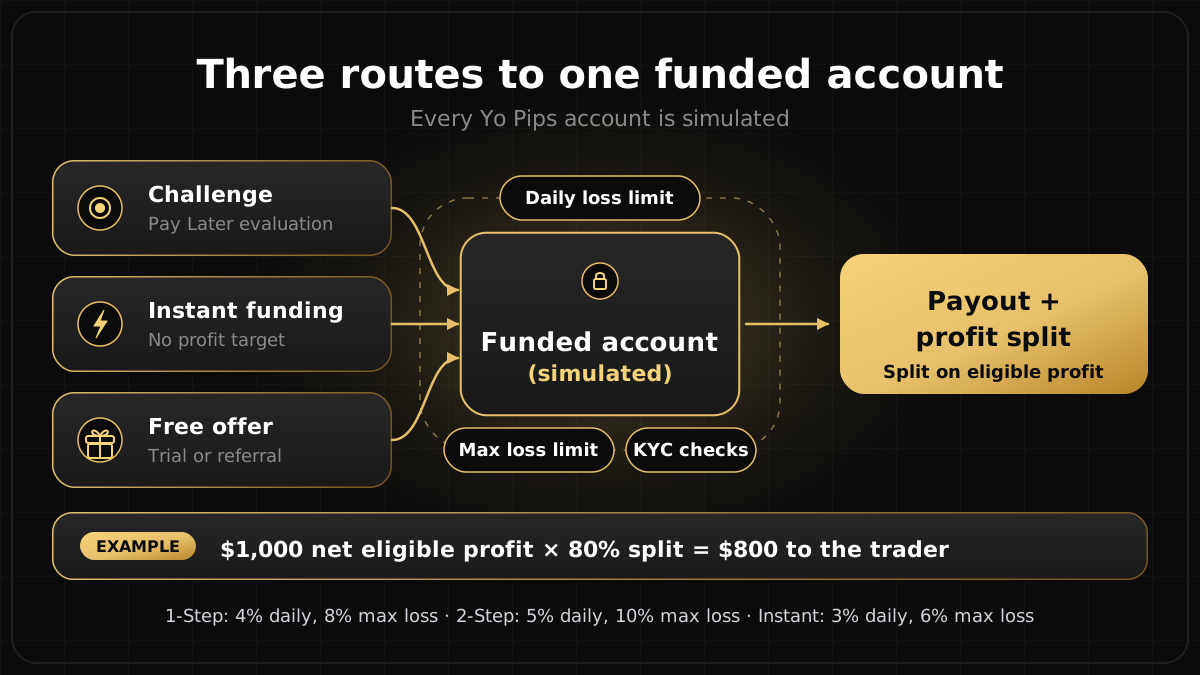
1-Step: 4% daily, 8% max loss · 2-Step: 5% daily, 10% max loss · Instant: 3% daily, 6% max loss
What you actually trade
Once your account is open, you trade on MetaTrader 5. Yo Pips challenges run on MetaTrader 5, as stated on the platforms page, so charts, order tickets and trade history will look familiar if you have used MT5 before. The platform does not change the rules. Your results are still measured against the account balance and the loss limits that the firm publishes.
At Yo Pips the account is simulated, which matters in two ways. The rules are checked against the simulated balance, not against a bank account in your name. And a simulated account does not replace the practice a trader needs before taking real risk elsewhere. Treat a funded account as a test of your process under limits, not as a source of guaranteed income.
Before you trade, check which instruments, holding periods and trading methods the current rules allow. Firms differ on news trading, weekend holding, automated trading and hedging. Do not assume that a habit from another firm is permitted here. Read the Yo Pips rules page first.
The rules that keep an account open
A funded account stays open only while you respect its limits. Under the Yo Pips rules, the main constraints are these. Checkout and promotion terms take precedence over the rules page, and rules can change, so check the current version before you buy.
- Daily loss limit: 4% on 1-Step Pay Later, 5% on 2-Step Pay Later and 3% on Instant Funding. The daily figure includes closed profit and loss, floating profit and loss, commissions and swaps for the current day. The daily reset uses UTC.
- Maximum loss limit: 8% on 1-Step Pay Later, 10% on 2-Step Pay Later and 6% on Instant Funding. This limit is measured on equity.
- Profit target: counts closed profit only. The 1-Step Pay Later target is 10%. Instant Funding has no evaluation and no profit target.
- Trading day: a day counts only if at least one trade is opened and closed that day.
- Inactivity: 30 consecutive calendar days with no trading may lead to the account being archived, suspended or closed.
The daily loss limit is easy to underestimate because open trades count. Suppose a trader has a 10K 1-Step Pay Later account with a 4% daily loss limit. As a planning assumption, take the $10,000 starting balance as the base, so the daily cap is 4% × $10,000 = $400. This is an assumption for planning, not a figure quoted from the rules. Now suppose the trader is down $250 on a position that is still open. That $250 counts toward the daily limit even though nothing has been closed, so the day has already used $250 of $400, or 62.5% of the allowance. A trader who lets one floating loss grow can breach the day’s limit without placing a new trade.
A breach is immediate. When a loss limit is hit, the account is closed, and a breached account is not eligible for a payout or a refund unless a published promotion says otherwise. Sizing each trade so that one loss cannot end the day is the most practical protection.
Payouts and profit split
Payouts are requested from the dashboard. Under the Yo Pips rules, approved payouts are typically processed within 1 to 3 business days. A payout needs the account to be in profit, no unresolved breaches and KYC approved, and Yo Pips may ask for all positions to be closed before it approves a payout. KYC may include government ID, a selfie or liveness check, proof of address, payment verification and tax information. Full payout rules are on the rules page.
The profit split is the share of profit the trader keeps. The Yo Pips split depends on program and size, as shown in the table below.
Swipe sideways to see every column.
| Program | Account sizes | Trader profit split |
|---|---|---|
| 1-Step Pay Later | 5K to 25K | 80% |
| 1-Step Pay Later | 50K to 100K | 85% |
| 2-Step Pay Later | 2K to 25K | 80% |
| 2-Step Pay Later | 50K to 100K | 85% |
| Instant Funding | 2K to 100K | From 70% at 2K, up to 85% at 50K to 100K |
Here is a worked example. Suppose a 1-Step account in the 5K to 25K range has $1,000 of net eligible profit when a payout is requested, and the split is 80%. The trader’s share is $1,000 × 80% = $800. The firm keeps the remaining $200. This is arithmetic, not a forecast. Actual payouts depend on the eligible profit, the rules in force at the time and the checks described above.
The first payout takes time. Under the Yo Pips rules published on the rules page, checked 7 November 2026, a Pay Later account becomes eligible 14 calendar days after funded activation and after at least 5 active trading days. Instant Funding counts its 14 calendar days from your first trade, and also needs at least 5 active trading days and at least 5% net profit without a breach. Plan for that delay before you count on a payout date.
Funded vs own money vs demo
A funded account is one of three ways to practice or trade. The table compares it with trading your own money and with a demo account.
Swipe sideways to see every column.
| Feature | Funded account | Your own money | Demo account |
|---|---|---|---|
| Capital at risk | The firm’s simulated balance, under its limits | Your deposit, in full | None, virtual balance |
| Upfront cost | Program fee set by the route you choose | Whatever you deposit | Usually none |
| Loss limits | Set by the firm, daily and maximum | Your own risk plan | Usually none |
| Share of profit | Set by the profit split | All profit, less your costs | None |
| Payout route | Requested from the dashboard under the firm’s rules | Withdrawal from your own broker | None |
A demo account is the cheapest way to learn a platform. Your own money gives you full control and full exposure. A funded account sits between them: it adds the firm’s limits and a payout route, and on the paid routes a fee is due at checkout, with the rest of a Pay Later fee due only after you pass. Choose the option that matches what you are trying to learn, and do not expect a demo result to carry over unchanged to a funded account.
Yo Pips funded account routes
Under the Yo Pips rules, the funded programs are 1-Step Pay Later (5K, 10K, 25K, 50K and 100K), 2-Step Pay Later (2K, 5K, 10K, 25K, 50K and 100K) and Instant Funding (2K, 5K, 10K, 25K, 50K and 100K). The table below summarizes the main limits and splits. The full rules are on the rules page.
Swipe sideways to see every column.
| Program | Profit target | Daily loss limit | Maximum loss limit | Profit split |
|---|---|---|---|---|
| 1-Step Pay Later | 10% | 4% | 8% | 80% (5K to 25K), 85% (50K to 100K) |
| 2-Step Pay Later | Two phases, see the rules page | 5% | 10% | 80% (2K to 25K), 85% (50K to 100K) |
| Instant Funding | None | 3% | 6% | From 70% (2K), up to 85% (50K to 100K) |
On Pay Later routes, a small starter fee is paid at checkout. The remaining program fee is paid only after you pass, within 7 calendar days of pass confirmation unless the dashboard states another deadline. If it is not paid, the pass may be canceled. Check these dates in your dashboard as soon as you pass.
Eligibility rules also apply. Under the Yo Pips rules, you must be 18 or older and not located in a restricted or sanctioned jurisdiction, and the list of restricted places can change. Free options are covered separately in our guide to free funded accounts, and the Refer and Earn conditions are on their own offer page before you share a link.
Frequently asked questions
01What is a funded trading account?
02Is a funded account the same as a demo account?
03Can I get a funded account for free?
04What happens if I break a loss limit?
05How long until I can request a first payout?
Risk disclosure: Trading leveraged products such as forex and CFDs carries a high level of risk, and most traders lose money. Prop firm challenges are evaluations on simulated accounts; passing one does not guarantee account activation, profits or a payout. Nothing on this page is investment advice. Always read the current rules and terms before you buy or start a challenge.