Traders who search for a free funded account often want to try a prop firm before committing to a paid plan. That goal is reasonable. The catch is that "free" can mean very different things. Some offers are simulated practice accounts with no payment needed. Others are promotions with entry conditions, or rewards you earn by bringing in other traders. This guide explains what each type includes, the conditions to read first, and how a free offer compares with a paid challenge. Yo Pips rules are quoted as published on the rules page, checked 7 November 2026.
Is a free funded account really free?
A free offer is often free to join, but it is not free of conditions. A prop firm funds a trader's simulated account in return for a share of the profit, and a free offer changes only how the trader enters. The trading still runs under loss limits, and the account is still simulated. When a firm calls an offer free, ask three questions: what do I pay now, what could I pay later, and what must I do before I can request a payout?
In practice, many free offers mean no charge to start, a simulated account, the same kinds of loss limits you would find on a paid account, and a route to payout only if the offer's conditions are met. It does not mean money you can withdraw without meeting those conditions. A free account is best treated as a test of your process under a firm's rules, with the same discipline you would apply to a paid challenge.
Consider a simple, hypothetical example. A trader joins a free promotion with a $10,000 simulated balance and a 2.5% daily loss limit. These figures are invented for illustration and are not any firm's rules. A 2% loss on the first day, or $200, leaves the account at $9,800. That is 2% against a 2.5% daily limit, which is $250, so the account is still open, but only $50 of room remains before the limit is hit. The offer is free to join; the risk controls are not.
The four kinds of free offers
Offers marketed as a "free funded account" usually fall into one of four routes. They look similar in an advert, but they differ in what you receive and whether the account can lead to a payout. Read the offer's own terms before you decide which category it belongs to.
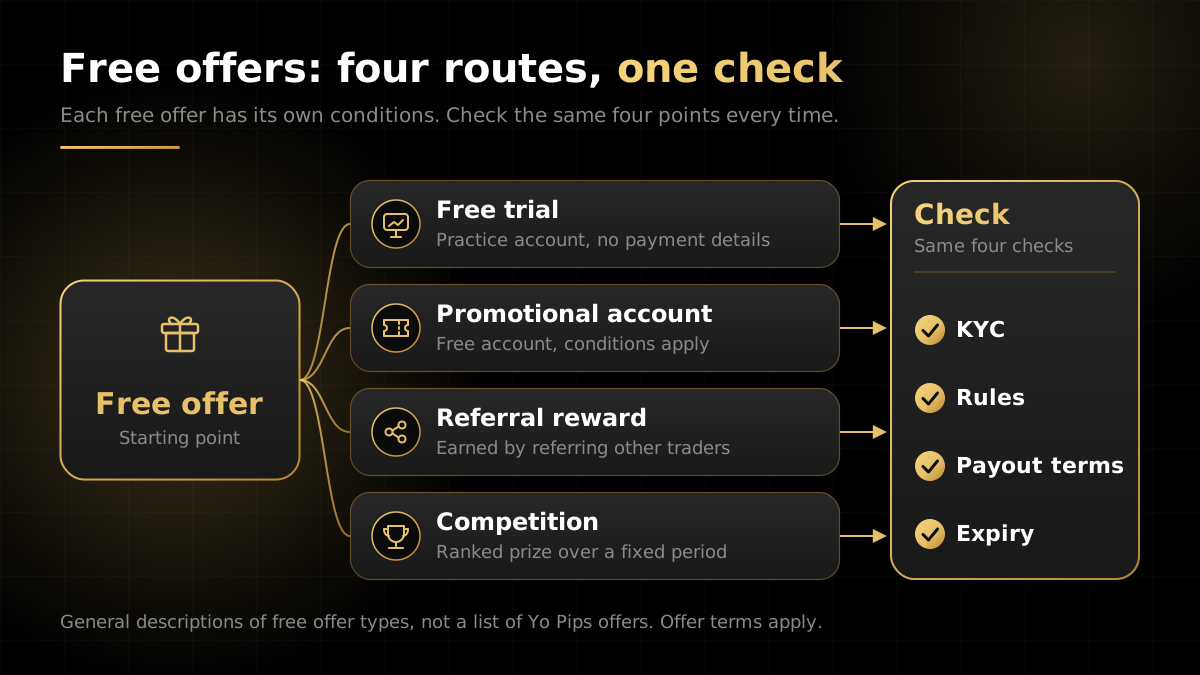
| Offer type | What you typically get | Typical conditions | Can it lead to a payout? |
|---|---|---|---|
| Free trial or demo | A simulated practice account, sometimes with a time limit | No payment details; sign-up steps; trading is for practice | Not presented as a payout route on the Yo Pips trial page |
| Promotional free challenge or giveaway | A simulated funded-style account for a set period | Entry criteria, profit targets, daily and maximum loss limits, time limits, identity checks | Possibly, if the account meets the published conditions |
| Referral reward | An account earned when referred traders meet set criteria | Referral thresholds, verification of referred users, expiry of the reward | Possibly, under the reward terms |
| Competition | A prize account or cash prize for ranked performance | Entry rules, ranking method, eligibility and a fixed competition period | Only if the prize terms say so |
A free trial is the safest of the four to understand. It gives you a simulated account to test a platform, a strategy or the firm's dashboard. It is useful for learning how the rules feel in practice. The Yo Pips trial page does not present it as a payout route. Use it to check the rules page, the platform and your own risk process before you consider any paid option.
A promotional free challenge is an evaluation or funded-style account offered for free, usually for a limited time or a limited number of entries. These can be real opportunities, but they usually carry the same rule types as paid accounts: profit targets, daily and maximum loss limits, and a set of behaviours that can close the account.
A referral reward is an account you earn by bringing in other traders who complete set steps. The reward is often tied to a count of successful referrals. Check how the referral is verified, whether the reward is credited automatically, and whether it expires if you do not claim it on time.
A competition, offered by some firms, ranks traders over a fixed period and awards prize accounts or cash. Ranking methods vary, and a top result in one period does not show that a trader can keep an account open under normal loss limits. Read how the ranking is calculated and whether prizes are paid as accounts, credit or cash.
Conditions to read before you accept
Before you accept any free offer, read the conditions in full. The following points are the ones that most often decide whether a free account turns into a payout or into a disappointment. Under the Yo Pips rules published on the rules page, checked 7 November 2026, the same kinds of conditions apply to Yo Pips accounts, and checkout and promotion terms take precedence over the general rules.
- Identity checks (KYC). Firms commonly ask for government ID, a selfie or liveness check, proof of address, payment verification and tax information. Yo Pips lists these checks in its rules. Complete them early, because a delayed check can delay any payout you later request.
- Loss limits. As a general industry point, many free accounts use the same loss logic as paid ones. The published Yo Pips rules count daily loss as closed profit and loss, floating profit and loss, commissions and swaps for the current day. Maximum loss is measured on equity. A breach is immediate when a limit is hit.
- Payout eligibility. A payout usually needs the account to be in profit, with no unresolved breaches and approved identity checks. Payouts are requested in the dashboard, and approved payouts are typically processed within 1 to 3 business days.
- Expiry and inactivity. Offers often expire, and accounts can be inactive for too long. A run of 30 consecutive calendar days with no trading may lead to archiving or closure. At many firms, a reward you have not claimed in time can also lapse, so check the claim window.
- Fees after a pass. Check whether any charge appears after you pass. A pass is not always the end of the costs. The remaining program fee on Pay Later plans is due within 7 calendar days of pass confirmation unless the dashboard states another deadline, and if it is unpaid the pass may be cancelled.
- Transfer and resale. Passed evaluations cannot be sold or transferred on Yo Pips.
Red flags to watch for
Some free offers are legitimate promotions. Others are a way to collect personal data or to sell a paid product under a free label. The warning signs below are common. None of them proves a firm is dishonest on its own, but several together are a reason to stop and read the terms again. For a broader vetting checklist, see our guide on whether prop firms are legit.
- An activation fee before you can trade or withdraw. If a "free" account needs a payment before you can start trading or request a payout, it is a paid product with a different label. Ask what the payment is for and where it is written down.
- Requests that go beyond identity checks. Full identity checks are a normal part of a payout process. Be wary of forms that ask for online banking logins, card PINs or passwords for other services. Never share those.
- Terms that are hard to find or missing. If you cannot find the loss limits, the expiry date or the payout conditions in writing, do not sign up.
- Countdown timers and pressure. "Claim now" banners that push you past the terms are a sales technique. A genuine offer can wait while you read.
- Promises of guaranteed income. No prop firm can promise a payout, and no free offer can promise profit. Treat any such claim as a warning.
- Rules that change after you start. Check whether the firm can change the rules and how you will be told. Yo Pips notes that rules can change, so the current version on the rules page is the one that matters.
Free vs paid challenge
A free route and a paid challenge differ mainly in how you enter, not in how the trading works. The table below compares them on the points that matter most. Typical differences are shown; the offer or plan terms always decide.
| Factor | Free offer (typical) | Paid challenge (typical) |
|---|---|---|
| Cost to enter | Usually no charge to start; check for fees later | Program fee, often paid in part at checkout |
| Account type | Simulated | Simulated |
| Loss limits | Set by the offer; read them carefully | Set by the plan's rules |
| Payout | Only if the offer's conditions are met | Only if the plan's conditions are met |
| Time window | Often a fixed period or a claim deadline | Depends on the plan; check the rules |
| Which terms apply | Promotion terms, which can differ from general rules | Checkout and plan terms, plus the general rules |
The practical point is this: a free offer lowers the cost of entry, but it does not lower the cost of breaking a rule. A breach on a free account can end it just as a breach on a paid one. If you would not accept a paid plan with the same loss limits and payout conditions, the free version is not a better deal just because it costs nothing to join.
Free options at Yo Pips
Yo Pips lists two free routes on its site. Each has its own page, and each page sets out its own terms. Read the page before you start, because the terms there take precedence over any summary, including this one.
- Free trial. A simulated account with no payment details, available at the free trial page. The trial page describes practice-mode access and needs no payment information.
- Refer & Earn. A free $1,000 account at 3 successful direct referrals and a free $5,000 account at 5, as described on the Refer & Earn page. The direct-referral count is cumulative, so claiming the $1,000 account still leaves the $5,000 milestone open. The reward terms define what counts as a successful referral.
Yo Pips challenges run on MetaTrader 5, as set out on the platforms page. If you are comparing routes, the pricing page and the guide to prop firm challenges show how paid plans differ from the free options above.
Frequently asked questions
01Is a free funded account real?
02Can you withdraw money from a free trial?
03Do free prop firm challenges have hidden fees?
04What should I check before I accept a free funded account?
05Is a free challenge easier than a paid one?
06What free options does Yo Pips offer?
Risk disclosure: Trading leveraged products such as forex and CFDs carries a high level of risk, and most traders lose money. Prop firm challenges are evaluations on simulated accounts; passing one does not guarantee account activation, profits or a payout. Nothing on this page is investment advice. Always read the current rules and terms before you buy or start a challenge.