Learning how to trade forex is a sequence of skills, not one decision. Many beginners open a chart first and only later find that the basics were missing: how a currency pair is quoted, what a pip is worth, and how a stop loss decides the size of a trade. This guide sets out eight steps in the order most traders find useful. None of them promises a profit, and forex trading can lose money quickly, so the aim of the first months is to practise on a simulated account and learn how your own results behave.
How to trade forex in eight steps at a glance
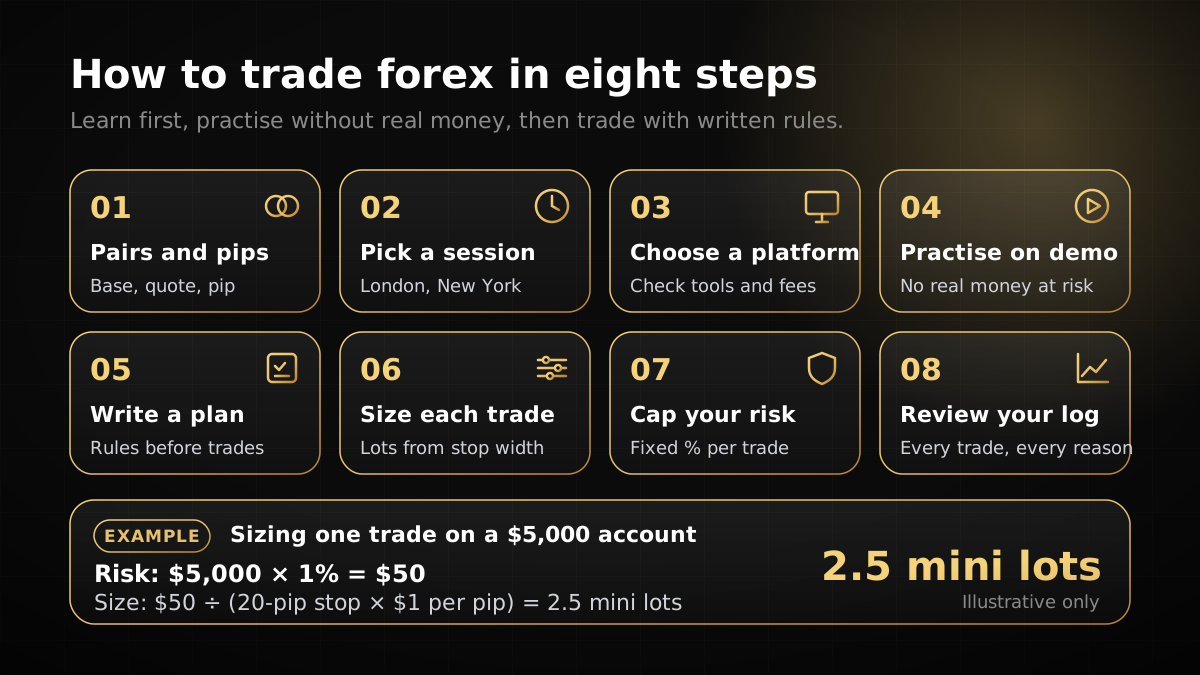
The list below is the whole process. Each step answers one question, and you should not move on until you can answer the question in writing.
- Learn the basics. Currency pairs, pips, lots and spreads.
- Choose a session and pairs. When you trade and what you trade.
- Pick a platform. Read the symbol specification before you trade it.
- Practise on a demo. Test the mechanics and your discipline with no real money.
- Write a trading plan. Entry, stop, target, invalidation and daily stop.
- Size each position. Lots come from your stop loss and your risk percentage.
- Manage risk. Set a daily stop and count correlated trades as one exposure.
- Review and journal. Log every trade and check it against the plan.
| Step | Question you answer | Done when |
|---|---|---|
| 1. Basics | What does a price move actually mean? | You can explain a pip and a lot on EUR/USD without notes. |
| 2. Session and pairs | When and what will I trade? | You have a written list of pairs and the hours you trade them. |
| 3. Platform | Where do I place orders and what do they cost? | You have read the spread, volume and volume step for each pair. |
| 4. Demo | Can I follow my rules with no real money at stake? | You have logged a set run of demo trades with reasons. |
| 5. Plan | What must be true before I enter? | Entry, stop, target and invalidation are written down. |
| 6. Size | How many lots should I open? | Lots are calculated from the stop loss and risk percentage. |
| 7. Risk | What is my worst acceptable day? | Your daily stop sits inside any limit a firm sets. |
| 8. Review | What is working, and why? | Every trade has its reason, result and rule check recorded. |
Steps 1 and 2: learn the basics and choose a session
A forex pair is two currencies quoted as one price. In EUR/USD, the euro is the base currency and the US dollar is the quote currency. The price tells you how many units of the quote currency one unit of the base currency costs. When EUR/USD rises, the euro has gained against the dollar. You make or lose money on that change, and the exchange rate is the only thing the trade tracks.
Price moves are counted in pips. On most pairs a pip is 0.0001, and on yen-quoted pairs such as USD/JPY it is 0.01. Volume is counted in lots, and one standard lot is 100,000 units of the base currency. The money value of a pip depends on the pair, the lot size and, for pairs that are not quoted in your account currency, the current exchange rate. If the terms are new, read what forex is first.
Next, decide when you will trade. The forex market is open around the clock from Sunday evening to Friday evening in most time zones, but activity is uneven. The London and New York sessions overlap for several hours and generally carry more volume than quiet periods. Spreads can widen and slippage can increase when liquidity is thin. The forex market hours guide covers the sessions in detail. Pick one session that fits your daily routine and two or three pairs you will watch during it.
Step 3: pick a platform and read the specification
Your platform is where orders are placed and where costs show up. Yo Pips challenges run on MetaTrader 5. Whichever platform you use, open the specification for each symbol before you trade it. It shows the contract size, the minimum and maximum volume, the volume step, the tick size and the usual spread. A calculated size such as 0.37 lots is only useful if the platform accepts that exact volume.
Two costs matter from the first trade. The spread is the gap between the buy and sell price, so every position starts slightly behind the chart. Commission, where a broker charges it, is a separate fee. Slippage is the difference between the price you expected and the price you received, and it appears most often when the market moves quickly. The slippage guide explains how it affects stops and limits.
Step 4: practise on a demo or simulated account
Practise before you risk anything. A demo account uses simulated money, and it lets you test the mechanics: placing an order, moving a stop loss, closing part of a position and reading the margin shown on screen. The free trial on Yo Pips is a simulated practice account and needs no payment details.
A demo account has limits. It does not reproduce every fill, every spread change or the discomfort of a real loss, so a good demo record does not prove that your method will work with real money. Use demo time to answer narrower questions. Can you follow the plan across a long run of trades? Do you move a stop when price gets close to it? Do you size every trade the same way? Keep a log of each demo trade with the entry, stop, target, size and reason.
Step 5: write a trading plan
A trading plan is a written set of rules you can check against a chart. It should answer five questions before any order: what setup you are looking for, what price action tells you the idea is wrong, where you take profit, how much you risk, and when you stop trading for the day. If a setup does not meet every condition, you do not take it.
Keep the plan short. One page is enough for a beginner. Write each rule in plain words, because a rule you cannot explain in one sentence is hard to follow when price is moving. Do not change the plan during a session. If you want to change a rule, write the change down, test it on a demo, and only then apply it.
Step 6: size each position from a fixed risk
Position size is where the plan meets the account. Decide the percentage of your balance you will lose if the stop is hit, then work out how many lots fit that loss. The full method is in the position size calculator guide. This section shows the arithmetic for one trade.
Take a $10,000 demo account, a 1% risk limit and an EUR/USD trade with a 20-pip stop. On a USD account, one pip on a standard lot is worth about $10, so the calculation runs as follows.
| Calculation | Working | Result |
|---|---|---|
| Amount at risk | $10,000 x 1% | $100 |
| Risk per standard lot | 20 pips x $10 | $200 |
| Lot size | $100 / $200 | 0.50 lots |
If the stop were 40 pips instead, the risk per lot would double to $400, and the size would fall to $100 / $400 = 0.25 lots. The stop comes from the chart, and the size follows from it. Round down to the nearest 0.01 lot, never up, and check that the platform accepts that volume. Sizing the trade first and placing the stop afterwards reverses the logic and is one of the most common beginner errors.
Step 7: manage risk and daily loss limits
Single trades are only part of the risk. A run of ordinary losses can damage an account, and an open losing trade counts as well as a closed one. Set a maximum loss for each day and for the account before you start, and stop trading when you reach the daily figure. Your own daily stop should sit well inside any limit a prop firm sets.
Under the Yo Pips rules page, checked 9 November 2026, the daily loss limit is 4% on 1-Step Pay Later, 5% on 2-Step Pay Later and 3% on Instant Funding, and the maximum loss limit is 8%, 10% and 6% respectively. The daily figure includes closed and floating profit and loss, commissions and swaps for the current day, and the daily reset uses UTC. Checkout and promotion terms take precedence, and rules can change, so read the current version before you trade.
Here is the arithmetic on a $10,000 account. A 4% daily limit is $400. At 1% risk, each full stop loss costs $100, so three full losses take the day to 3%, and a fourth would reach the 4% limit. Spread, commission and slippage add to each loss, which means the real room is smaller than the simple count suggests, so leave a buffer.
Correlation also matters. A long EUR/USD trade and a long GBP/USD trade often move in the same direction, so two positions can lose together. Treat correlated positions as one exposure when you add up your risk.
Step 8: review your trades and keep a journal
Review is where a beginner turns results into lessons. Once a week, read every trade and check it against the plan. Ask whether the entry rules were met, whether the stop was set before the size was chosen, and whether you moved the stop or closed the trade early. A trade can lose money and still follow the plan. A trade can win and still break it. Only the second kind should worry you in the long run.
Record the reason for each trade, the result in pips and in money, and how you felt when you entered. Log the setups you did not take because the plan said no, too. Over time, the journal shows whether your problems lie in the setup, in the risk or in your behaviour. Each of those needs a different fix, and a journal is the only way to tell them apart.
Before you consider a prop firm evaluation
A prop firm evaluation tests your process under the firm’s rules. It is not a course in forex. Many traders take one only after they have practised a written plan for a sustained period. Before you pay any fee, read the profit target, the daily loss limit, the definition of maximum loss, any minimum trading days, and the rules on the strategies you intend to use. The prop firm challenge guide compares the programme formats.
On Yo Pips, expert advisors and indicators are allowed unless they break a prohibited practice. Latency arbitrage, high-frequency or feed-delay exploitation, account or device sharing, and strategies built to exploit the simulated environment are prohibited. Overnight holding is allowed. For scalping, news trading, weekend holding and copy trading, check the current rules page.
Common beginner mistakes
- Trading live before a demo record exists. Without a log of demo results, there is nothing to compare your live results with.
- Choosing the lot size first. The size should follow from the stop, not the other way round.
- Moving a stop away from price. A wider stop makes the loss bigger than the plan allowed, and it hides the problem rather than solving it.
- Adding to a losing trade to win back a loss. This often increases the risk on the same idea that already failed.
- Trading every session and every pair. Too many variables make the journal unreadable.
- Treating a demo gain as proof. A short winning run on a simulated account does not show that a method works.
Frequently asked questions
01How do I start trading forex as a beginner?
02How long does it take to learn forex trading?
03Do I need a lot of money to start forex?
04What should I learn first in forex?
05Is forex trading suitable for everyone?
06What is the difference between a broker and a prop firm?
Risk disclosure: Trading leveraged products such as forex and CFDs carries a high level of risk, and most traders lose money. Prop firm challenges are evaluations on simulated accounts; passing one does not guarantee account activation, profits or a payout. Nothing on this page is investment advice. Always read the current rules and terms before you buy or start a challenge.