If you are asking what is forex, the short answer is that it is the market where one currency is exchanged for another. Forex, short for foreign exchange, is one of the largest financial markets in the world, and it trades on weekdays around the clock. Anyone can speculate on the price of a currency pair without owning either currency. Most retail traders do this through a broker or a trading platform, using a contract that follows the exchange rate. This guide explains the core terms, the arithmetic behind a trade and the risks you should understand before you put money at stake. It is a beginner’s guide, not a trading plan.
What is forex? The market explained
Every country has its own currency, and businesses, travellers, banks and investors constantly need to exchange one for another. A European importer paying a supplier in US dollars sells euros and buys dollars. A traveller changing cash at an airport is doing a small piece of foreign exchange. The total of all these needs sets exchange rates, and the foreign exchange market is where that happens.
Retail forex trading is different. A trader does not need the currency itself. They form a view on whether one currency will rise or fall against another, open a position, and close it later. The profit or loss is the change in price multiplied by the size of the position, minus the costs. This is speculation, and it is the activity most people mean when they ask what forex trading is.
The market is open on weekdays and moves from one session to the next. It opens in Sydney, continues through Tokyo and London, and closes in New York. Trading is busier at some hours than others, and prices can jump around major news. Our forex market hours guide covers the session times in detail.
How currency pairs work
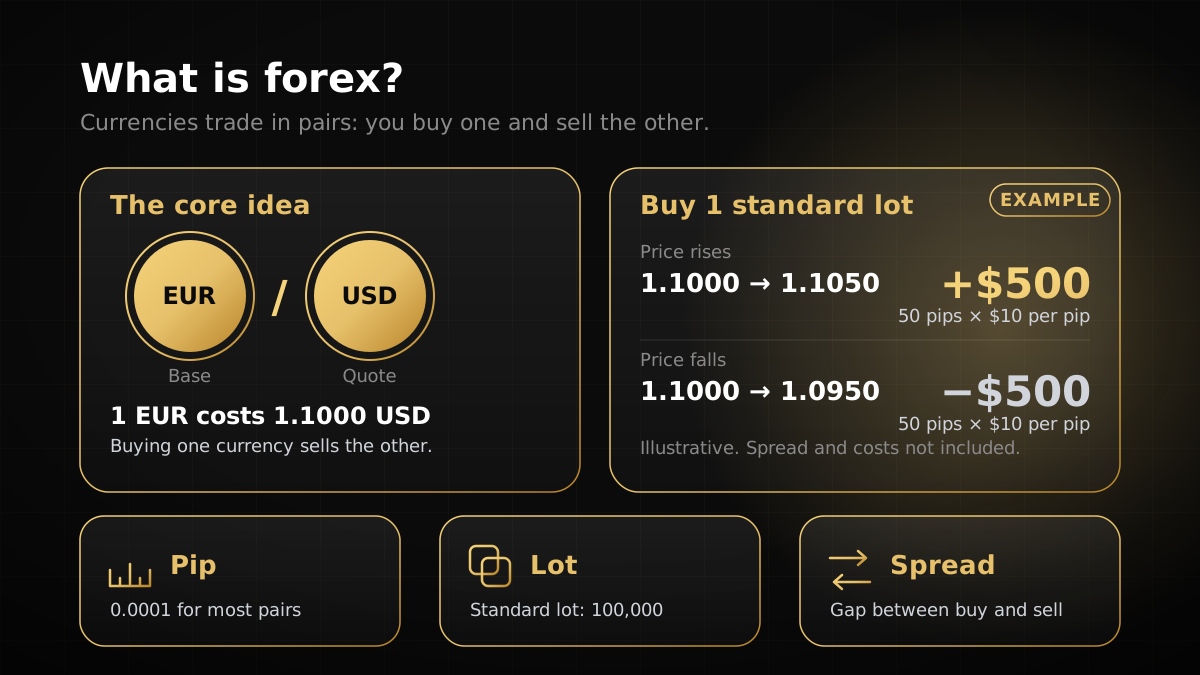
Currencies are always traded against each other, so every price is a pair. In EUR/USD, the euro is the base currency and the US dollar is the quote currency. A price of 1.0850 means one euro costs 1.0850 US dollars. If the price rises to 1.0900, the euro has strengthened against the dollar. Anyone who bought EUR/USD at the lower price has gained, and anyone who sold it has lost.
Pairs that include the US dollar are often called majors, and they include EUR/USD, GBP/USD and USD/JPY. Pairs without the dollar, such as EUR/GBP, are usually called crosses. The most heavily traded pairs usually have the tightest spreads. Pairs that involve less widely traded currencies tend to move more sharply and can be more expensive to trade.
Direction matters. Buying a pair, or going long, means you expect the base currency to rise against the quote currency. Selling it, or going short, means you expect the base currency to fall. There is no separate bet on the dollar alone. Every forex trade is a view on one currency relative to another.
The table below defines the terms you will see on every quote screen.
| Term | What it means | Example |
|---|---|---|
| Base currency | The first currency in the pair. You are buying or selling it. | EUR in EUR/USD |
| Quote currency | The currency used to price one unit of the base currency. | USD in EUR/USD |
| Bid | The price at which you can sell the pair. | 1.0850 |
| Ask | The price at which you can buy the pair. | 1.0851 |
| Pip | The usual smallest unit of price movement. | 0.0001 on most pairs |
| Standard lot | The conventional contract size, in units of the base currency. | 100,000 EUR |
Pips, lots and spreads
A pip is the standard unit for measuring price movement. On most pairs, one pip is 0.0001, the fourth decimal place. On pairs quoted in yen, such as USD/JPY, one pip is 0.01, the second decimal place. A move from 1.0850 to 1.0870 on EUR/USD is 20 pips.
The money value of a pip depends on the size of your position, and traders express size in lots. A standard lot is conventionally 100,000 units of the base currency. A mini lot is a tenth of that, and a micro lot is a hundredth. Brokers can offer other contract sizes, so confirm the exact convention in the symbol specification on your platform.
On a pair quoted in US dollars, such as EUR/USD, one pip on a standard lot is worth about $10, because 0.0001 × 100,000 = $10. The pip value scales down with the lot size. On yen pairs, the pip value is set in yen and has to be converted into your account currency, so it moves with the exchange rate.
The spread is the gap between the bid and the ask. In the example above it is 1 pip. You buy at the ask and sell at the bid, so opening a position costs you the spread straight away. Some brokers charge a separate commission in place of, or on top of, the spread. Work out the full cost of a round trip before you place a trade.
How forex trading works in practice
A trader opens a position through a broker, chooses a size and may place orders that close the trade automatically. A stop loss caps the loss if price moves against you. A take profit closes the trade if price reaches a chosen level. Many traders use MetaTrader 5 or a similar platform to chart prices, place orders and track open profit and loss. Yo Pips evaluations run on MetaTrader 5.
Leverage is the feature that sets forex apart from buying shares outright. A broker may let you control a position much larger than your deposit by setting aside only part of its value as margin. A margin requirement of 1% means you set aside $1 for every $100 of position value. Leverage magnifies results in both directions, and the margin requirement depends on the broker, the instrument and the regulator in your jurisdiction. Our margin calculator guide explains how the figure is worked out.
Worked example: a EUR/USD trade
This example is hypothetical and uses round numbers. It is not a forecast, and it is not a rule from any broker or firm. It shows how the arithmetic fits together.
- You buy 1 standard lot of EUR/USD at the ask price of 1.0851.
- The price rises and the bid reaches 1.0871, so you close the trade by selling at that price.
- Price movement: 1.0871 − 1.0851 = 0.0020, which is 20 pips.
- Gross profit before costs: 20 pips × $10 per pip = $200.
- Notional value at entry: 100,000 EUR × 1.0851 = $108,510.
- Margin at 1:100 leverage: $108,510 ÷ 100 = $1,085.10 set aside.
If the price had fallen 20 pips instead, the same arithmetic gives a $200 loss on the same position, and that loss is taken from your account balance. Commission, the spread and any overnight financing would reduce the result in both cases. The table shows how the same 20-pip move works out at different lot sizes.
| Lot size | Units of EUR | Value of one pip | Result of a 20-pip move |
|---|---|---|---|
| 1.00 (standard) | 100,000 | $10.00 | $200 |
| 0.10 (mini) | 10,000 | $1.00 | $20 |
| 0.01 (micro) | 1,000 | $0.10 | $2 |
The pip value is the number that changes most when you change lot size. Before you enter a trade, multiply the pip distance of your planned stop loss by the pip value at your intended size. If that figure is more than you are prepared to lose, reduce the size.
The main risks
Forex is not safer because it is large or because it trades around the clock. Several risks deserve attention before you open a position.
- Leverage risk. A small adverse move can cost a large share of the margin you set aside. Losses are calculated on the full position, not only on the margin.
- Gap and news risk. Prices can jump around scheduled announcements and unexpected events. A stop loss may fill further from your chosen level than you planned, which is known as slippage. Our slippage guide explains how this happens.
- Cost risk. Spreads, commissions and financing charges add up, especially for traders who open and close positions often.
- Concentration risk. Trading one pair means taking exposure to two currencies at once, and several pairs can be exposed to the same currency.
- Behavioural risk. After a loss, many traders increase size to win the money back. That turns a planned loss into a much larger one.
- Broker and platform risk. The firm you trade with matters. Check its regulation, its terms for negative balances and how it handles client funds.
Many traders who lose money in forex are not wrong about every direction. They were wrong about size, or they had no limit on how much a single day could cost them. A plan that sets those two limits in advance is a better starting point than any view on the direction of the market.
Where prop firms fit in
A prop firm lets a trader take an evaluation, usually on a simulated account, before any firm capital is used. Our guide to what a prop firm is explains the model. Whether forex is offered, and which pairs are included, depends on each firm, so check its own instrument list. The rules are what make these evaluations demanding. Profit targets, daily loss limits and maximum loss limits are measured against the account, and a breach can end an evaluation quickly.
Yo Pips runs its evaluations on a simulated account on MetaTrader 5. Its programme rules, including how loss limits are calculated, are set out on the Yo Pips rules page. Checkout terms take precedence over general descriptions, and rules can change, so check the current rules before you buy.
Whatever programme you consider, do the sizing arithmetic before the first trade. Our position size calculator guide shows how to turn a risk percentage into a lot size, using the same steps as the EUR/USD example above.
How to start learning safely
Forex is a skill that takes time to build, and most of that time should be spent on process rather than profit. A sensible first month looks like this.
- Learn the terms in this guide until the pip and lot arithmetic is automatic. You should be able to work out the value of a move in your account currency without a calculator.
- Practise on a demo or simulated account and record every trade with the reason for it, following the steps in the how to trade forex guide.
- Decide the maximum you will lose on one trade and in one day before you open the platform, and write both numbers down.
- Read your broker’s cost schedule and margin rules, so you know the full cost of a round trip before you trade.
- Review results against your plan rather than against a single good week, and reduce size when the plan is not being followed.
There is no single right way to learn forex. The aim is to make each trade a decision you can explain, size and survive, and to find out how you behave under losses while the money at stake is still small.
Frequently asked questions
01What is forex trading in simple terms?
02Is forex the same as changing money at an airport?
03What is a pip in forex?
04Do I need a lot of money to start forex trading?
05Can you lose more than you deposit in forex?
06Is forex trading legal?
Risk disclosure: Trading leveraged products such as forex and CFDs carries a high level of risk, and most traders lose money. Prop firm challenges are evaluations on simulated accounts; passing one does not guarantee account activation, profits or a payout. Nothing on this page is investment advice. Always read the current rules and terms before you buy or start a challenge.