Forex market hours describe when currency trading is active. The forex market is decentralised, so no single exchange opens or closes it. Trading moves from one financial centre to the next as the day turns, through Sydney, Tokyo, London and New York. This guide gives typical session times in UTC, explains how daylight saving changes them, shows where the sessions overlap and explains why the UTC clock matters for a prop firm’s daily reset. It covers timing only. It does not say which session you should trade.
What forex market hours mean
When people search for forex market hours, they usually want to know when they can trade a currency pair and when prices are likely to move the most. The answer has two parts. The first is the week: the market runs around the clock from Sunday evening to Friday evening, New York time, and goes quiet over the weekend. The second is the day, which is split into four regional sessions. Each session is the stretch of the day when its home centre is open for business, and banks, brokers and large funds do most of their work during those hours.
Because there is no single exchange, nobody publishes an official opening bell for forex. The session times you see on charts and websites are conventions. They are useful for planning, but a time on a website is not a guarantee of how the market behaves at that minute. Treat them as a map of the day, not a timetable that a regulator enforces.
Forex session times in UTC
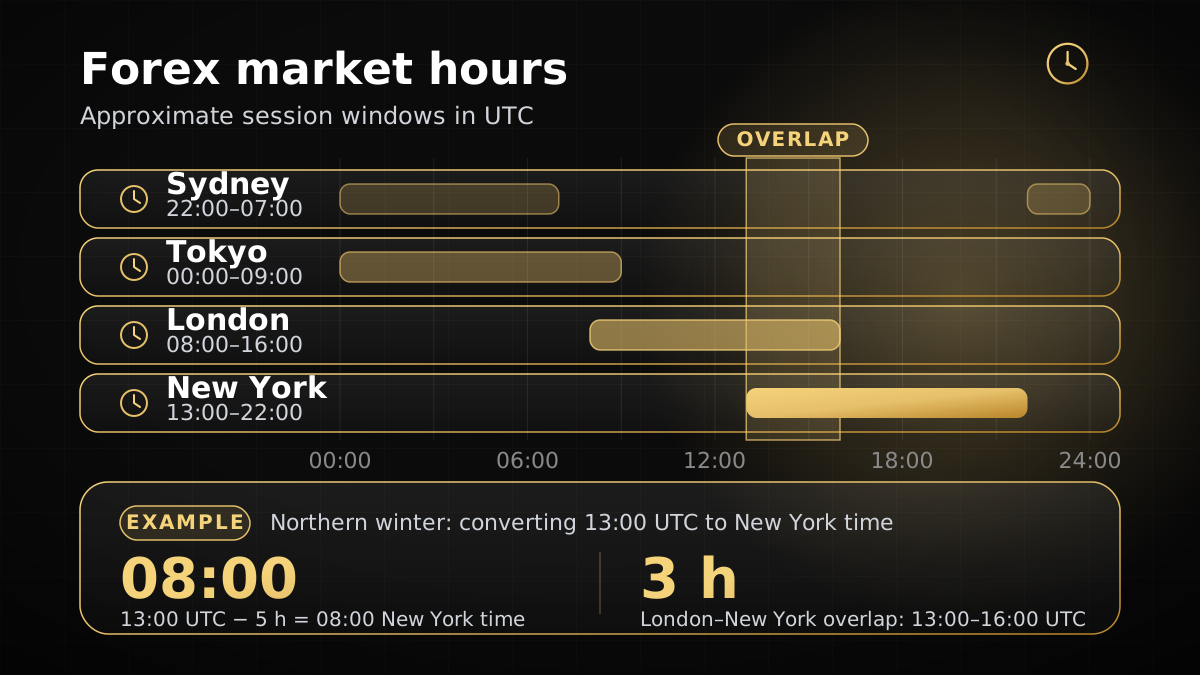
UTC does not change with daylight saving, so it gives a stable reference for comparing sessions. The table gives approximate opening and closing windows in UTC for northern winter, when London and New York are on standard time. Tokyo keeps the same UTC offset all year. Sydney does not, so its window is a convention, as explained below the table. Each New York time is shown for the same stretch of the day.
| Session | Approx. open (UTC) | Approx. close (UTC) | Same hours in New York time (winter) |
|---|---|---|---|
| Sydney | 22:00 (previous day) | 07:00 | 17:00 to 02:00 (previous day) |
| Tokyo | 00:00 | 09:00 | 19:00 to 04:00 (previous day) |
| London | 08:00 | 16:00 | 03:00 to 11:00 |
| New York | 13:00 | 22:00 | 08:00 to 17:00 |
These windows are conventions. No exchange publishes an official forex session schedule, so the edges are not fixed and brokers may draw them differently. In northern winter Sydney is on daylight time (UTC+11), so the 22:00 to 07:00 UTC window runs from 09:00 to 18:00 in Sydney. The table uses one commonly quoted set of edges, not a local market schedule. For a precise start time for a product you trade, use your broker’s published market hours for that instrument.
Daylight saving and session times
Session times move in UTC because the countries involved do not change their clocks on the same dates. The United States, the United Kingdom and Australia each change at different times of the year, and Japan does not use daylight saving. Each government publishes its own clock-change dates, so check those each year rather than relying on any date written in this guide. Sydney changes at a different time from London and New York, so its UTC open moves at a different time of year.
The practical effect is that the sessions drift against each other for part of spring and autumn. In autumn, for example, London may already be on winter time while New York is still on summer time. New York then opens an hour earlier in UTC than in winter, and the London and New York overlap shifts with it. Check the calendar of clock changes each year rather than relying on a fixed UTC time you wrote down months earlier.
Where the sessions overlap
Overlaps are the periods when two centres are open together. They matter because more traders are active at once, so the market often has more participants on both sides of a price. The table shows the main overlaps in UTC for northern winter. Overlap timings are approximate, for the same reason as the session times.
| Overlap | Approx. time (UTC, winter) | What it means |
|---|---|---|
| Sydney and Tokyo | 00:00 to 07:00 | Asian session hours, with Sydney and Tokyo both active |
| Tokyo and London | 08:00 to 09:00 | A short window when the Asian and European sessions meet |
| London and New York | 13:00 to 16:00 | Two large centres open together, often described as the busiest overlap |
The London and New York overlap is the one most often cited as the busiest part of the day. The reason is simple: two large centres are open together. That is a general observation rather than a measured figure, and it does not tell you how a particular pair will move on a particular day. News, holidays and the pair itself all change the picture. The economic calendar shows when major releases are scheduled, which is often more useful for timing than the session map alone.
The weekly open and close
The forex week starts when Sydney opens on Sunday evening and ends when New York closes on Friday. In northern winter, the usual convention is 17:00 New York time, which is 22:00 UTC. The weekly open you see in a platform depends on that broker’s server clock, so check the time shown in your own platform rather than assume it matches the UTC figure in this guide.
The weekend pause is the main reason the weekly open is a separate event. Prices can gap when trading restarts, because the market has been closed while news arrived. Some traders focus on that first hour, and some avoid it. Either way, the timing is set by the calendar rather than by any single centre, so check the open time for your own platform before the market reopens.
Converting session times to your time zone
The UTC table is useful only if you can convert it to your own clock. The method is one step: local time equals UTC plus your offset from UTC. Offsets are written as positive or negative hours, so a trader who is three hours ahead of UTC adds three. Remember that your offset can change with your own daylight saving rules, even when the session times are fixed in UTC.
Take the London open at 08:00 UTC in winter. For a trader at UTC+3, that is 11:00 local time. For a trader at UTC−5, it is 03:00. Read the figure twice before you rely on it, because a single hour out is the most common error in session planning. A reliable approach is to save the UTC times and convert them once for each clock change.
Why the UTC clock matters for Yo Pips
Session times are only one reason to use UTC. The Yo Pips rules page says that, unless otherwise stated, Yo Pips uses UTC for daily reset, loss-limit calculations, trading-day counts and payout-cycle timing. For an evaluation or funded account, that makes UTC the time reference that matters most, because the daily loss limit is counted within a UTC day, not within a London or New York session.
That has a practical effect. A trader who thinks of the day as the New York session may be working in a different daily window from the one the account uses. A trade that closes late in New York may already belong to the next UTC day. Check the rules page for the full definitions, including what counts toward the daily loss figure, and treat the UTC reset as part of your risk plan rather than as a detail to look up later. Checkout and promotion terms take precedence, and rules can change.
Worked example: when the UTC day changes
Take Monday 9 November 2026. New York is on standard time, which is UTC minus 5 hours. Start with the reset arithmetic:
- The UTC day resets at 00:00 UTC on Tuesday 10 November.
- Convert that to New York time: 00:00 UTC minus 5 hours = 19:00 on Monday 9 November.
- So a trader who is still working at 20:30 New York time on Monday is already in the Tuesday UTC day, because 20:30 plus 5 hours = 01:30 UTC on Tuesday.
Now the session side. The New York session opens at 13:00 UTC, which is 08:00 New York time. London closes at 16:00 UTC, which is 11:00 New York time. The overlap is therefore 13:00 to 16:00 UTC, or 08:00 to 11:00 New York time, on that day. The same arithmetic applies in summer, but the offsets change, so the reset moves to 20:00 New York time and the New York open moves to 12:00 UTC.
This example is illustrative and uses the approximate times above. It is not a prediction of how any pair will trade on that day.
Common mistakes with session times
Most errors come from a few habits. These are worth checking before you plan a week.
- Using a fixed local time. A session that is at 08:00 UTC in winter may be at a different local time in summer. Re-convert the times at each clock change.
- Treating session times as exchange hours. Forex has no central exchange, so there is no official open or close bell. Your broker’s market hours are the figures to rely on for trading.
- Confusing server time with UTC. Some platforms show broker server time, which may be offset from UTC. Check the offset before you compare a platform clock with a table.
- Copying rules from another firm. Loss limits, reset times and permissions differ between prop firms. Read the rules for the account you hold, not a rule you remember from somewhere else.
- Forgetting holidays. A public holiday in one centre can thin out liquidity and change the normal pattern of the day.
- Assuming a session guarantees movement. Session times describe when centres are open. They do not promise a move, a direction or a profit.
For Yo Pips permissions on scalping, news trading or weekend holding, check the current rules page. This guide does not restate them. Session timing also sits alongside other planning topics, such as what forex is and how to size a trade with the position size calculator guide.
Frequently asked questions
01What time does the forex market open?
02What are the forex session times in UTC?
03Which forex session is the busiest?
04Do forex session times change with daylight saving?
05Does the forex market close on public holidays?
06Does Yo Pips reset at the start of the London session?
Risk disclosure: Trading leveraged products such as forex and CFDs carries a high level of risk, and most traders lose money. Prop firm challenges are evaluations on simulated accounts; passing one does not guarantee account activation, profits or a payout. Nothing on this page is investment advice. Always read the current rules and terms before you buy or start a challenge.