If you read forex news, you will often see the dollar described as up or down against “DXY”. This guide answers the question directly: what is DXY, what it measures, which currencies sit inside it and how to read a move without mistaking it for a trade on a single pair. The index is a useful summary of dollar strength, but it is not a price you can buy, and it does not tell you what a specific pair will do next.
What the DXY measures
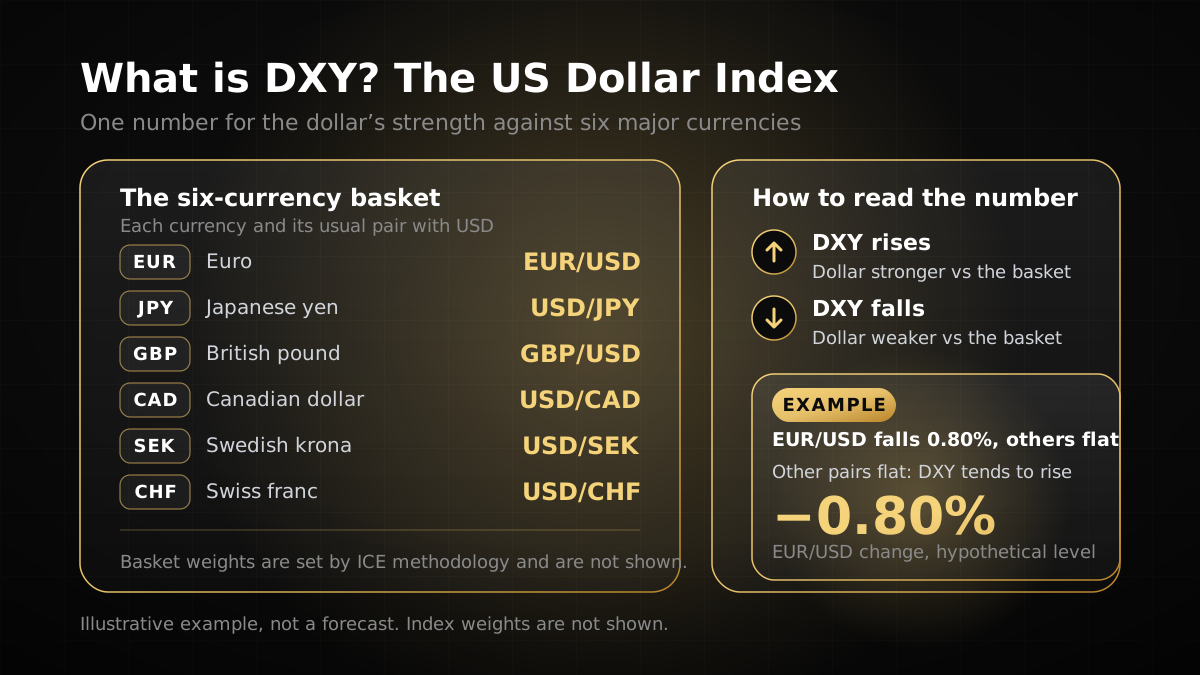
DXY is a single number that tracks the US dollar against a basket of six major currencies. It is not a currency pair. EUR/USD tells you how many dollars one euro buys. DXY combines the dollar’s position against six currencies into one index value. When that value rises, the dollar has generally strengthened against the basket. When it falls, the dollar has generally weakened.
ICE publishes the index and maintains its methodology, which covers the formula and the basket weights. Methodologies can change, so check the current document before you rely on a specific number, rather than copying figures from an older article.
The level you see is an index value in points, not a price in dollars. A move from 104.00 to 105.00 is one index point. It is not one dollar, and it is not one cent or one pip on a pair.
The six currencies in the basket
The index tracks the dollar against six currencies: the euro, Japanese yen, British pound sterling, Canadian dollar, Swedish krona and Swiss franc. This guide does not quote the basket weights. They are set in ICE’s methodology and can change, so look them up in the current document before you do any calculation.
| Basket currency | Code | Common pair with USD | Usual pair move if the dollar strengthens |
|---|---|---|---|
| Euro | EUR | EUR/USD | Tends to fall |
| Japanese yen | JPY | USD/JPY | Tends to rise |
| British pound sterling | GBP | GBP/USD | Tends to fall |
| Canadian dollar | CAD | USD/CAD | Tends to rise |
| Swedish krona | SEK | USD/SEK | Tends to rise |
| Swiss franc | CHF | USD/CHF | Tends to rise |
The right-hand column describes the usual direction, all else being equal. A pair can move against the index because of its own news, a central bank decision or a change in risk appetite. If forex quotes are new to you, our what is forex guide explains how base and quote currencies work.
How the index moves
Think of DXY as a weighted summary of the dollar’s strength against six currencies. A rise means the dollar has, on balance, bought more of the basket. Because DXY is a basket, a move in the index is not a move in any single pair. A 1% move in DXY does not mean a 1% move in every pair, since each pair has its own quote currency, its own drivers and its own weight in the calculation.
Percentage changes are easy to get wrong when the index level is in points. Use the change divided by the starting level:
- Start level: 104.00.
- End level: 105.20.
- Change: 105.20 − 104.00 = 1.20 points.
- Percentage change: 1.20 ÷ 104.00 = 0.0115, or about 1.15%.
Those levels are hypothetical and used only to show the arithmetic. Index values change over time, so check the live level and the current methodology on ICE’s pages before you use any figure.
DXY and the major forex pairs
The euro and the pound are both in the basket, so EUR/USD and GBP/USD often move opposite to DXY. Traders describe this as an inverse relationship. The yen, Canadian dollar, Swedish krona and Swiss franc sit on the other side of the quote, so USD/JPY, USD/CAD, USD/SEK and USD/CHF often move with DXY. The table above sets out the usual direction for each.
That relationship is a tendency, not a law. It weakens when interest rate expectations diverge, when a central bank changes course or when a risk event pushes investors toward or away from the dollar. Measure the relationship over the period you trade rather than relying on a long-run average from a textbook. Treat DXY as context for a trade, not as a signal to enter one.
Worked example: EUR/USD against a stronger dollar
This example is hypothetical. It shows how one pair move turns into a dollar figure, and how that figure compares with a daily loss limit. It is arithmetic, not a forecast of how DXY and EUR/USD will move together.
Assume a trader holds 0.50 standard lots of EUR/USD on a $10,000 account. A standard lot is 100,000 units, and for EUR/USD with the dollar as the quote currency, one pip of 0.0001 is worth about $10 per standard lot. During one session, DXY gains 1.0% and EUR/USD falls from 1.1000 to 1.0912.
- Price move: 1.0912 − 1.1000 = −0.0088, which is −0.80% of 1.1000.
- Pips: 0.0088 ÷ 0.0001 = 88 pips.
- Value: 88 pips × $10 per pip per standard lot × 0.50 lots = $440 floating loss.
- Share of the account: $440 ÷ $10,000 = 4.4%.
On a 1-Step Pay Later account, the Yo Pips rules page sets a 4% daily loss limit and counts floating P/L toward it. The rules page does not say which balance the limit is measured on, so this example uses the $10,000 starting balance for arithmetic only. If the limit is 4% of that balance, the limit is $400, and this trade would breach it while still open, even though the dollar call was directionally sensible. Check the rules page for how the limit is measured. Rules can change, and checkout terms take precedence over the rules page. The lesson is about position size: a macro view can be right and the size can still break the account rules.
Our position size calculator guide shows how to size a trade to a fixed percentage of the account, so a normal pair move stays inside your daily limit.
Why traders watch the dollar index
DXY gives a quick read on the dollar across several major pairs at once. Traders use it to check whether a move in EUR/USD is dollar-wide or specific to the euro. If several pairs move against the dollar on the same news, the cause is more likely the dollar itself. If only one pair moves, the cause is more likely that currency’s own news.
The dollar also matters beyond forex. Many commodities, including gold and oil, are quoted in US dollars, so a stronger dollar can weigh on their dollar price, though the link is loose and changes over time. Equity and bond markets also react to the dollar and to interest rate expectations.
Dollar moves often follow scheduled US data releases and central bank decisions. Check the economic calendar before a session so you know when those events fall. Prop firm rules on scalping, news trading and weekend holding differ between firms and can change. For Yo Pips, check the current rules page for scalping, news and weekend rules before you plan a trade around a release or hold a position over a weekend.
A checklist before you use DXY
- Confirm the current index methodology and any weights on ICE’s published pages.
- Decide whether you need the index view, a single pair view or both, and say why in your plan.
- Check how the pair has tracked DXY over the period you trade, not only over a long history.
- Size each trade so a normal move in the pair stays inside your daily loss limit, including floating P/L.
- Check your forex session times in our forex market hours guide, since spreads and moves change between sessions.
Common mistakes
- Treating DXY as a tradable pair. It is an index value. The product you trade may be a pair, a future or a linked product, and each has its own specification.
- Reading a 1% index move as a 1% pair move. Each pair responds to the basket and to its own currency, so the size of the move differs.
- Using old weights. Weights and methodology can change. Check ICE’s current documentation before you do any calculation.
- Assuming the correlation is fixed. The inverse link with EUR/USD can weaken or reverse for long periods.
- Ignoring open trades. A floating loss can use up a daily limit before you close anything, on accounts where the rules count floating P/L.
Thin trading hours can also make a pair jump on small news, so a dollar view that looks clear on paper can be harder to execute. Our what is P&L guide explains how floating and closed results differ, which matters when you read a daily limit.
Frequently asked questions
01What does DXY measure?
02Is DXY a currency pair I can trade?
03Which currency has the biggest effect on DXY?
04If DXY rises, will EUR/USD always fall?
05Who maintains the US Dollar Index?
06Why does DXY matter to a prop firm trader?
Risk disclosure: Trading leveraged products such as forex and CFDs carries a high level of risk, and most traders lose money. Prop firm challenges are evaluations on simulated accounts; passing one does not guarantee account activation, profits or a payout. Nothing on this page is investment advice. Always read the current rules and terms before you buy or start a challenge.