PnL meaning is simple: profit and loss. In trading, PnL is the result of your positions over a chosen period. The figure is not fixed, though. It depends on whether a trade is still open or already closed, and on which costs have been charged. Prop traders need to read PnL with that precision, because many firm rules are written in terms of PnL. This guide explains realised and floating PnL, how commissions and swaps change the net figure, and how the same numbers feed a prop firm’s loss limits.
What PnL means
PnL is shorthand for profit and loss. Any trade, session or account has a PnL: the difference between what it is worth now, or when it closed, and what it was worth at the start. If the result is positive, you made a profit. If it is negative, you made a loss. The abbreviation also appears as P&L or P/L, and the three forms mean the same thing.
PnL is a cash amount in the account’s currency, not a percentage. That distinction matters in prop trading, where a profit target and a loss limit are often stated as percentages of the account size, and the same cash figure means a different percentage on a different account. We come back to that in the FAQ below.
The word is also used in accounting for a company’s profit and loss statement. This guide uses it only in the trading sense.
Realised PnL: closed trades
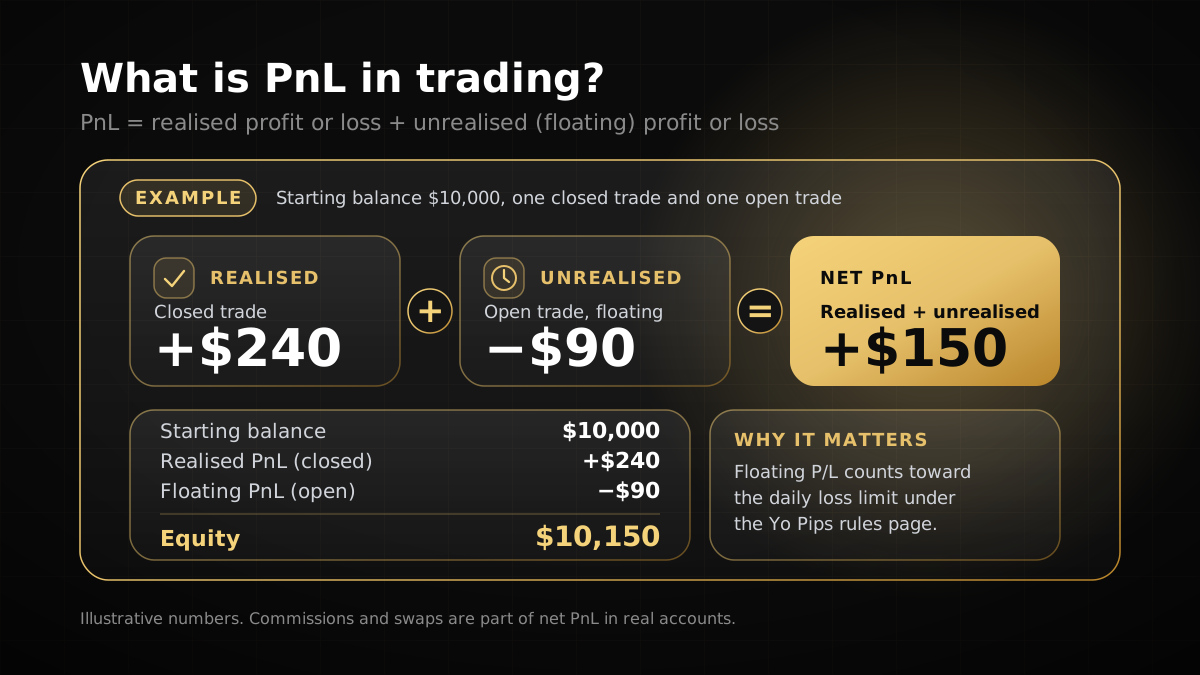
Realised PnL is the profit or loss locked in by trades you have closed. Once a trade is closed, its result is settled and does not move with the market again. If you buy an asset at one price and sell it at a higher price, the difference is realised profit, before any costs are taken off.
Realised PnL is the number most people mean when they talk about a trading result for a day or a month. It is also the figure most profit targets count, because it is fixed. Under the Yo Pips rules, the profit target counts closed profit only. An open trade in profit does not count until you close it.
Floating PnL: open trades
Floating PnL, also called unrealised PnL, is the result of trades that are still open, measured at the current price. It is a live estimate. If a position is up at the moment, its floating PnL is positive. If the price moves against it, the floating PnL falls, and it can turn into a loss without any trade being closed.
Floating PnL is real exposure even though it is not yet settled. A trader with a large open loss has a larger risk of hitting a limit than the closed results suggest. This is why risk control is usually set around the open position, not only around the last closed trade. Our position size calculator guide shows how to size a trade so that a move against you stays inside a planned loss.
Net PnL, commissions and swaps
Gross PnL is the trading result before costs. Net PnL is what remains after costs are taken into account. Two costs appear most often:
- Commissions are a charge for placing and executing a trade. They depend on the broker or platform terms, and they are usually charged per trade.
- Swaps are overnight financing charges or credits on a position held past the daily rollover. They can be a cost or a credit, depending on the instrument and the direction of the position.
Costs are easy to forget because they do not look like trades. A position that closes exactly at its entry price can still show a net loss once commissions and swaps are counted. Check whether the figure on your screen is gross or net, and whether it includes costs that have been charged but not yet closed.
The table below sets out how the parts of a PnL figure fit together. The example figures are the ones used in the worked example later in this guide.
| Measure | What it includes | When it changes | Example figure |
|---|---|---|---|
| Realised PnL | Closed trades, before costs | When a trade closes | -$180 |
| Costs | Commissions and swaps charged | When a cost is charged | -$16 |
| Net realised PnL | Realised PnL less costs | When a trade closes or a cost posts | -$196 |
| Floating PnL | Open trades at the current price | With every price move | -$120 |
| Total net PnL | Net realised PnL plus floating PnL | With every price move and every cost | -$316 |
Balance, equity and PnL
Balance and equity are often confused with PnL, and they answer different questions. Balance is the account’s cash value after all closed trades and costs. It moves when a trade closes or a cost is charged, and it does not move with open positions.
Equity is balance plus floating PnL. It shows what the account is worth at current prices, as if the open trades were closed at those prices. A trader can have a healthy balance and a much lower equity because of an open loss. Many prop firm maximum loss limits are measured on equity, so equity is the number to watch during a session.
In short: PnL describes the result, balance records the closed result, and equity adds the open result. Each one can be the right figure to look at, depending on the question you are asking.
How Yo Pips counts PnL
Under the Yo Pips rules page, PnL is counted in three places, and each uses a different mix of the measures above. The figures below come from that page and the rulebook. Checkout terms take precedence, and rules can change, so read the current version before you start.
- Profit target: counts closed profit only, so floating profit does not count toward the target until the trade is closed.
- Daily loss limit: includes closed P/L, floating P/L, commissions and swaps for the current day. A losing open trade counts toward the limit straight away. Daily figures reset at UTC.
- Maximum loss limit: is measured on equity, so floating losses reduce the buffer as well as closed losses.
The practical result is that a daily loss figure can be higher than the closed loss you can see in your trade history. Watch the open positions and the costs as well as the closed trades. For the full definitions and the programme limits, see the rules and regulations page. The prop firm challenge guide covers how these limits fit into a full evaluation.
Worked example: a day on a $10,000 account
Take a hypothetical $10,000 account on a prop firm with a 4% daily loss limit and an 8% maximum loss limit. The daily limit is 4% of $10,000, which is $400. The maximum loss limit is 8% of $10,000, which is $800, so equity must stay above $9,200. The example uses the starting balance as the base for both limits.
During the day, the account has these results:
- Trade A closed at a loss of $180 before costs.
- Costs charged so far: $14 in commissions and $2 in swaps, a total of $16.
- Trade B is still open, with a floating loss of $120 at the current price.
Step one, realised PnL: the closed trade gives -$180. Step two, net realised PnL: add the costs, -$180 - $16 = -$196. Step three, total net PnL: add the floating loss, -$196 - $120 = -$316. That is the day’s figure so far.
Now check the limits. The daily loss limit is $400, and the day has used $316, so $84 of room is left. The balance is $10,000 - $196 = $9,804. Equity is $9,804 - $120 = $9,684, which is $484 above the $9,200 floor.
Now the sensitivity. Suppose trade B moves a further $90 against you before you close it. Its floating loss becomes $210, and the day’s total becomes -$180 - $16 - $210 = -$406. That is beyond the $400 daily limit, so the account would breach even though trade B has not been closed. The open trade was the part that moved the figure over the line, which is the point of counting floating PnL.
Common PnL mistakes
Most PnL errors come from reading one number as if it were another. These are the ones to check for:
- Reading balance as equity. A healthy balance can hide a large open loss. Check equity during the session.
- Counting open profit as banked. Floating profit can disappear on the next price move. Closed profit is the figure that is settled.
- Ignoring costs. Commissions and swaps lower net PnL, and on Yo Pips they count toward the daily loss.
- Mixing gross and net. A platform may show one, the rules may use another. Confirm which figure each rule uses.
- Mixing currencies. If the platform reports in a different currency from your account, a conversion rate changes the figure even when the trades do not change.
- Mixing up time periods. A daily figure and a weekly figure answer different questions. For Yo Pips, daily figures reset at UTC, so work out which day a late trade belongs to in UTC, not in your local time.
A simple habit helps with all of these. Before each session, write down the balance, the equity, the daily loss figure and the room left under each limit. Review them again after every trade. Our guide to what a prop firm is explains why these limits exist in the first place.
Frequently asked questions
01What does PnL stand for?
02What is the difference between realised and floating PnL?
03Is PnL the same as account balance?
04Do commissions and swaps count as PnL?
05Does floating PnL count toward a prop firm’s daily loss limit?
06Is PnL the same as return?
Risk disclosure: Trading leveraged products such as forex and CFDs carries a high level of risk, and most traders lose money. Prop firm challenges are evaluations on simulated accounts; passing one does not guarantee account activation, profits or a payout. Nothing on this page is investment advice. Always read the current rules and terms before you buy or start a challenge.