A prop firm challenge, or prop firm evaluation, is the test many proprietary trading firms use before they give a trader firm capital. You trade a simulated account, aim for a profit target and stay inside loss limits. Pass, and you move to a funded account where you keep a share of the profit. The detail sits in the rules. Many failed attempts involve a rule that was misread or a habit that pushed the account past a limit. This guide explains each rule with the arithmetic, compares the main challenge models and uses the published Yo Pips rules as a worked reference.
What a prop firm challenge is
A prop firm challenge is a set of trading conditions a firm sets before it trusts you with its capital. The evaluation account is simulated, so you are not trading live capital during the challenge. Your results are measured against the firm’s rules. If you meet the profit target and never break a loss limit, you may move on to a funded account, subject to the firm’s fee and verification steps. If you break a limit, the attempt ends.
The model rests on a simple idea. Firms are usually not looking for a single good month. They want evidence that you can make a return while keeping losses small and predictable. A challenge is therefore a test of risk control as much as a test of returns. A trader who makes ten percent with one oversized position has shown the firm very little. A trader who makes ten percent with small, repeatable losses has shown a great deal more.
For the wider model, read our guide to what a prop firm is.
The rules explained
Yo Pips figures in this section come from the Yo Pips rules page and rulebook PDF; the Yo Pips section below lists them in full with the date they were checked.
Many challenges use the same five ideas, although firms name and calculate them differently. Read each one as a precise definition.
Profit target
The profit target is the gain you must reach before you can move on. Many firms count closed profit only, so an open trade does not count until you close it. Yo Pips counts closed profit only toward profit targets.
Daily loss limit
The daily loss limit caps how much you can lose in one trading day. On Yo Pips it includes closed P/L, floating P/L, commissions and swaps for the current day. A losing open trade counts straight away, even though you have not closed it. Yo Pips resets daily figures at UTC, so check the reset time on any firm you compare.
Maximum loss limit
The maximum loss limit is the overall floor for the account. Yo Pips measures it on equity, not only on closed trades, so floating losses reduce the buffer too. When equity reaches the floor, the account breaches. Watch equity through the session, not only the closed result at the end of the day.
Minimum trading days
Some firms require a minimum number of trading days before you can pass. On Yo Pips, a trading day counts only if at least one trade is both opened and closed that day. The minimum is 4 days for 1-Step Pay Later and 5 days for 2-Step Pay Later. Instant Funding has no pass stage; its 5 active trading days are a condition for the first payout.
Time limit and inactivity
Some firms cap how long you have to pass. Under the current Yo Pips rules, the 1-Step and 2-Step Pay Later programmes have unlimited time. Inactivity is a separate rule: 30 consecutive calendar days with no trading may lead to the account being archived, suspended or closed.
One-step, two-step and instant funding compared
Many firms sell one of three models. One-step and two-step prop firm challenges differ mainly in how many stages sit between you and funding, which sets the trade-off between cost, speed and room for error. The table below is generic, and individual firms vary.
| Model | How it works | Typical trade-off |
|---|---|---|
| One-step | One evaluation phase with one profit target, then a funded account | Fewer steps to funding, but one target to hit and loss limits to hold throughout |
| Two-step | A first phase with a target, then a second phase with its own target, then a funded account | More stages to pass, so more time spent and more rules to keep to |
| Instant funding | No evaluation: you pay once and trade a funded account under the firm’s rules | Fastest route to a funded account, but loss limits can be tighter and there is no evaluation stage in which to show consistency |
Instant funding is not a shortcut around risk. It removes the evaluation, so there is no profit target to hit, but the Yo Pips account carries tighter loss limits from the first day. Our instant funding guide covers those trade-offs in more depth.
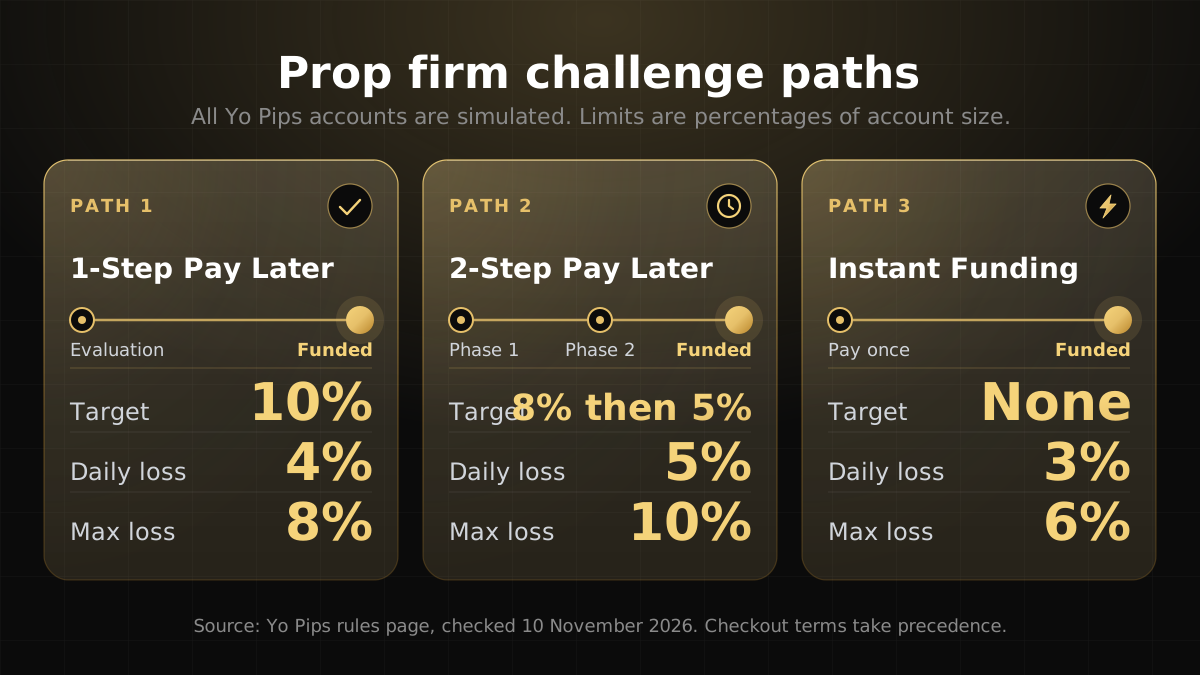
Yo Pips challenge and funding rules
The programmes covered here are 1-Step Pay Later, 2-Step Pay Later and Instant Funding. All are simulated. The figures below come from the Yo Pips rules page and rulebook PDF, checked on 10 November 2026. Checkout and promotion terms take precedence, and rules can change, so confirm them on the rules and regulations page before you buy.
| Programme | Account sizes | Profit target | Daily loss limit | Maximum loss limit | Profit split |
|---|---|---|---|---|---|
| 1-Step Pay Later | 5K, 10K, 25K, 50K, 100K | 10% | 4% | 8% | 80% (5K to 25K); 85% (50K to 100K) |
| 2-Step Pay Later | 2K, 5K, 10K, 25K, 50K, 100K | Phase 1 8%; Phase 2 5% | 5% | 10% | 80% (2K to 25K); 85% (50K to 100K) |
| Instant Funding | 2K, 5K, 10K, 25K, 50K, 100K | None (no evaluation) | 3% | 6% | 70% (2K); 75% (5K); 80% (10K to 25K); 85% (50K to 100K) |
The minimum trading days are 4 on 1-Step Pay Later and 5 on 2-Step Pay Later. Our rules comparison sets out the Yo Pips rules in full.
Two rules decide how you trade. First, a breach is immediate. When a loss limit is hit, the account is breached and closed, and a breached account is not eligible for a payout or refund unless a published promotion says otherwise. Second, a passed evaluation cannot be sold or transferred.
Eligibility matters too. You must be 18 or over and not live in a restricted or sanctioned jurisdiction, and that list can change. Verification (KYC) can include government ID, a selfie or liveness check, proof of address, payment verification and tax information. Complete it early, so it does not hold up your first payout.
Payouts are requested in the dashboard. For Pay Later accounts, the rulebook PDF says the first payout is possible 14 calendar days after funded activation and after at least 5 active trading days. Instant Funding needs at least 14 calendar days, counted from your first trade according to the rulebook PDF, plus at least 5 active trading days and at least 5% net profit without a breach. Approved payouts are typically processed within one to three business days. The account needs to be in profit, free of unresolved breaches, with KYC approved.
Worked example: a $10,000 one-step account
Take a hypothetical $10,000 account on the 1-Step Pay Later programme. Applying the published percentages to the $10,000 starting balance gives three limits in dollars (the rules page’s compliance list says trailing drawdown applies, so the maximum-loss floor can rise as the account grows; check your dashboard):
- Profit target: 10% of $10,000 = $1,000 of closed profit.
- Daily loss limit: 4% of $10,000 = $400 of combined loss in one UTC trading day.
- Maximum loss limit: 8% of $10,000 = $800, so equity must stay above $9,200.
Now run a single day. You close one trade for a loss of $250. You still hold an open trade with a floating loss of $160. Commissions for the day come to $15. The daily loss figure is $250 + $160 + $15 = $425. That is above the $400 limit, so the account breaches, even though the closed trade on its own was only $250 down. The open trade counted as soon as it moved into loss.
Now the profit side. Suppose you have $800 of closed profit and an open trade showing $300 in profit. Only the $800 counts, so you are still $200 short of the $1,000 target. If the open trade closes at $300, closed profit becomes $1,100 and the target is met, provided no loss limit has been breached along the way.
How fees work
Yo Pips Pay Later programmes do not ask for the full programme fee up front. A small starter fee is paid at checkout. The remaining programme fee is due only after you pass, and it must be paid within 7 calendar days of pass confirmation, unless the dashboard shows a different deadline. If it is not paid, the pass may be cancelled. The wider idea is set out on our pass first, pay later page.
Instant Funding works differently. The rulebook PDF describes a single one-time fee paid at checkout, with no evaluation stage to pay for later.
Fee amounts are not listed in this guide. Read the checkout summary before you confirm. Refunds and fee credits apply only where a plan advertises them. Free routes also exist. A free trial runs on a simulated account with no payment details, and free account offers come with their own conditions, which are listed on each offer page. Treat any free offer as a set of conditions to read first.
How to choose a challenge type
There is no best model for every trader. Choose by how you actually trade, not by the headline.
- Start with your bad day. Work out the largest loss you have had in an ordinary session. If that would already use much of a daily limit, a model with a wider daily limit leaves more room. Compare the daily percentages in the table above.
- Count the stages. One phase means one target to hit, so you reach funding sooner if you hit it. Two phases give you two targets and more time, but also more rules to keep to over a longer period.
- Price the attempt, not only the fee. A cheaper first step is only useful if you can pass it. Think about what a failed attempt costs you in money and time, and whether you could afford to repeat it.
- Practise before you pay. Use the free trial, a simulated account with no payment details, to practise your process before you commit to a paid challenge.
Work out your position size against the daily limit before you start. Our position size calculator guide shows how to turn a risk percentage into a lot size.
Common reasons challenges fail
Failed challenges often share a few patterns. Many come down to a misread rule or a habit that pushed the account past a limit. These are the patterns to watch for. This guide does not quote pass rates.
- Ignoring floating losses. On Yo Pips an open losing trade counts toward the daily limit and equity straight away.
- Oversized positions. One large trade can use up much of a daily limit quickly. Size to the limit, not to the target.
- Forgetting costs. Commissions and swaps count toward the daily loss on Yo Pips, so a trade that looks flat on price can still use up the limit.
- Chasing the target. Pressure to reach the target near a deadline, or straight after a losing day, is a common reason traders take larger risks than their plan allows.
- Misreading the reset. Yo Pips resets daily figures at UTC. Work out which day a late session belongs to in UTC, not in your local time.
- Going quiet. A long pause with no trading can lead to archiving under the inactivity rule, and trading days only count when a trade is opened and closed.
Frequently asked questions
01Is a prop firm challenge the same as a funded account?
02Do open trades count toward the profit target?
03What happens if I break a loss limit?
04What is the difference between one-step and two-step?
05Do I pay the full fee at checkout on Pay Later?
Risk disclosure: Trading leveraged products such as forex and CFDs carries a high level of risk, and most traders lose money. Prop firm challenges are evaluations on simulated accounts; passing one does not guarantee account activation, profits or a payout. Nothing on this page is investment advice. Always read the current rules and terms before you buy or start a challenge.