Searches for the cheapest prop firm challenge usually mean one thing: the smallest fee needed to start an evaluation. That number matters, but it is only the first payment. Some programmes add a second fee after a pass, charge for add-ons, sell a reset at a separate price, or set minimum trading days and payout thresholds that take time and money to meet. This guide lists the entry fees shown on seven firms’ own official pages, checked on 10 November 2026, puts them on one basis and shows what the low numbers leave out. FundingPips and E8 Markets are not in the tables: FundingPips’ site returned HTTP 429 to our requests on 10 November 2026, and E8 Markets’ fees were not captured for this guide. One row, Alpha Capital’s Alpha Direct, shows no fee on the pages checked. It does not rank firms by value, and it is not investment advice. Yo Pips is itself a prop firm and is the publisher of this comparison.
What “cheapest” means for a challenge
The word cheapest hides three different numbers in prop firm challenge fees. The first is the entry fee at checkout. The second is the total you pay to reach a funded account and keep it, including any second payment, add-ons and resets. The third is the expected cost of a failed attempt, which depends on how tight the loss limits are and how many attempts you can afford. A low entry fee on a programme you cannot pass is not a cheap route to funding.
The listed figures also need care. Some pages show a “starting from” label without saying what it includes. Some show a dollar sign with no currency code. Some pages for the same firm disagree on a fee or an account size. Where that matters, this guide says so, rather than picking one figure and presenting it as settled.
If you are new to the model itself, our prop firm challenge explainer covers the profit targets and loss limits that sit behind every fee.
Entry fees listed on each firm’s own page
The table below is selective. For each firm’s main programmes it lists the smallest account shown and the fee shown beside it, as the firm’s page showed them when we checked on 10 November 2026. FundedNext labels its prices approximate and says they vary with promotions and add-ons. Maven, Blue Guardian and Goat Funded Trader show a lower price beside a list or struck-through price. Alpha Capital’s checkout advertises a discount code against the price shown, and the table gives the price before any code. Promotions change, so the amount at checkout can differ from every figure here. The5ers’ Summer Plan, a limited-time offer, has no row in the table. Where a page does not give a fee or an account size, the cell says “not stated”. Discount codes are left out. Sources are listed at the end of this guide.
Swipe sideways to see every column.
| Firm and programme | Model | Smallest listed account | Listed fee, as shown | Fee per $1,000 of account |
|---|---|---|---|---|
| FTMO 1-Step Challenge | 1-step | $10,000 | €79, one-time and non-refundable (fee shown in EUR) | €7.90 |
| FTMO 2-Step Challenge | 2-step | $10,000 | €89, shown as a one-time refundable fee (in EUR) | €8.90 |
| FTMO Instant Account | Instant | $5,000 | €169, one-time and non-refundable (in EUR) | €33.80 |
| FundedNext Stellar Lite | 2-step | $5,000 | $32.99 | $6.60 |
| FundedNext Stellar 2-Step | 2-step | $6,000 | $59.99 | $10.00 |
| FundedNext Stellar 1-Step | 1-step | $6,000 | $65.99 | $11.00 |
| FundedNext Stellar Instant | Instant | $2,000 | $59.99 | $30.00 |
| The5ers 2 Step High Stakes, New plan (Step 1) | 2-step | $2,500 | $19; the Classic plan on the same page shows $22 | $7.60 |
| The5ers 1 Step Hyper Growth (Growth tab of the Hyper Growth page) | 1-step | $5,000 | $260 one-time fee | $52.00 |
| The5ers 1 Step Pro Growth (default tab of the Hyper Growth page) | 1-step | $5,000 | $52 one-time fee | $10.40 |
| The5ers 3 Step Bootcamp | 3-step | $5,000 | $22 at Step 1 and $50 at the Pro Trader stage of the $20K Bootcamp | $4.40 at Step 1 ($22 on $5,000); $3.60 if you reach the $20,000 stage ($72 in total) |
| Goat Funded Trader 1-Step | 1-step | $5,000 | $57 list price, struck through; $34 shown beside it | $11.40 on the list price |
| Goat Funded Trader Pay Later | Pay after pass | $5,000 | $5.00 at checkout, then $78 after passing (page FAQ), $83 in total. The 5K card shows a struck-through $54.00 | $1.00 at checkout; $16.60 if you pass |
| Goat Funded Trader GOAT $1 | Instant-style | $1,000 | $1 (as shown on the page) | $1.00 |
| Alpha Capital Group Alpha One 6% | 1-step | $5,000 | $37.00 in the checkout’s default selection | $7.40 |
| Alpha Capital Group Alpha Pro 8% | 2-step | $5,000 | $37.00 in the checkout’s default selection | $7.40 |
| Alpha Capital Group Alpha Direct | Instant (qualified account) | $2,500 | Not stated on the pages checked | Not calculable |
| Blue Guardian Instant Starter | Instant | $5,000 | $27 list price, struck through; $11 shown beside it, which the page labels 45% off as a limited-time offer | $5.40 on the list price |
| Blue Guardian Instant | Instant | $5,000 | $72 list price, struck through; $54 shown beside it | $14.40 on the list price |
| Blue Guardian 1 Step Standard | 1-step | $5,000 | $40 list price, struck through; $30 shown beside it | $8.00 on the list price |
| Blue Guardian 1 Step Nano | 1-step | $5,000 | $26.66 list price, struck through; $20 shown beside it | $5.33 on the list price |
| Blue Guardian 2 Step Standard | 2-step | $5,000 | $32 list price, struck through; $24 shown beside it | $6.40 on the list price |
| Blue Guardian 2 Step Nano | 2-step | $25,000 | $66.66 list price, struck through; $50 shown beside it | $2.67 on the list price |
| Maven Standard 3-Step | 3-step | $2,000 | $13 (list price) | $6.50 |
| Maven Standard 1-Step | 1-step | $2,000 | $15 (list price) | $7.50 |
| Maven Instant Funding | Instant | $2,000 | $15 (list price) | $7.50 |
| Maven Mini (Instant Mini Funding) | Instant | $2,000 | $17 (list price) | $8.50 |
| Maven Standard 2-Step | 2-step | $2,000 | $19 (list price) | $9.50 |
| Maven Omo 2-Step | 2-step | $2,000 | $19 (list price) | $9.50 |
| Maven Buy Now, Pay Later | Pay after pass | $2,000 | $5 now and $40 later, a total of $45 | $22.50 if you pass |
Read the table with four cautions. First, currencies differ. FTMO shows its fees in EUR against account sizes in USD. The table uses FTMO’s main 1-Step, 2-Step and Instant pages. Its separate page for US residents, which describes a US-only service, shows “starting from” €89 for the 1-Step and $99 for the 2-Step. The fee per $1,000 column is arithmetic on the number shown, not a currency conversion. Second, where a page shows a struck-through list price beside a lower price, this guide uses the list price. The one exception is Goat Funded Trader’s Pay Later, where the page FAQ gives the price after passing; the pay-later section below explains it. Blue Guardian’s price grid does this and changes with the plan you select, and Goat Funded Trader’s 1-Step selector does the same; both pages advertise a discount code. Maven’s standard rows show its list price too, and its challenge pages show a lower price with a coupon beside each one. Blue Guardian’s Instant Starter card shows $27 struck through beside $11, and the same page labels the $11 as 45% off. Third, some prices depend on a selection. Alpha Capital’s checkout price changes with the payout schedule and add-ons, and the rows give its default selection. Fourth, some pages hold more than one plan. The5ers’ Hyper Growth page has two tabs, Growth and Pro Growth, with different fees, and its High Stakes page has a New and a Classic plan.
Cheapest prop firm challenge fees compared per $1,000 of account size
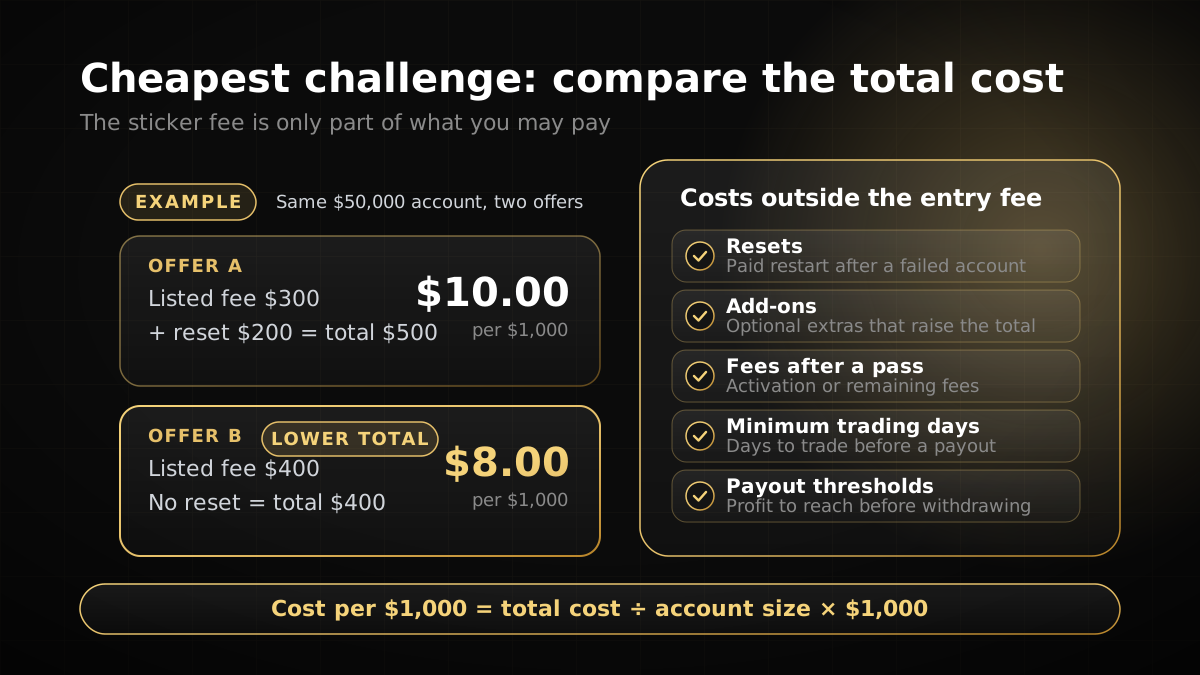
Account sizes differ, so the raw fee is a poor basis for comparison. A $60 fee on a $6,000 account is not the same offer as a $60 fee on a $2,000 account. Divide the fee by the account size in thousands:
Cost per $1,000 = listed fee ÷ (account size ÷ 1,000)
Take FundedNext’s Stellar 2-Step, with a $59.99 fee on a $6,000 account. The account is six units of $1,000, so $59.99 ÷ 6 = $9.998, or about $10.00 per $1,000. Now take Stellar Lite, listed at $32.99 on a $5,000 account. That is $32.99 ÷ 5 = $6.60 per $1,000. Maven’s Standard 3-Step, at $13 on a $2,000 account, works out to $13 ÷ 2 = $6.50 per $1,000.
The per-$1,000 figure makes account sizes comparable, but it does not make the rules comparable. Stellar Lite has an 8% first-phase target and a 4% daily loss limit. Maven’s Standard 3-Step has three phases at a 3% target each and a 2% daily loss limit. Two programmes at about the same cost per $1,000 can still ask for very different trading.
Two of the low-fee rows carry limits that the per-$1,000 figure does not show. GOAT $1 accounts expire 28 days after activation, need three profitable days per payout and cap lifetime withdrawable profit at $100. The Blue Guardian Instant Starter caps profit at $250 and allows one payout, after which the account closes. A low figure on this basis is a reason to read the rules, not a reason to buy.
How pay-later and instant models move the cost
Pay-later programmes move part of the cost to after the result. A starter fee comes at checkout, and the rest is due only if you pass. That lowers the amount at risk on a first attempt, but it does not lower the total cost if you pass. Before you pay, check three things: the amount due at checkout, the amount due after a pass and the deadline for that amount.
Take the total in Maven’s Buy Now, Pay Later row for a $2,000 account. Its page says you pay the remaining fee only after you pass, as a separate payment. If you pass, the total gives $45 ÷ 2 = $22.50 per $1,000, which is three times the $7.50 per $1,000 of its Standard 1-Step. The two products have different rules, so the comparison shows the cost of the pay-later route, not a judgement of the programme.
Goat Funded Trader’s Pay Later page charges $5 at checkout. Its FAQ says the $5 covers server and infrastructure expenses, and that you pay the full challenge fee only after passing, just before you receive the funded account. The same FAQ lists the price after passing for six account sizes, shown below. Each card on the page also shows a struck-through figure, and for five of the six sizes it differs from the FAQ price, so this guide uses the FAQ. The card calls the fee “100% refundable”, while the firm’s refund policy says there are no refunds on any services. Ask the firm which figures apply before you pay.
Swipe sideways to see every column.
| Account size | Price after passing (page FAQ) | Total with the $5 paid at checkout | Total per $1,000 if you pass | Struck-through figure on the card |
|---|---|---|---|---|
| $5,000 | $78 | $83 | $16.60 | $54.00 |
| $10,000 | $118 | $123 | $12.30 | $118.00 |
| $15,000 | $168 | $173 | $11.53 | $178.00 |
| $25,000 | $238 | $243 | $9.72 | $248.00 |
| $50,000 | $368 | $373 | $7.46 | $290.00 |
| $100,000 | $598 | $603 | $6.03 | $550.00 |
| $200,000 | Not in the FAQ | Not calculable | Not calculable | $998.00 |
On the FAQ figures, the total per $1,000 falls as the account gets larger, from $16.60 at $5,000 to $6.03 at $100,000. The5ers’ Bootcamp splits its fee in a similar way: its table shows $22 at Step 1 and $50 at the Pro Trader stage of the $20K programme.
Instant funding removes the evaluation and charges one fee. FundedNext’s Stellar Instant is listed at $59.99 for a $2,000 account, which is $30.00 per $1,000. Maven’s Instant Funding is listed at $15 for $2,000, or $7.50 per $1,000. Instant does not remove the loss limits. Blue Guardian’s Instant Starter has a 3% daily loss limit and a 5% trailing drawdown. Its help article caps profit at $250 and allows one payout, after which the account closes.
What a low fee may not cover
All seven firms show an entry fee for at least one programme, so the entry fee is the figure most often shown. The items below often decide the final cost of reaching a funded account. Each example comes from a page checked on 10 November 2026.
Swipe sideways to see every column.
| Cost that can sit outside the entry fee | What to check | Example from the captured pages |
|---|---|---|
| Second payment after a pass | The amount, the deadline and what happens if it is unpaid | Maven Buy Now, Pay Later and Goat Funded Trader Pay Later both have a second payment. See the pay-later section above for how each one adds up. |
| Add-ons | Which add-ons change the profit split, the swap terms, the EA rules or the platform setup | Alpha Capital Alpha Pro: the swap-free add-on adds about 10% to the price, and the 90% split add-on adds 10% to the On-Demand price. Goat Funded Trader: a 100% profit split add-on at checkout. FundedNext: EA and VPS add-ons, prices not stated. |
| Resets after a failed attempt | The reset price, and whether it is set below the first purchase | FundedNext Stellar Instant: the reset fee is 10% less than the original purchase price and is not refundable. |
| Minimum trading days | Days you must trade before a pass or a payout | FTMO 2-Step: at least 4 trading days, a rule that applies to both phases. Maven Standard 2-Step: 3 profitable days per phase, each at least 0.5% of the initial balance. The5ers 2 Step High Stakes: 3 profitable days per step, each with closed positions making at least 0.5% of the initial balance. |
| Payout minimums | The minimum amount before a withdrawal can be requested | The5ers Summer Plan: a $250 minimum withdrawal on the funded account. Alpha Capital Alpha Pro bi-weekly: a first request needs 5 trading days and a $100 minimum. Blue Guardian 1 Step Nano: $100 minimum withdrawal in crypto, and $500 through Rise. Goat Funded Trader: a $100 minimum withdrawal, except on Instant Daily accounts, where each request must be between 1% and 3% of the initial balance. |
| Validity and inactivity | How long the account lasts and when it expires | GOAT $1: expires 28 days after activation. Maven Omo 2-Step: 180 days across both phases. The5ers High Stakes: accounts with no activity for more than 30 consecutive days are set to expire. |
| Consistency rules | Rules that cap how much of the profit can come from one day | Blue Guardian 1 Step Nano: the largest single-day profit must stay below 50% of total profit. Blue Guardian Instant Standard: 20% of total profit on any single day, and 15% on $300,000 and $400,000 accounts. |
Breach terms differ by programme. Where the captured pages state the consequence, it can change the cost of a failed attempt. On The5ers’ Summer Plan 1-Step ($100K), reaching the 3% daily loss limit permanently terminates the account. Blue Guardian’s 1 Step Nano consistency breach does not terminate the account, but it blocks payout requests until the rule is met. The cost of one failed attempt is therefore the entry fee, plus the time you spent, plus any reset or second payment that follows. If you expect to need a second attempt, add its price to your calculation before you start. Refund terms also vary and change how much of an attempt you get back. FTMO’s FAQ, for example, says the 1-Step and Instant Account fees are not refundable and the 2-Step fee is refunded with the first Reward withdrawal. Read the refund wording on the firm’s own page.
Yo Pips fee structure, without a price comparison
This guide does not put a Yo Pips price in the tables above, and it does not compare Yo Pips with other firms on price. The fee structure below comes from the Yo Pips rules page and the rulebook PDF. The Pay Later lines are in both sources. The Instant Funding line is in the rulebook PDF only, because the rules page shows no fee rule for that programme. Checkout terms take precedence over the rules page, and rules can change.
Swipe sideways to see every column.
| Yo Pips model | Paid at checkout | Paid later | Where to check the current figures |
|---|---|---|---|
| Pay Later (1-Step and 2-Step programmes) | A small starter fee | The remaining programme fee, within 7 calendar days of pass confirmation, unless Yo Pips states another deadline in the dashboard | Pricing page, with checkout terms |
| Instant Funding | A one-time fee (rulebook PDF) | None stated: the rulebook PDF describes a one-time fee paid at checkout | Pricing page, with checkout terms |
Under Pay Later, the second payment is due only after you pass, and it has a deadline, so the cost structure follows the pay-later pattern described above. Compare Yo Pips with the other firms in this guide on structure only: whether there is a second payment, whether any add-ons apply and the rules that decide whether you pass. This guide does not compare price. Check the current figures on the pricing page before you rely on any of them. For how the pass-first model works in practice, see pass first, pay later.
How to compare fees before you buy
Use the same steps for every programme, including the one you already have in mind. Work with the figures on the checkout page, not the headline.
- Write down the account size, the fee at checkout and any second payment. Note the deadline for the second payment and what happens if you miss it.
- Keep each figure in the currency the page shows, and compare only like with like. Do not mix an EUR figure with a dollar figure unless you have a source for the exchange rate.
- Divide by the account size in thousands to get the cost per $1,000.
- Add the cost of any add-on you need, such as a swap-free account or a higher profit split.
- Check the rules that decide whether you pass: the daily and maximum loss limits, the profit targets, the minimum trading days and the time limit.
- Estimate the cost of one failed attempt, including any reset price, and decide whether you could afford a second.
While you compare, keep the daily loss limit of the programme you are considering in view. A daily loss limit covers the whole day’s loss, not one trade. FTMO measures its limit against equity, so open positions count, and Blue Guardian sets its limit from the higher of balance or equity at its daily reset.
Sources
Each competitor figure in this guide comes from the firm’s own official page or help centre. Every page listed below was checked on 10 November 2026. FTMO’s, Alpha Capital’s, Blue Guardian’s and Goat Funded Trader’s price selectors and The5ers’ plan tabs were read in a browser on the same day, because their figures change with the option selected. Prices and rules change, so check the firm’s live page before you buy. The Yo Pips rules page and rulebook PDF were checked on 10 November 2026.
- FTMO: https://ftmo.com/lp/ftmo-challenge-1-step-vs-2-step/us/ ; https://ftmo.com/en/1-step-challenge/ ; https://ftmo.com/en/2-step-challenge/ ; https://ftmo.com/en/instant-account/ ; https://ftmo.com/en/trading-objectives/ ; https://ftmo.com/en/faq/is-the-entry-fee-refunded/ (checked 10 November 2026)
- FundedNext: https://help.fundednext.com/en/articles/17252927-stellar-1-step-account ; https://help.fundednext.com/en/articles/17255124-stellar-2-step-challenge ; https://help.fundednext.com/en/articles/17253939-stellar-lite-account ; https://help.fundednext.com/en/articles/17253243-stellar-instant-account ; https://fundednext.com/blog/fundednext-cfds-stellar-1-step-explained (checked 10 November 2026)
- The5ers: https://the5ers.com/high-stakes/ ; https://the5ers.com/hyper-growth/ ; https://the5ers.com/bootcamp/ ; https://the5ers.com/summer-plan/ ; https://the5ers.com/terms-and-conditions/ (checked 10 November 2026)
- Goat Funded Trader: https://goatfundedtrader.com/gft-pay-later ; https://help.goatfundedtrader.com/compare-models.html ; https://help.goatfundedtrader.com/trading-rules.html ; https://help.goatfundedtrader.com/rewards.html ; https://goatfundedtrader.com/legal/refund-policy ; https://goatfundedtrader.com/ (checked 10 November 2026)
- Alpha Capital Group: https://alphacapitalgroup.uk/product/alpha-one ; https://alphacapitalgroup.uk/product/alpha-pro ; https://alphacapitalgroup.uk/product/2-step ; https://help.alphacapitalgroup.uk/en/articles/16003693-alpha-direct (checked 10 November 2026)
- Blue Guardian: https://blueguardian.com/instant-funding-starter ; https://blueguardian.com/forex ; https://help.blueguardian.com/en/articles/14061939-instant-starter ; https://help.blueguardian.com/en/articles/14062186-1-step-standard-rules ; https://help.blueguardian.com/en/articles/14062291-2-step-standard-rules ; https://help.blueguardian.com/en/articles/16444654-1-step-nano-rules ; https://help.blueguardian.com/en/articles/14061082-instant-standard-account-rules (checked 10 November 2026)
- Maven Trading: https://maventrading.com/pricing ; https://maventrading.com/challenges/1-step ; https://maventrading.com/challenges/2-step ; https://maventrading.com/challenges/3-step ; https://maventrading.com/challenges/instant ; https://maventrading.com/challenges/mini ; https://maventrading.com/omo-2-step ; https://maventrading.com/buy-now-pay-later ; https://maventrading.com/faqs (checked 10 November 2026)
- Yo Pips: https://www.yopips.com/rules-and-regulations ; https://www.yopips.com/Rules.pdf (checked 10 November 2026). https://www.yopips.com/pricing is linked for current prices only; no figure is taken from it
FundingPips and E8 Markets are not in these tables: FundingPips’ site returned HTTP 429 to our requests on 10 November 2026, and E8 Markets’ fees were not captured for this guide. Futures-only programmes are out of scope.
Frequently asked questions
01Which prop firm has the cheapest challenge?
02Is the listed fee the amount I pay?
03What is a pay-later prop firm challenge?
04Does a lower fee mean a lower cost to pass?
05How do I calculate the cost per $1,000 of account size?
06Does this guide list Yo Pips prices?
Risk disclosure: Trading leveraged products such as forex and CFDs carries a high level of risk, and most traders lose money. Prop firm challenges are evaluations on simulated accounts; passing one does not guarantee account activation, profits or a payout. Nothing on this page is investment advice. Always read the current rules and terms before you buy or start a challenge.