Prop trading is the business of trading with a firm’s money, and a prop firm is the company that provides it. In short, you pay for an evaluation, show you can trade within set limits, and then receive a funded account where you keep part of the profit. The idea is simple to describe, but the details vary a great deal between firms. Rules, fees and loss limits decide whether the model works for you. This guide explains how prop trading firms operate, how they earn money, what you agree to and where the risks sit. Yo Pips rules are used as a worked reference point, not as a standard for the whole industry.
What a prop firm is
A prop firm is a company that provides trading capital to people who trade for it. “Prop” is short for proprietary, which means the money belongs to the firm rather than to the trader. Proprietary trading is an older idea. For many years, banks and trading houses have employed traders to trade the firm’s own capital in live markets, with the profit kept inside the firm.
The retail version is what people usually mean today when they search for a prop firm. Individual traders from many countries can apply, pay an evaluation fee and trade a simulated account under published rules. If they meet the conditions, they receive a funded account and a profit split. Yo Pips is one example of this retail model. Its challenges run on MetaTrader 5, and its accounts are simulated.
How retail prop firms work, step by step
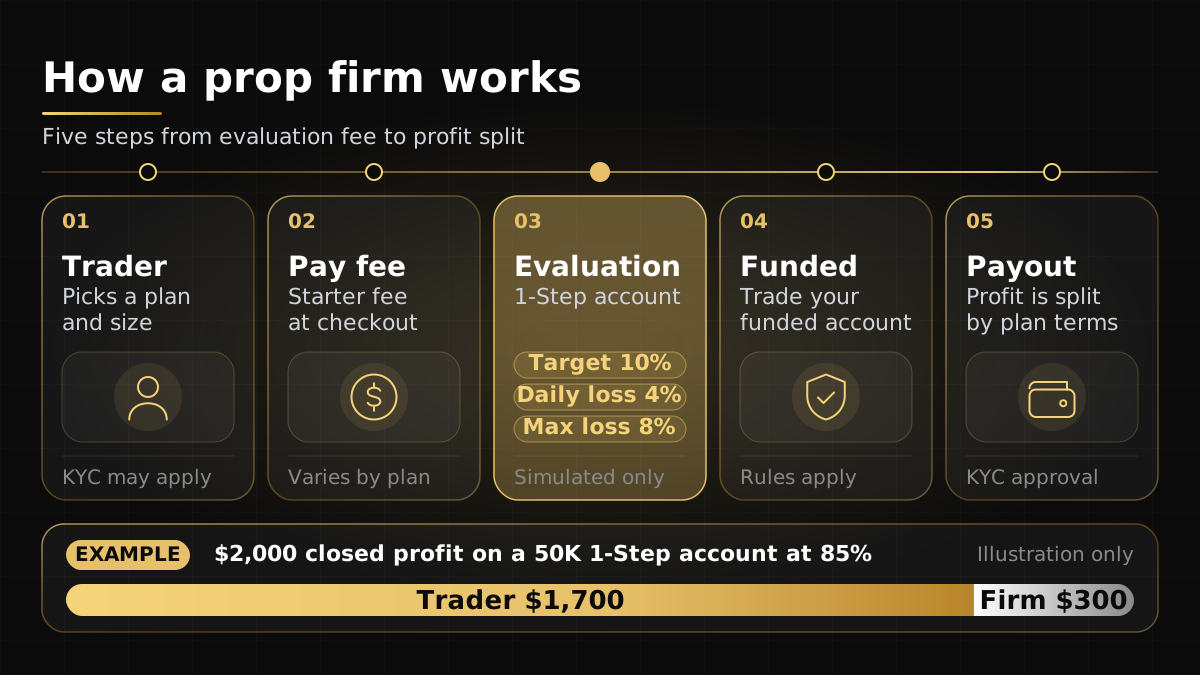
Most retail firms follow the same basic sequence. The exact numbers change from firm to firm, so read the steps as a map rather than a template.
- You choose a plan and account size, then pay the fee due at checkout. On Yo Pips Pay Later, this is a small starter fee.
- You trade a simulated account to reach a profit target without breaching the loss limits.
- If you pass, the remaining programme fee is paid under the firm’s rules. On Yo Pips it is due within 7 calendar days of pass confirmation, unless your dashboard shows another deadline.
- You receive a funded simulated account that follows your plan’s loss limits.
- You request a payout from your dashboard once the account is in profit and the conditions are met.
- The profit is split according to your plan’s share.
The full Yo Pips sequence is covered on the how it works page, and every rule is on the rules and regulations page.
How prop firms make money
A retail firm has two main sources of income, and it helps to understand both before you compare offers.
The first is evaluation fees. Each trader who buys a challenge pays a fee, so the firm earns something whether or not that trader later passes. If a firm sells many challenges, fee income can make up a large share of its revenue, so check how each one describes its model.
The second is the profit share on funded accounts. When a funded trader makes a profit and requests a payout, the firm keeps the part that is not paid to the trader. Take the Yo Pips 1-Step plan on a 50K account, where the published split is 85 percent. Before any deductions the plan terms allow, a closed profit of $2,000 would pay the trader $1,700 (2,000 × 0.85) and leave the firm $300 (2,000 × 0.15). This is arithmetic for illustration, not a forecast of what any trader will earn.
Where accounts are simulated, a trader’s losses on the account are not losses of real capital. The business still depends on its rules and fee structure, so read both closely. Neither point is a reason to avoid a firm, but both are reasons to check how its rules and payouts are described before you pay.
Traditional vs online prop firms
The table compares the two models in general terms. Individual firms differ, so check each firm’s own terms.
| Feature | Traditional proprietary trading firm | Online (retail) prop firm |
|---|---|---|
| Who trades | Traders selected and employed or partnered by the firm | Individual traders who apply and pay an evaluation fee |
| Capital | The firm’s own capital in live markets | Usually simulated accounts funded through the firm’s model |
| How you get in | Usually a selection process and internal training | Choose a plan and pass a published evaluation |
| Rules | Set internally by the firm | Published online, with profit targets and loss limits |
| How the trader is paid | Share of profit under an internal arrangement | Profit split stated in the plan terms |
| Platform | Firm’s internal systems | Varies by firm. Yo Pips challenges run on MetaTrader 5 |
The retail model lowers the bar to entry, which also puts more weight on the rules. A trader who misreads a loss limit can lose the account in a single session.
The rules you agree to
Every firm sets rules that you accept when you buy a plan. Read them as a contract. The figures below come from the Yo Pips rules page and are summarised again in the Yo Pips section further down.
Daily loss limit
A daily loss limit caps how much an account can lose in one trading day. Yo Pips counts closed profit and loss, floating profit and loss, commissions and swaps for the current day. The daily reset uses UTC, which may not match your local clock. On a 50K 1-Step account, taking the $50,000 starting balance as the base, the 4 percent limit is a loss of $2,000, so one bad session can end an attempt.
Maximum loss limit
The maximum loss limit is the total drawdown an account can take before it is breached. Yo Pips measures it on equity, at 8 percent on 1-Step plans and 10 percent on 2-Step plans. On a 50K account, 8 percent is $4,000. A breach is immediate when a loss limit is hit, and breached accounts are closed.
Profit target and trading days
A profit target is the closed profit you must reach to pass. Yo Pips counts closed profit only. The 1-Step target is 10 percent, which is $5,000 on a 50K account. A trading day counts only if at least one trade is opened and closed that day. Two-step plans have two phases; confirm the phase targets in the checkout terms before you buy.
Prohibited practices and inactivity
Firms publish a list of prohibited practices. Do not assume a strategy is allowed because it is legal where you live or common on social media. Check the list for every habit you use, from how you handle news to how you hold trades overnight. The Yo Pips list includes latency arbitrage, account or device sharing, wash trading and any strategy built mainly to exploit the simulated environment. On Yo Pips, 30 consecutive calendar days with no trading may lead to archiving or closure.
Eligibility and identity checks
Yo Pips requires participants to be 18 or older and not located in a restricted or sanctioned jurisdiction. That list can change. Verification may ask for a government ID, a selfie or liveness check, proof of address, payment verification and tax information. A payout needs approved verification.
Costs and what you can lose
The total cost of an attempt is more than the price of a plan. Count the evaluation fee, any remaining programme fee due after a pass, the time you spend on the attempt and the cost of a breach. A failed attempt usually means the fee is gone, because refunds or fee credits apply only where a plan advertises them. Before you pay, read the checklist in our guide on whether prop firms are legit.
Trading losses work differently. On a simulated account, the money you lose on trades is not your own capital, but the fee is. A common mistake is to treat the next attempt as a way to recover the last one. Set a fee budget before you start, and treat each attempt as a single, complete decision.
Is prop trading right for you?
Only you can judge that, and this is general information rather than personal financial advice. The model tends to suit traders who already have a written strategy with a tested record, can keep to fixed loss limits under pressure and are paying with money they can afford to lose. It is a poor fit for anyone who wants quick income, plans to trade to recover losses or has not yet seen how their strategy behaves over a meaningful number of trades.
Before you buy, ask yourself:
- Can I describe my strategy and its worst historical drawdown in writing?
- Have I tested it over a meaningful sample of trades?
- Can I accept a lost fee and wait before any new attempt?
- Do I understand every loss limit, including the ones measured on equity?
- Have I read the full rules, the verification requirements and the restricted-jurisdiction list?
How Yo Pips works
Yo Pips offers three programme types. The details below come from the Yo Pips rules page and the published rulebook, checked on 7 November 2026. Checkout and promotion terms take precedence, and rules can change. They show how one firm’s rules can look and are not a recommendation.
- 1-Step Pay Later (5K, 10K, 25K, 50K and 100K): a 10 percent profit target, a 4 percent daily loss limit and an 8 percent maximum loss limit, with unlimited time. Profit split is 80 percent on 5K–25K and 85 percent on 50K–100K.
- 2-Step Pay Later (2K, 5K, 10K, 25K, 50K and 100K): two phases, a 5 percent daily loss limit and a 10 percent maximum loss limit, with unlimited time. Profit split is 80 percent on 2K–25K and 85 percent on 50K–100K.
- Instant Funding (2K, 5K, 10K, 25K, 50K and 100K): no evaluation and no profit target, a 3 percent daily loss limit and a 6 percent maximum loss limit. Profit split runs from 70 percent on 2K up to 85 percent on 50K–100K.
Under those rules, all accounts are simulated and challenges run on MetaTrader 5. Compare the plans on the pricing page before you choose.
Yo Pips also lists free options that you can read about before buying: a free trial on a simulated account with no payment details and a Refer & Earn programme. Each one has its own conditions, so read them on its page before you sign up.
Frequently asked questions
01How is a prop firm different from a broker?
02Is prop trading the same as having a funded account?
03Do prop firms trade real money?
04Do you have to pay to join a prop firm?
05Can you lose money with a prop firm?
06Is a prop firm legit?
Risk disclosure: Trading leveraged products such as forex and CFDs carries a high level of risk, and most traders lose money. Prop firm challenges are evaluations on simulated accounts; passing one does not guarantee account activation, profits or a payout. Nothing on this page is investment advice. Always read the current rules and terms before you buy or start a challenge.