Are prop firms legit, or does the model mainly sell evaluations? The honest answer is that both kinds exist. Some prop firms are legitimate businesses that publish clear rules, pay approved payouts and tell traders who they are dealing with. Others use vague wording and fast sales tactics to collect evaluation fees. Sound firms are easier to spot once you know where the model’s incentives sit and which documents to read.
This guide explains how the prop trading model works, the warning signs that should slow you down and a ten-point checklist you can apply to any firm. At the end, we run the same checklist on Yo Pips, using only what our published rules say, so you can see the method applied.
Are prop firms legit? Some are, so check first
A sound prop firm is one that does what its published documents say it will do. It sells a clearly described evaluation, runs the account under written rules, reviews results using those rules and pays approved payouts when the conditions are met. That is the test. Marketing claims, social proof and a polished dashboard do not answer it on their own.
The reason caution matters is structural. In many prop firm models, a meaningful part of revenue can come from evaluation purchases, not only from the trading profits the firm later shares. That does not make the model illegitimate. It does mean the firm benefits when the sales funnel is busy, so a trader should ask how the firm earns money and what happens to an account after it passes.
How the prop firm business model works
Many prop firms follow a similar sequence. A trader buys an evaluation, sometimes called a challenge, which gives access to a simulated account. The trader must meet a profit target while staying inside a daily loss limit and a maximum loss limit. If the trader passes and the account is activated, the firm lets the trader trade its capital and shares a percentage of the profit. Evaluations and funded accounts are usually simulated, not live money in the trader’s own name.
Worked example, using the Yo Pips 1-Step Pay Later rules as an illustration. On a $10,000 account, the maximum loss limit of 8% is $800, and the daily loss limit of 4% is $400. The profit target of 10% is $1,000. Suppose a funded account later closes $1,500 of profit at an 80% split. The trader’s share is $1,200 and the firm keeps $300. The arithmetic is simple. What matters is whether the rules that produce the profit, and the rules that remove it, are written down clearly enough to check.
Swipe sideways to see every column.
| Stage | What the trader pays or risks | What the firm gets | What to check in writing |
|---|---|---|---|
| Evaluation or instant access | An evaluation fee or a one-time fee | Revenue from the purchase | Price terms, refund policy, what the fee covers |
| Simulated trading | Time, effort and the risk of a breach | Control over breach outcomes under its rules | Profit target, loss limits, minimum trading days |
| Pass and activation | Any remaining fee and KYC steps | Confirmation of the funded account | Deadlines for further fees, activation process |
| Funded trading | Breach risk under the loss limits | Its share of profit, usually the remainder | Profit split, breach definitions, inactivity rules |
| Payout | Waiting time and eligibility conditions | Pays the trader’s share if conditions are met | Payout eligibility, processing time, method |
Warning signs that a prop firm needs a closer look
No single sign proves a firm is a scam, and some legitimate firms are imperfect in one area. A pattern of several signs is different. Treat these as reasons to stop and check before you pay:
- No published rulebook. If the rules exist only in a sales video, a chat message or a screenshot, you cannot hold the firm to them.
- Rules that change without notice. Changes are normal, but a legit firm states when rules change and whether open accounts are affected.
- Vague loss-limit wording. A firm that says “you can lose a little” without defining the basis, such as balance, equity or closed P/L, is leaving the most important question open.
- Payout terms that depend on who you ask. If eligibility, timing or method changes between a support reply and the terms, the terms should win, and you should ask for the answer in writing.
- Pressure tactics. Countdown timers, “last chance” messages and discounts that expire in minutes are sales tools. They do not tell you whether the firm is honest.
- Promises of profit or easy payouts. Any statement that you will earn a fixed return, or that payouts are guaranteed, is a serious red flag. Trading does not work like that.
- No named legal entity. A firm that does not say which company you contract with, or hides it behind a brand name, makes disputes hard to pursue.
- Unclear identity checks. Some KYC is normal and expected. A firm that asks for personal data with no explanation of what it checks, why, or how it stores the data should be questioned.
A ten-point checklist before you pay
Use this table on any firm. If you cannot find a row in the firm’s own documents, that gap is itself the answer you need.
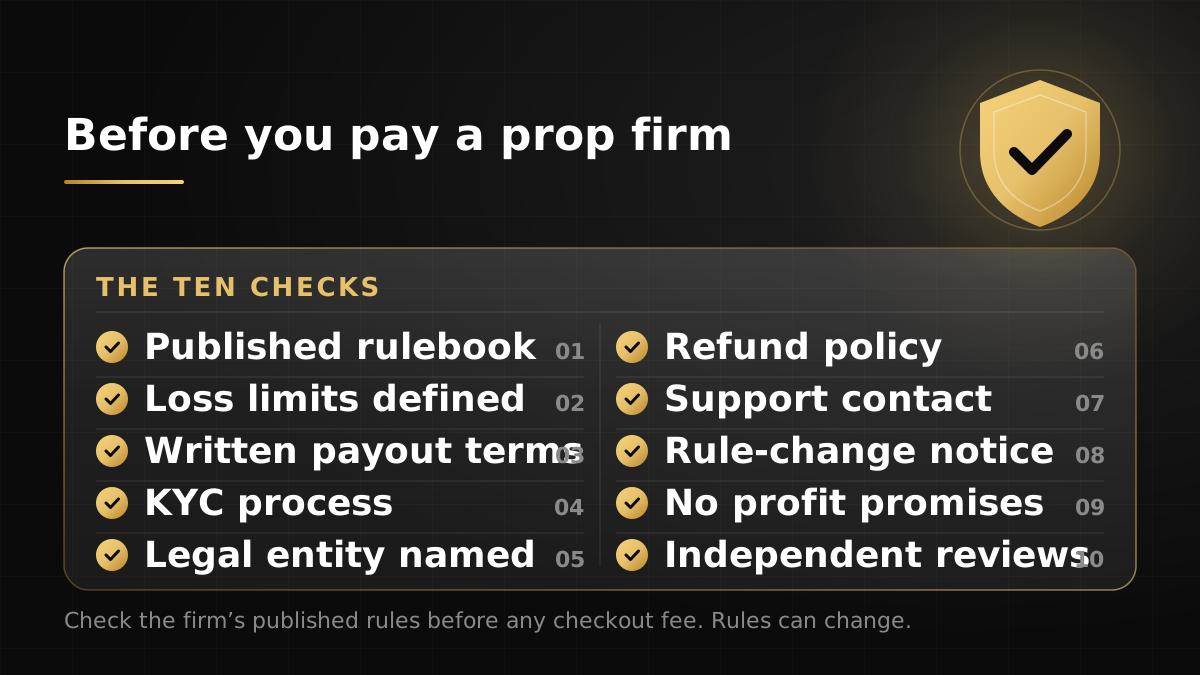
The ten checks
- Published rulebook
- Loss limits defined
- Written payout terms
- KYC process
- Legal entity named
- Refund policy
- Support contact
- Rule-change notice
- No profit promises
- Independent reviews
Swipe sideways to see every column.
| Check | Where to find it | What good looks like |
|---|---|---|
| 1. Published rulebook | A rules page or downloadable rulebook on the firm’s site | Complete, dated and easy to find without signing up |
| 2. Clear loss-limit definitions | The rulebook section on daily and maximum loss | States whether loss is measured on balance, equity or closed P/L, and the reset time |
| 3. Payout eligibility in writing | Payout section of the rules and terms | Lists the conditions, such as profit, KYC and no open breach, with the first-payout timing |
| 4. KYC process | Verification page, terms or onboarding steps | Explains which documents are needed, why, and what happens if a check fails |
| 5. Legal entity named in terms | The terms of service, usually at the foot of the site | A named company, with a registered address, that the contract is with |
| 6. Refund policy | Terms or checkout page | States clearly when fees are refundable, credited or not refunded |
| 7. Support contact | Contact page or help centre | A working channel, with replies you can keep as written evidence |
| 8. Rule-change notice | Terms or a dated changelog | Says how changes are announced and whether open accounts are affected |
| 9. No profit promises | Homepage, ads and sales pages | Sales copy talks about rules and process, and includes a risk warning |
| 10. Independent reviews | Third-party sites and forums, read critically | Specific, dated accounts of payouts and breaches, with disclosed affiliate links |
Passing every row does not make a firm safe, and failing one row does not make it a scam. The point is to find the gaps and decide whether they matter for the money you are about to spend.
How to read a prop firm rulebook
Most traders read the profit target and skip the rest, which is where trouble usually starts. Three parts deserve a slow read: precedence, breach definitions and payout eligibility.
Rule precedence
Firms often publish several documents: general rules, checkout terms, promotion terms and the terms of service. When they conflict, the rulebook should say which one wins. A common order is checkout terms first, then promotion terms, then general rules, with the terms of service as the framework. If your firm does not state this, ask before you buy.
Breach definitions
A breach is the event that closes or suspends an account. Read exactly what counts. Daily loss rules differ widely. Some firms measure loss on closed trades only, others include floating loss and swaps, and the reset time can be a server time, a broker time or UTC. The difference matters. Suppose a $10,000 account with a 4% daily loss limit of $400 starts the day at $10,000. The trader has a floating loss of $450 at one point, then closes the day with a profit of $50. If the rules measure floating loss, the account has breached, even though the day ended positive. If the rules measure only closed P/L, it has not. Two firms can describe the same limit and produce opposite results.
Payout eligibility
Payout rules are where many disputes begin. Look for the minimum profit needed, the minimum number of active trading days, the first payout date, the KYC status required, whether an open breach blocks a payout, and what happens to a request that is rejected. If eligibility is described only as “subject to review”, ask which review and how long it takes.
How to check Yo Pips with the same checklist
Applying the checklist to Yo Pips shows how the method works on a real firm. The facts below are taken from the Yo Pips rules published on the rules and regulations page and in the downloadable rulebook, both checked on 10 November 2026. The rule facts below are in both unless marked. Checkout and promotion terms take precedence over the general rules, and rules can change, so re-check them before you buy.
- Published rulebook (check 1). The rules are on the rules page and in a downloadable PDF.
- Loss-limit definitions (check 2). The published rules state that the daily loss includes closed P/L, floating P/L, commissions and swaps for the current day, that maximum loss is measured on equity, and that UTC is used for the daily reset.
- Payout eligibility (check 3). Payouts are requested in the dashboard, need the account in profit with no unresolved breach and approved KYC, and approved payouts are typically processed within 1 to 3 business days. The rulebook PDF says the first payout on a Pay Later account requires 14 calendar days after funded activation and at least 5 active trading days.
- KYC process (check 4). The rules say KYC may include a government ID, a selfie or liveness check, proof of address, payment verification and tax information. Eligibility is limited to people aged 18 or over, outside restricted or sanctioned jurisdictions.
- Legal entity (check 5). The site footer and the contact page name YO PIPS as a company registered in Saint Lucia (Reg No. 2024-00752), with a registered address in Rodney Bay, Gros-Islet. The terms page sets out the agreement that governs your account. Confirm in writing which company you contract with before you pay, and keep the reply with your records.
- Refund policy (check 6). Under the published rules, refunds or fee credits apply only where a plan advertises them, and breached accounts are not eligible for payout or refund unless a published promotion says otherwise.
- Support contact (check 7). Send any rule question through the contact page before you pay, and keep the replies you receive.
- Rule-change notice (check 8). Re-check the rules and terms before each purchase, because the published rules say they can change.
- No profit promises (check 9). Read the programme pages and the how it works page against the rulebook. The published rules describe conditions and limits, not guaranteed returns.
- Independent reviews (check 10). Look for third-party accounts and read them critically, the same way you would for any firm.
Two points deserve extra attention. First, the programmes run on simulated accounts, and a passed evaluation cannot be sold or transferred. Second, a 30-day inactivity rule can lead to archiving, suspension or closure, so an account that sits unused is not a safe place to leave a fee. If you want to test the platform before paying, the free trial runs on a simulated account with no payment details. Compare the programmes on the pricing page and the challenge guide before you decide.
Frequently asked questions
01Are prop firms legit?
02Is a prop firm a scam?
03Why do prop firms charge evaluation fees?
04How do I check a prop firm before I pay?
05Does a reputable prop firm guarantee a payout?
06Is Yo Pips legit?
Risk disclosure: Trading leveraged products such as forex and CFDs carries a high level of risk, and most traders lose money. Prop firm challenges are evaluations on simulated accounts; passing one does not guarantee account activation, profits or a payout. Nothing on this page is investment advice. Always read the current rules and terms before you buy or start a challenge.