Is day trading gambling? The honest answer is that it depends on how it is done. Buying and selling within one session is an activity that can be run as a tested process with defined risk, or as a series of bets placed on hunches and sustained by hope. The activity itself does not decide which one it is. The way a trader sizes positions, handles losses and reviews results does. This guide sets out what separates a process from a bet, which controls change the answer, and what to do if you recognise your own habits in the warning signs.
What the question really asks
People who ask whether day trading is gambling are usually asking one of three things. Is the outcome mostly luck? Am I taking more risk than I can afford? Or am I behaving the way a gambler does? All three are fair questions, and none of them has a yes-or-no answer that applies to every trader. A surgeon and a casino player both face uncertainty, but we would not call surgery gambling, because the surgeon works from training, a process and feedback. The same test applies to trading.
It helps to separate the market from the trader. Prices move for reasons no one controls, so every trade carries uncertainty. That uncertainty is not what makes a trader a gambler. What matters is whether the trader has an edge they can describe, a plan for when they are wrong, and a way of measuring whether the approach works over many trades rather than over one good or bad afternoon.
What gambling means in plain terms
Gambling, in the ordinary sense, means staking money on an outcome where chance decides the result and the player has no real influence over the odds. A roulette wheel has no memory and no strategy you can apply to it. Each spin is independent of the last, and the house edge is built into the game. The player can choose the bet, but not the probability.
Markets are different in one important way: the trader can influence the result of each trade through choices that happen before and after the entry. They choose which setups to take, how much to risk, where to place a stop-loss, and when to exit. Those choices do not remove uncertainty, and they do not guarantee a profit. But they do mean the trader is working on the odds rather than simply accepting them. That is the line between a process and a bet.
Gambling behaviour can still appear in a trading account. If the choices above are made on impulse, the activity starts to resemble a bet even though the instrument is a market. The question to ask is not what you are trading, but how each decision is made.
Process versus chance: how to tell them apart
The table below sets out the difference in behaviour. Each row is something you can check in your own records. If most of the right-hand column describes you, the process is working. If most of the left-hand column does, the activity is closer to a bet, whatever the market.
| Question | Chance-based (bet-like) | Process-based |
|---|---|---|
| Why enter? | A feeling, a hunch or a news headline with no defined condition | A written setup with conditions that were checked before the trade |
| How big? | Varies with confidence or with the last result | Fixed risk per trade, set before the entry |
| Stop-loss | Moved further away, or not used | Set before the entry and not widened once the trade is open |
| After a loss | Trades again at once to win the money back | Reviews the trade, then waits for the next valid setup |
| Records | None, or only the wins remembered | A journal of every trade, with reasons and results |
| When to stop | When the money is gone or the mood changes | At a daily loss limit, or when the plan says so |
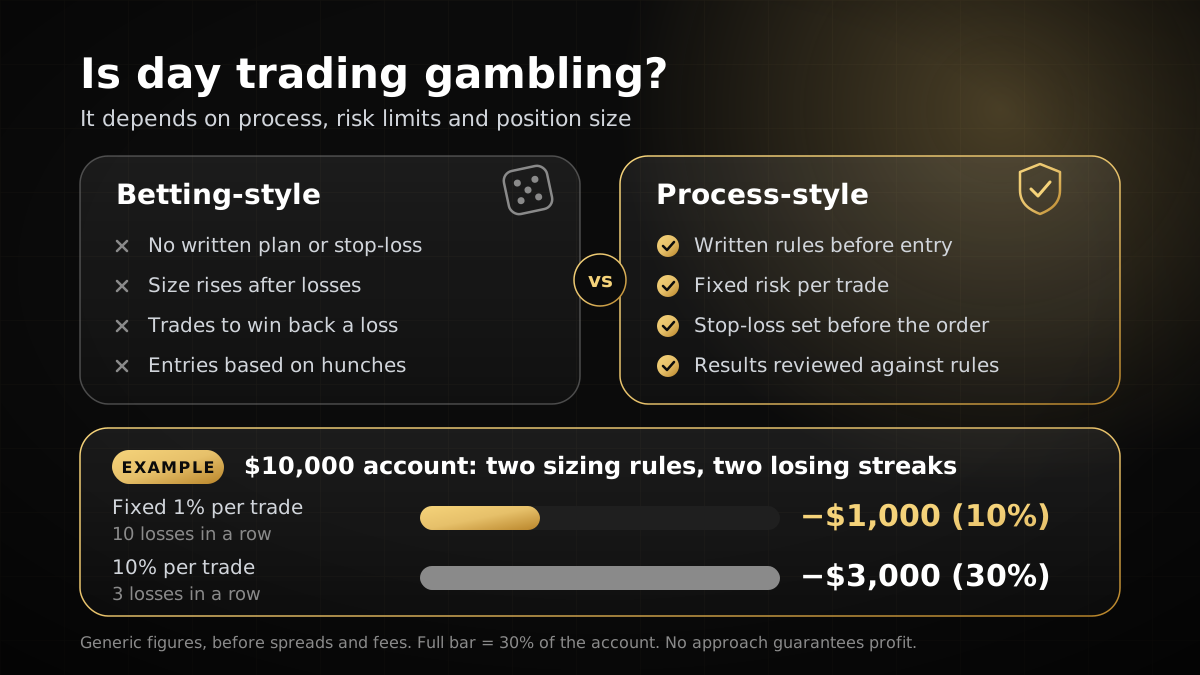
The most useful test is simple: can you explain each trade in advance, in one sentence, and can you show the result against that sentence afterwards? If not, the trade was not a process decision, however careful it felt at the time.
The controls that change the answer
Several controls turn a chance-based activity into a process. None of them guarantees profit, but each one limits how much damage a bad decision can do.
- Fixed risk per trade. Decide the largest loss you will accept on one trade, as a percentage of the account, before you look at the chart. Many traders use a small percentage, but the number matters less than the fact that it is fixed.
- A stop-loss set before entry. A stop tells you where the idea is wrong. Moving it further away after the trade is open turns a planned loss into an open-ended one.
- A daily loss limit. Set a loss figure for the day and stop trading when you reach it. This removes the urge to chase a bad session, which is one of the most common routes from trading into betting.
- A written setup. Write down the conditions for a valid trade. If a trade does not meet them, it does not happen. Vague setups such as “it looks strong” leave room for impulse.
- A trade journal. Record entry, stop, size, reason, result and what you felt. A journal is the only way to see whether your results come from the process or from luck.
- A review rhythm. Look at the journal weekly, not after every trade. Patterns show up over dozens of trades, and a single result rarely tells you anything about the method.
Position sizing deserves its own look, because it is where most gambling-style behaviour shows up in numbers. Our position size calculator guide explains how to turn a risk percentage into a lot size before you enter.
Worked example: the same account, two ways
Take a hypothetical $10,000 account trading a pair where one standard lot moves about $10 for each pip of price movement. The trader wants to enter a trade with a stop-loss 20 pips from the entry. The arithmetic below is for illustration only and is not a prediction of any result.
Process approach. The trader risks 0.5% per trade. That is $10,000 × 0.5% = $50. The loss at the stop is 20 pips, so the lot size is $50 ÷ (20 pips × $10 per pip per lot) = $50 ÷ $200 = 0.25 lots. Check: 0.25 lots × $10 × 20 pips = $50. If the stop is hit, the loss is $50, which is 0.5% of the account.
Bet-like approach. The same trader feels confident and trades 5 standard lots with the same 20-pip stop. The loss at the stop is 5 × $10 × 20 pips = $1,000, which is 10% of the account on one trade. A single loss of that size can take a trader into a deep hole, and it often triggers the urge to trade again at a larger size to recover.
Adding a daily limit. Now suppose the trader sets a daily loss limit of 2% of the account, which is $200. At $50 per losing trade, four losses reach the limit exactly. Once the limit is reached, the trader stops for the day. The fifth trade does not happen, and that decision is made in advance, not in the heat of a losing run.
The two approaches use the same market and the same account. Only the rules differ, and the rules decide how much of the outcome is left to chance.
Where prop firm rules fit
Prop firm challenges often impose the kind of controls described above. Under the Yo Pips rules page, the 1-Step Pay Later programme has a 4% daily loss limit and an 8% maximum loss limit, and daily loss counts closed profit and loss, floating profit and loss, commissions and swaps for the current day. Checkout terms take precedence and rules can change, so confirm them before you rely on them. For scalping, news or weekend rules, check the current rules page.
Loss limits can help a trader build discipline, because a breach ends the attempt and so the cost of a bad session is visible. But a challenge is still a test you can fail, and it is designed to measure risk control as much as returns. Passing a challenge shows that a trader kept within a set of limits for a period. It does not show that a strategy will work in the next month, or that the trader would have the same discipline without the limits in place.
Read our prop firm challenge guide for the rule definitions in more detail. Whatever the account, the same principle applies: the limits are a risk framework, not a guarantee.
Warning signs that trading has become a bet
Gambling-style behaviour rarely starts as a plan to gamble. It usually grows out of small decisions that feel reasonable at the time. These are the signs to watch for.
- You increase size after a loss to win the money back.
- You move a stop-loss further away, or remove it, because you do not want to be stopped out.
- You trade to escape a bad mood, or to feel something other than boredom or fear.
- You keep trading after you have reached your own daily limit, or you have no limit at all.
- You remember the wins and forget the losses when you think about your results.
- You take trades you cannot explain in one sentence.
- You feel you must trade to pay a bill, cover a debt or recover a loss.
The last sign is the most serious. Trading money you cannot afford to lose is a risk on its own, whatever the method. If that is your situation, the process controls above are not enough, and it is worth stepping back.
What to do if you recognise yourself
If several of the warning signs describe your recent trading, the first step is to stop adding risk. Reduce size or step away from the screen for a while. Then write down your last 20 trades with entry, stop, size, reason and result. Look at the reasons. If many of them were about recovering a loss or escaping a feeling, the problem is behaviour, and changing the strategy alone will not fix it.
Set rules you can keep. A daily loss limit, a maximum number of trades per day and a fixed risk per trade are a simple start. Test any change on a simulated account before you return to live money. The free trial on Yo Pips runs on a simulated account with no payment details, which makes it a low-cost place to practise following your rules.
If trading is causing financial or emotional harm, speak to a qualified professional. Trading should not be the only source of money you rely on to meet essential costs.
Frequently asked questions
01Is day trading the same as gambling?
02Can a day trader make money consistently?
03What is the difference between a bet and a trade?
04Does a prop firm challenge make day trading less like gambling?
05What should I do first if I think my trading has become gambling?
06Is a free trial a good way to test a process?
Risk disclosure: Trading leveraged products such as forex and CFDs carries a high level of risk, and most traders lose money. Prop firm challenges are evaluations on simulated accounts; passing one does not guarantee account activation, profits or a payout. Nothing on this page is investment advice. Always read the current rules and terms before you buy or start a challenge.