Searching for an FTMO alternative usually means one of two things: a firm with a similar challenge model, or a firm whose rules suit the way you trade. This guide covers both. It starts with a neutral summary of FTMO’s own published model, then compares six other prop firms and Yo Pips in two tables. Figures come from each firm’s own pages, checked on 10 November 2026. Where a page does not state a term, the guide says not stated.
Nothing here ranks firms. Yo Pips is itself a prop firm and is the publisher of this comparison. Each one trades off fees, loss limits, news and weekend rules, and payout timing differently. The same percentage loss limit can also breach at different points depending on its basis.
FTMO’s model, from its own pages
FTMO publishes three routes on its own pages: a 1-Step Challenge, a 2-Step Challenge and an Instant Account. The figures below are as stated on those pages when we checked on 10 November 2026.
Swipe sideways to see every column.
| FTMO term | 1-Step Challenge | 2-Step Challenge | Instant Account |
|---|---|---|---|
| Listed fee (as shown) | €79 for a $10,000 account, one-time and non-refundable | €89 for a $10,000 account, shown as a one-time refundable fee | €169 for a $5,000 account, one-time and non-refundable |
| Profit target | 10% | 10% in phase 1, 5% in phase 2 | None shown in the Instant Account table |
| Daily loss | 3% of initial capital below the 00:00 CE(S)T balance, checked on equity | 5% of initial capital below the 00:00 CE(S)T balance, checked on equity | 3% of initial capital below the 00:00 CE(S)T balance, checked on equity |
| Maximum loss | 10%, end-of-day trailing from the highest balance; measured on equity | 10%, static on initial capital; measured on equity | 10%, intraday trailing, balance-based; measured on equity |
| Profit split | 90% of simulated profit | 80% by default; up to 90% under stated conditions | 90% of simulated profit |
| Minimum trading days | None shown on the 1-Step page; FTMO’s page for US residents says no minimum trading days | 4 trading days; the rule applies to both phases | Not stated |
Three points on FTMO’s pages need care. First, FTMO shows its fees in EUR against account sizes in USD, and the fee rises with the account size; the table gives the smallest size. Its separate page for US residents shows “starting from” €89 for the 1-Step and $99 for the 2-Step. Second, FTMO’s news FAQ lets Challenge and Verification accounts trade news freely, provided its forbidden trading practices are avoided. On other accounts, except Swing-type accounts, it restricts order execution from 2 minutes before to 2 minutes after selected releases, and its breach wording names the FTMO Account and the FTMO Instant Account. Third, refunds differ by route. FTMO’s FAQ says the 1-Step and Instant Account entry fees are not refundable, and the 2-Step fee is refunded with the first Reward withdrawal. FTMO’s page for US residents, which covers a US-only service, says you can use discretionary trading, algorithmic trading or EAs, provided the trading is legitimate and replicable. We found no EA rule on the main FTMO pages checked on 10 November 2026 and no copy-trading rule on any FTMO page checked; its Forbidden Trading Practices page was not read.
Six alternatives and Yo Pips, side by side
Each firm row uses one programme, the closest match to a 1-Step or 2-Step challenge; the Yo Pips row covers its 1-Step, 2-Step and Instant programmes. Futures-only and prediction-market products are out of scope. FundingPips is left out because its site returned HTTP 429 to our requests on 10 November 2026, and E8 Markets because its terms were not captured for this guide.
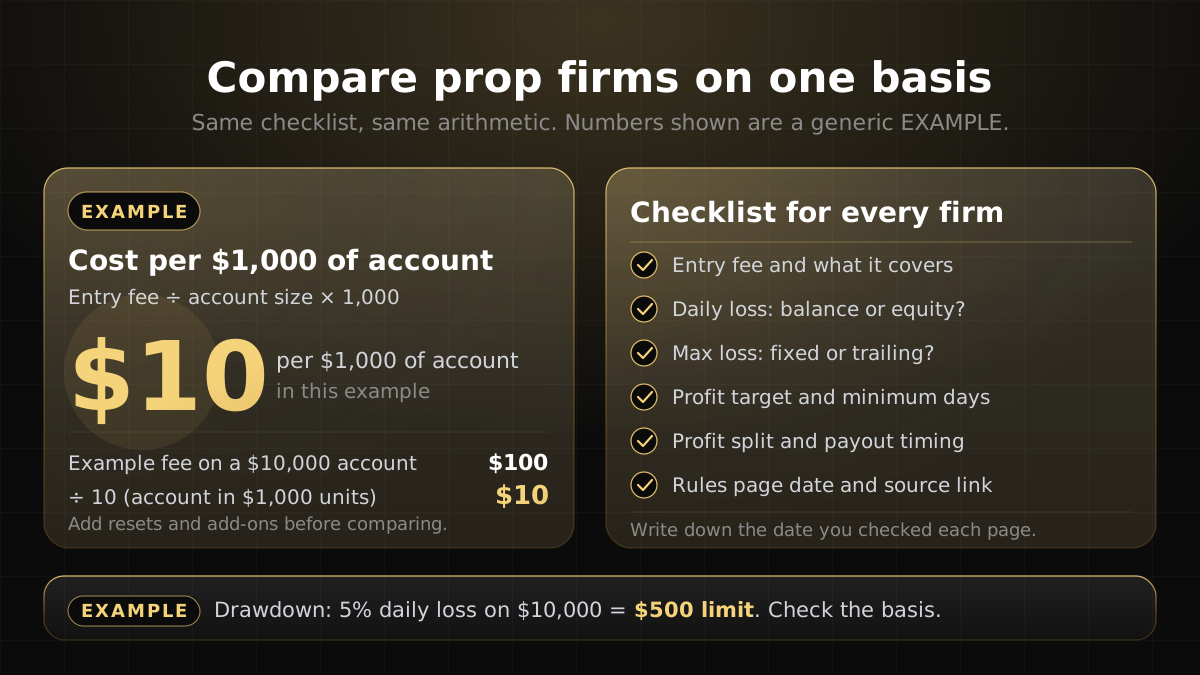
Fees are listed prices on each firm’s page. They belong to different account sizes and sometimes different currencies, so a higher or lower fee in this table does not show which firm suits you. Where a fee is not on a page, the cell says not stated.
Swipe sideways to see every column.
| Firm and programme | Listed entry fee | Profit split | First payout timing |
|---|---|---|---|
| FundedNext: Stellar 2-Step (2-step; from $6,000) | $59.99 for $6,000, listed as approximate (help article dated 2 October 2026) | 80% standard; 60% or 90% options | 21 days from activation on the standard cycle; other payout options are chosen at checkout |
| The5ers: High Stakes 2 Step (2-step; from $2,500) | $19 for Step 1 on the New plan; $22 on the Classic plan | Pro Trader stage: 80% to 100% (page range) | First payout 14 days after you receive a funded account, then every 2 weeks; payout requests need at least $150 in profit, and the same list mentions 3 consecutive profitable days (High Stakes page) |
| Goat Funded Trader: 1-Step (1-step; from $5,000) | $57 list price for 5K, struck through; $34 shown beside it | 80% standard; 100% add-on at checkout. A first Reward on Demand, itself an add-on, is paid at a 40% split whatever add-ons are bought | Every 14 days after first trade; processed within 2 business days |
| Alpha Capital Group: Alpha Pro 8% (2-step; from $5,000) | $37.00 for $5,000 in the checkout’s default selection; the price changes with the payout type and add-ons | 80%; 90% add-on on On-Demand Pro only | Bi-weekly: first request after 5 trading days and a $100 minimum; on-demand needs 2% profit |
| Blue Guardian: 2 Step Standard (2-step; from $5,000) | $32 list price for 5K, struck through; $24 shown beside it | 85%; 90% add-on | Every 14 days by default; 7-day add-on; processed within 24 business hours |
| Maven Trading: Standard 1-Step (1-step; from $2,000) | $15 list price for a $2,000 account; the 1-Step page shows a lower price with a coupon beside it | 80%; 90% with add-on | 10 business days after your first trade on the funded account (FAQ) |
| Yo Pips: 1-Step, 2-Step and Instant | A starter fee at checkout on Pay Later (both sources); a one-time fee on Instant (rulebook PDF only). Amounts are on the pricing page, not here | 1-Step and 2-Step 80% (smaller sizes) or 85% (50K and 100K); Instant 70% to 85% by size | Pay Later: 14 calendar days after funded activation and 5 active trading days (rulebook PDF; the rules page shows no first-payout timing for Pay Later). Instant: at least 14 calendar days, 5 active trading days and 5% net profit (both sources) |
Profit targets and loss limits for the same programmes are in the next table.
Swipe sideways to see every column.
| Firm and programme | Profit target | Daily loss | Maximum loss |
|---|---|---|---|
| FundedNext: Stellar 2-Step (2-step; from $6,000) | 8% in phase 1, 5% in phase 2 | 5% of initial balance, fixed; the blog says it does not trail | 10% of initial balance; balance or equity must not fall below 90%, a floor the blog says stays fixed for the whole phase |
| The5ers: High Stakes 2 Step (2-step; from $2,500) | New plan: 10% in Step 1, 5% in Step 2. Classic plan: 8%, then 5% | 5% on accounts up to $25,000; the page’s plan data shows 4% on the $50,000 and $100,000 sizes. Taken from the higher of the day’s starting equity or balance at MT5 server time (High Stakes page); reaching it terminates the account (explainer) | 10% of the initial balance (explainer) |
| Goat Funded Trader: 1-Step (1-step; from $5,000) | 10% | 3% of the higher of balance or equity, measured at 5 PM EST; 2% if chosen at checkout | 6%, static |
| Alpha Capital Group: Alpha Pro 8% (2-step; from $5,000) | 8% in phase 1, 5% in phase 2 | 4%, balance-based | 8%, static |
| Blue Guardian: 2 Step Standard (2-step; from $5,000) | 8% in phase 1, 4% in phase 2 | 4% of initial balance, set from the higher of balance or equity at the 5 PM EST reset | 8%, static, equity-based |
| Maven Trading: Standard 1-Step (1-step; from $2,000) | 8% | 3%, on the higher of balance or equity at 00:00 UTC | 5%, trailing from highest equity |
| Yo Pips: 1-Step, 2-Step and Instant | 1-Step 10%; 2-Step 8% in phase 1 and 5% in phase 2; Instant none | 1-Step 4%; 2-Step 5%; Instant 3% | 1-Step 8%; 2-Step 10%; Instant 6% |
The tables summarise one programme per competitor firm and all three Yo Pips programmes. News, weekend, EA, copy-trading and refund rules are in the notes below, and minimum trading days are in our prop firm rules comparison. Sources for each row are listed under the firm’s name at the end of this guide.
The rules that matter, firm by firm
The notes below cover what each firm states on news, weekend holding, expert advisors, copy trading and refunds. Where a firm’s own pages conflict, the conflict is named rather than resolved. Read the prop firm challenge guide for how these rules usually fit together.
FundedNext: Stellar 2-Step
The help article lists its news rule under the funded account: trades placed within 5 minutes before and after a high-impact news event on a correlated pair count for only 40% of profit, while losses remain fully the trader’s responsibility. A separate help article says weekend holding is allowed on challenge and funded accounts, with swap charges. Expert advisors are allowed on accounts below $50,000, with settings aligned to the account. Copy trading is allowed only between challenge accounts owned by the same trader. The help article says the challenge fee is returned as a Refundable Fee, which you may request with your first Performance Reward.
The5ers: High Stakes 2 Step
The High Stakes page offers a New and a Classic plan, which differ in fee and Step 1 target. It says trades placed 2 minutes before or after high-impact news events are not allowed. It says overnight and weekend positions are allowed, with a high swap on indices. The terms let you use your own automated trading software only with prior written approval, prohibit third-party software, and bar copy trading with other traders. The terms also bar bracket strategies with pending orders around news. The5ers’ explainer article says EAs are permitted across programmes, except systems that exploit price feeds or latency, so check which applies before you automate. The page says the first payout comes 14 days after you receive a funded account and every 2 weeks after that, and that traders can request payouts after reaching at least $150 in profit. The same list says both that payouts can be requested after 3 consecutive profitable days and that they can be requested regardless of 3 profitable days, so check which applies. One sentence in the explainer gives High Stakes a 3% daily loss, against 5% in its own table and on the High Stakes page. The terms allow a full refund within 5 days of purchase if no trading has taken place and no terms were breached. After 5 days, refunds are Hub Credit only. The fee is non-refundable once evaluation trading has started.
Goat Funded Trader: 1-Step
Profit on a trade opened or closed within 5 minutes of a high-impact release is capped at 3% of the initial balance for accounts bought on or after 10 November 2026, and at 1% for earlier accounts. Opening trades solely to exploit the Monday gap is not allowed. Third-party EAs, high-frequency EAs and trade copier EAs are not allowed, while self-developed EAs are. From 6 October 2026, VPNs, VPSs and other hosting services are not allowed during trading. From 12 October 2026, copy trading is allowed only through the GOAT Trade Copier between your own Goat Funded Trader accounts, and copying from an external account is not allowed, even if it is your own. The refund position conflicts: the homepage calls the one-time fee 100% refundable, but the refund policy says there are no refunds on any service. This guide reports the policy wording.
Alpha Capital Group: Alpha Pro 8%
The product page says news trading is unrestricted during evaluation, and that on the Qualified Account no trades on listed instruments may be opened or closed 5 minutes before or after listed news events. Help article 8420429 describes the 5-minute window and does not say whether it applies only to the Qualified Account. Weekend holding is allowed in evaluation and not allowed on the Qualified Account under the terms. The product page shows an EA Use heading with no text. The terms disable EAs on swap-free accounts, and the EA help article was not read. Copy trading is allowed only from your own external account. The terms say refunds are issued only as the terms set out. They give consumers a 14-day cooling-off right from opening the account (clause 16.1), which is waived when you access the account to place your first virtual trade (clause 16.2). The return policy page was not read.
Blue Guardian: 2 Step Standard
News trading is allowed on challenge accounts. On funded accounts, opening or closing trades 5 minutes before and after red-folder and FOMC news is restricted, and profit from such trades may be removed. Weekend and overnight holding are allowed. Expert advisors are allowed for your own strategies, and copying another trader’s account is not allowed. On funded accounts, Guardian Shield, a funded-only feature, in most cases closes all open trades at a 2% floating loss, and a first breach cuts the split to 50%. A second breach permanently breaches the account. The help article requires 3 trading days for accounts bought on or after 20 August. Refund terms are not stated on the pages fetched.
Maven Trading: Standard 1-Step
Opening or closing trades on affected instruments is restricted from 2 minutes before to 2 minutes after applicable Red Folder releases. Weekend holding is permitted. Expert advisors are prohibited, and copying is limited to your own trades, placed manually. The pricing page says the initial challenge fee is refundable on the third withdrawal. The challenge page gives the maximum loss as a trailing drawdown from the highest equity.
Yo Pips: 1-Step, 2-Step and Instant
Yo Pips is included as one more option: it sells evaluation programmes and an Instant Funding account with no evaluation. Its rules page and rulebook PDF agree on the loss limits in the table and on how they are counted: floating losses, commissions and swaps count toward the daily limit, and a breach closes the account.
The 2-Step profit targets are 8% in phase 1 and 5% in phase 2, and the 1-Step minimum is 4 trading days. News trading is not allowed, weekend holding is not allowed unless an instrument or plan rule says otherwise, and copy trading is allowed only between accounts owned and verified by the same trader. Our prop firm rules comparison sets out the Yo Pips rules in full. Checkout terms take precedence, and rules can change. Prices are not listed here.
Worked example: a daily loss limit in dollars
Take FundedNext’s Stellar 2-Step as a hypothetical $6,000 account. The listed daily loss is 5% of initial balance, and the maximum loss is 10% of initial balance, with a floor at 90%. The arithmetic is:
- Daily loss limit: 5% × $6,000 = $300.
- Maximum loss floor: 90% × $6,000 = $5,400, so balance or equity must stay at or above $5,400.
Now run a single day. You close a trade for a loss of $180 and still hold another trade with a floating loss of $140. The total loss for the day is $180 + $140 = $320. That is above the $300 limit, so the question is whether the firm counts open losses. FundedNext’s Stellar 2-Step blog says it does: the daily figure is the day’s closed results plus the running profit or loss on open positions. On that reading, this day breaches the limit.
The same arithmetic works for any firm in the table. The figures use listed percentages only, so they exclude fees, add-ons and swaps.
Criteria for comparing any FTMO alternative
Use this table with any firm, including ones not listed here. Each row is a term that changes how a trade, a breach or a payout is counted.
Swipe sideways to see every column.
| Criterion | What to check on the firm’s page | Why it changes the result |
|---|---|---|
| Model | Number of phases, profit targets and whether the funded stage has a target | More phases mean more rules to keep to over a longer period |
| Entry fee | One-time, pay-later or per-reset; what it covers; refund conditions | Fees are for different account sizes, and refunds often depend on payouts |
| Daily loss basis and reset time | Balance or equity; reset at 00:00 CE(S)T, 5 PM EST or UTC; whether open losses count | The same percentage can breach at different points |
| Maximum loss basis | Static or trailing; balance or equity; whether it locks at the starting balance | A trailing floor rises with profit, which leaves less room |
| Minimum trading days | The number of days and what counts as a trading day, such as a 0.5% profit threshold | Minimum days can take longer than the profit target |
| News rules | Window length, phase, funded-account restrictions and whether profit is removed | Trade timing near releases can decide whether profit counts |
| Weekend and overnight holding | Whether it is allowed, swap costs and any funded-stage restriction | It affects how you can manage a position |
| EAs and copy trading | Third-party EAs, own-account copying and trade copiers | Breaking a rule can remove profit or close the account |
| Profit split and add-ons | Base split, add-on splits and any payout caps | The share you keep often depends on the add-ons you buy |
| First payout timing | Waiting period, verification, minimum amount and processing time | The time to cash differs even when the split is the same |
How to choose
There is no single right alternative. Choose by how you trade, and use the table as a shortlist rather than a verdict.
- Start from your worst normal day. Work out the loss you could absorb in one session, then check whether the firm’s daily limit is balance or equity based.
- Match the phases to your pace. A 1-step has one target. A 2-step adds a second phase and more days to keep to. Compare the minimum days with how often you actually trade.
- Check news, weekend and EA rules against your strategy before you pay, not after a trade has been removed or an account closed.
- Compare the split and the first payout for your size, not only the headline split, because add-ons and waiting periods change what you keep and when you receive it.
- Keep a note of the rules you read and the date. Rules change, so a comparison that is six months old may no longer describe the firm.
If Yo Pips is on your shortlist, test it against the same criteria. See the official rules on the rules and regulations page or in the rulebook PDF for its loss limits and split, and the pass first, pay later page explains how the starter fee and the remaining fee work. The pricing page shows current amounts. For the broader model, read what a prop firm is.
Sources
The figures on this page come from the pages listed below. Each one was checked on 10 November 2026, including the two Yo Pips rule sources. FTMO’s, Alpha Capital’s, Blue Guardian’s and Goat Funded Trader’s price selectors and The5ers’ plan tabs were read in a browser on the same day. Where a page did not state a term, this guide says not stated. Discount codes and promotions shown on these pages are not applied.
FTMO
- https://ftmo.com/en/1-step-challenge/: checked 10 November 2026
- https://ftmo.com/en/2-step-challenge/: checked 10 November 2026
- https://ftmo.com/en/instant-account/: checked 10 November 2026
- https://ftmo.com/en/trading-objectives/: checked 10 November 2026
- https://ftmo.com/lp/ftmo-challenge-1-step-vs-2-step/us/: checked 10 November 2026
- https://ftmo.com/en/faq/is-the-entry-fee-refunded/: checked 10 November 2026
- https://ftmo.com/en/faq/can-i-trade-news/: checked 10 November 2026
- https://ftmo.com/en/faq/how-do-i-withdraw-my-profits/: checked 10 November 2026
FundedNext
- https://help.fundednext.com/en/articles/17255124-stellar-2-step-challenge: checked 10 November 2026
- https://fundednext.com/blog/fundednext-cfds-stellar-2-step-explained: checked 10 November 2026
- https://fundednext.com/blog/fundednext-cfds-stellar-1-step-explained: checked 10 November 2026
- https://help.fundednext.com/en/articles/11982358-does-fundednext-allow-holding-trades-over-the-night-weekend: checked 10 November 2026
- https://help.fundednext.com/en/articles/8020351-what-are-the-restricted-prohibited-trading-strategies: checked 10 November 2026
The5ers
- https://the5ers.com/high-stakes/: checked 10 November 2026
- https://the5ers.com/terms-and-conditions/: checked 10 November 2026
- https://the5ers.com/challenge-programs-bootcamp-high-stakes-hyper-growth-explained/: checked 10 November 2026
Goat Funded Trader
- https://help.goatfundedtrader.com/rewards.html: checked 10 November 2026
- https://help.goatfundedtrader.com/1-step.html: checked 10 November 2026
- https://help.goatfundedtrader.com/compare-models.html: checked 10 November 2026
- https://help.goatfundedtrader.com/trading-rules.html: checked 10 November 2026
- https://goatfundedtrader.com/legal/refund-policy: checked 10 November 2026
- https://goatfundedtrader.com/: checked 10 November 2026
Alpha Capital Group
- https://alphacapitalgroup.uk/product/alpha-pro: checked 10 November 2026
- https://help.alphacapitalgroup.uk/en/articles/8420429-alpha-pro-8-10: checked 10 November 2026
- https://alphacapitalgroup.uk/terms-and-conditions: checked 10 November 2026
Blue Guardian
- https://help.blueguardian.com/en/articles/14062291-2-step-standard-rules: checked 10 November 2026
- https://blueguardian.com/forex: checked 10 November 2026
Maven Trading
- https://maventrading.com/challenges/1-step: checked 10 November 2026
- https://maventrading.com/pricing: checked 10 November 2026
- https://maventrading.com/faqs: checked 10 November 2026
Yo Pips
- https://www.yopips.com/rules-and-regulations: checked 10 November 2026
- https://www.yopips.com/Rules.pdf: checked 10 November 2026
- https://www.yopips.com/pricing: linked for current prices; no figure is taken from it
Frequently asked questions
01Is FTMO the only firm with this kind of model?
02Does this page rank the firms?
03Are the listed fees the amount I will pay?
04Do these firms allow expert advisors?
05Where can I check the Yo Pips loss limits?
06How should I use this page?
Risk disclosure: Trading leveraged products such as forex and CFDs carries a high level of risk, and most traders lose money. Prop firm challenges are evaluations on simulated accounts; passing one does not guarantee account activation, profits or a payout. Nothing on this page is investment advice. Always read the current rules and terms before you buy or start a challenge.