This prop firm comparison looks at Yo Pips and The5ers side by side. Both use simulated evaluations, loss limits and profit splits, and the details decide whether a challenge suits the way you trade. This guide lists what each firm publishes, works through one hypothetical account and marks what is not stated. It does not rank the firms. Yo Pips is itself a prop firm and is the publisher of this comparison.
How to compare two prop firms on published terms
A fair prop firm comparison asks the same questions of each firm. What is the profit target, and does it count closed profit only? How is the daily loss limit calculated, and does it include open trades? How is the maximum loss measured? How many trading days are required? How is the profit split set? What do the rules say about news, weekend holds, automated trading and scalping?
Where a firm’s page does not answer one of these questions, this guide writes not stated rather than assume. Read the full rules before you buy. New to challenge structures? Start with our challenge models guide.
Prop firm comparison: Yo Pips terms from its published rules
The Yo Pips figures below come from the Yo Pips rules page and rulebook. Checkout and promotion terms take precedence, and rules can change, so confirm them on the rules and regulations page before you buy.
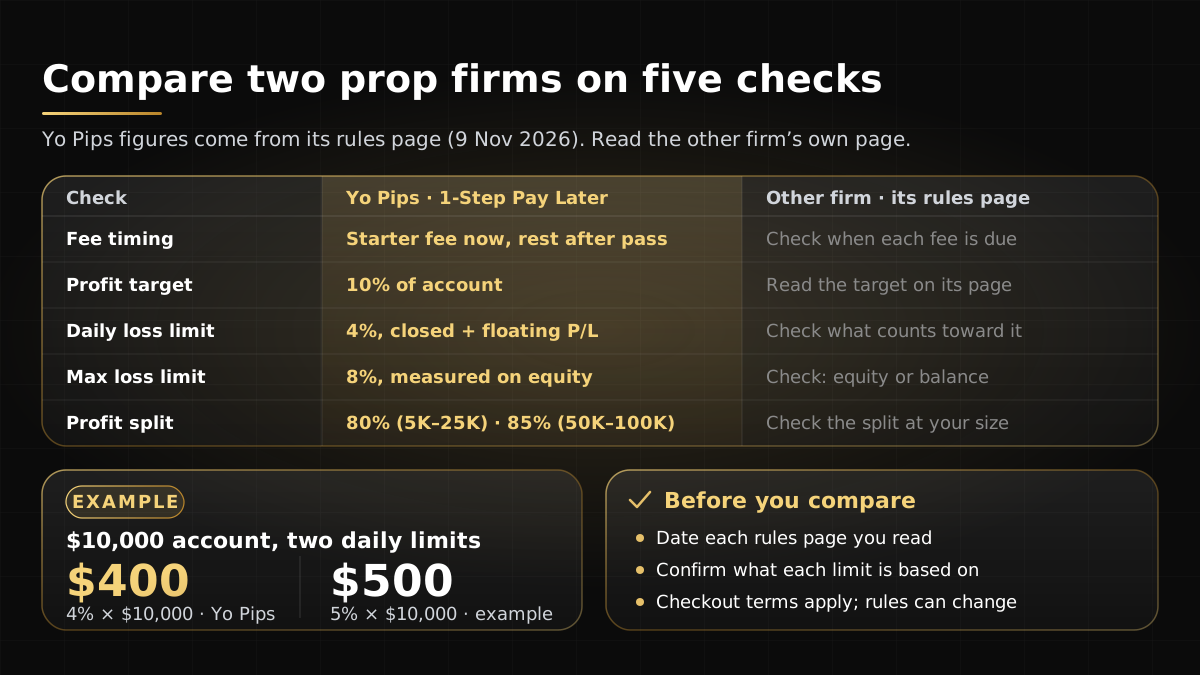
- 1-Step Pay Later: account sizes from 5K to 100K, a 10% profit target, a 4% daily loss limit and an 8% maximum loss limit. Time is unlimited. The profit split is 80% on the 5K to 25K sizes and 85% on the 50K to 100K sizes.
- 2-Step Pay Later: account sizes from 2K to 100K, two phases, with targets of 8% and 5%, a 5% daily loss limit and a 10% maximum loss limit. The minimum is 5 trading days and time is unlimited. The split is 80% on 2K to 25K and 85% on 50K to 100K.
- Instant Funding: no evaluation and no profit target, a 3% daily loss limit and a 6% maximum loss limit, with a one-time fee at checkout according to the rulebook PDF. The split runs from 70% on the 2K size up to 85% on the 50K to 100K sizes. The 5K size is 75%.
The starter fee on Pay Later programmes is paid at checkout. The remaining programme fee is paid after you pass, within 7 calendar days of pass confirmation. Daily loss counts closed and floating profit and loss, commissions and swaps for the current day, and the daily reset runs at UTC. The maximum loss is measured on equity, and a breach closes the account immediately.
The5ers terms from its own published page
The5ers terms below come from its page titled Challenge Programs, shown on the site as updated 25 June 2026. We checked it on 9 November 2026.
- Hyper Growth (one step): a 10% profit target against a 6% stop-out level, with a 6% maximum loss from the initial balance. The page describes a 3% daily pause, with the account suspended for the day. There is no minimum day requirement, and the profit split starts at 50%.
- Pro Growth (one step): a 10% profit target against a 6% stop-out level and a 6% maximum loss from the initial balance. The page treats a 3% daily loss as a termination event, with no next-day recovery. It requires three minimum profitable days, which the page defines as sessions where closed positions generate at least 0.5% of the initial balance. The split starts at 75%.
- Bootcamp (three steps): a 6% profit target in each of three steps, with a 5% maximum loss per step. The 3% daily pause applies only after the funded stage, not during evaluation. There is no minimum day requirement, and the split starts at 50%.
- High Stakes (two steps): a 10% target in Phase 1 according to the page’s body text, and 5% in Phase 2. The page’s comparison table gives 8% for Step 1 (see the note below). The programme has a 5% daily loss limit that ends the account immediately, and a 10% overall maximum loss of the initial balance. Three minimum profitable days apply in each step, although the page’s best-fit table describes High Stakes as having no minimum days in evaluation phase 1. The split starts at 80% on funding.
- Instant Funding: no evaluation and no profit target. The page states no daily rule and a 6% static maximum loss.
The5ers’ page conflicts with itself on High Stakes. Its body text gives a 10% Phase 1 target, but its comparison table gives 8% for Step 1. This guide uses the body text figure and does not resolve the conflict. Check the current page before you decide on High Stakes.
Side-by-side: the one-step programmes
The table compares the two one-step programmes most directly: Yo Pips 1-Step Pay Later against The5ers Hyper Growth and Pro Growth.
| Term | Yo Pips 1-Step Pay Later | The5ers Hyper Growth | The5ers Pro Growth |
|---|---|---|---|
| Profit target | 10% | 10% (stop-out level 6%) | 10% (stop-out level 6%) |
| Daily loss rule | 4% daily loss limit; a breach closes the account | 3% daily pause; suspended for the day, returns the following session | 3% daily loss is a termination event, no next-day recovery |
| Maximum loss | 8% maximum loss, measured on equity | 6% from initial balance | 6% from initial balance |
| Minimum trading days | 4 days | None stated | Three profitable days, each at least 0.5% of the initial balance |
| Starting profit split | 80% (5K to 25K); 85% (50K to 100K) | 50% | 75% |
| Time limit | Unlimited; 30 days without trading may lead to archiving, suspension or closure | Unlimited while the account stays active; closes after 30 days of inactivity | Unlimited while the account stays active; closes after 30 days of inactivity |
Hyper Growth and Pro Growth share a 10% target and 6% maximum loss, but their daily rules differ. Read the daily rule row first, because it decides what happens on a bad day.
How the loss limits are measured
Loss limits are where challenges are most often lost, so the measurement basis matters as much as the percentage. On Yo Pips, the daily loss counts closed and floating profit and loss, plus commissions and swaps, for the current UTC day. The maximum loss is measured on equity, and the rules page’s compliance list says trailing drawdown applies. The full definitions are on the Yo Pips rules page.
The5ers measures its maximum loss from the initial balance. The page checked here does not state whether the evaluation maximum loss is static or trailing, or how the daily pause is calculated for each programme.
Whatever the firm, size each trade against the daily limit, not the profit target. A position that fits the target can still use up the daily limit in one bad move. Our position size calculator guide shows how to turn a risk percentage into a lot size.
News, weekend holds, EAs and hedging
Trading rules decide whether a strategy can run on a given programme at all. The table below lists only what the two sources state.
| Rule | Yo Pips | The5ers |
|---|---|---|
| News trading | Not allowed | Bootcamp and Hyper Growth permit news trading, but not bracket strategies around high-impact events. High Stakes restricts orders within two minutes of high-impact news. |
| Weekend holds | Overnight holding is allowed. Weekend holding is not allowed unless an instrument specification or special plan rule says otherwise | Overnight and weekend holds are stated as permitted on all programmes. |
| EAs and indicators | Allowed unless they break a prohibited-practice rule | Permitted across programmes; systems that exploit price feeds or latency are prohibited, and tick-scalping or rollover-scalping EA systems are not permitted. The terms require prior written approval for your own automated software and prohibit third-party software |
| Latency and feed exploitation | Prohibited | Prohibited |
| Hedging | Not allowed | Permitted with a stop-loss on every position; the terms list hedge arbitrage trading as prohibited |
| Scalping | Allowed, except with a holding time of 2 minutes or less | No general scalping rule found. Tick-scalping and rollover-scalping EA systems are restricted under the EA rules. |
The Yo Pips cells come from its rules page. Our rules comparison sets out the Yo Pips rules in full. Check the current rules before you plan a strategy that depends on them. Our scalping guide explains the style, but not either firm’s permission for it.
Profit split and payouts
A profit split is the share of profit the trader keeps. The figures below are starting splits. The5ers says Bootcamp and Hyper Growth start at 50%, with higher splits at later scale-up milestones described on its programme page (see the sources below).
Payout timing differs as well. On Yo Pips, payouts are requested in the dashboard. The rulebook PDF says Pay Later accounts can request a first payout 14 calendar days after funded activation, after at least 5 active trading days. Approved payouts are typically processed within one to three business days. The5ers’ page says payouts are processed bi-weekly, with a minimum threshold of $150. Payout methods are not stated on the page checked here. Confirm Yo Pips payout frequency and methods on the rules page before you rely on a payout schedule.
Worked example: a $10,000 account on each firm’s numbers
Take a hypothetical $10,000 account and apply each firm’s published percentages. Nothing here is a prediction or a claim about how often either firm pays out.
The limits in dollars. On Yo Pips 1-Step, the daily limit is 4% of $10,000, which is $400. The maximum loss is 8%, or $800, so on this illustration equity must stay above $9,200 at the start. The rules page’s compliance list says trailing drawdown applies, so that floor can rise as the account grows. On The5ers Hyper Growth, the maximum loss is 6% of $10,000, or $600, so the floor is $9,400. Its 3% daily pause is triggered at $300, if the firm measures it the same way as Yo Pips. The page does not say how the threshold is measured, so treat that last step as an assumption.
One bad day. Suppose you close one trade at a loss of $250, you hold an open trade at a floating loss of $80, and commissions for the day come to $10. The day total is $250 + $80 + $10 = $340. On Yo Pips that is under the $400 daily limit, so the account is still open with $60 of room. On Hyper Growth the same $340 is above a $300 pause threshold. Under the page’s description, trading would be suspended for the day, and the trader returns in the next session.
The split on $1,000 of net profit. On Yo Pips 1-Step at the 5K to 25K sizes, an 80% split gives the trader $800 and leaves $200. On Hyper Growth, a 50% starting split gives the trader $500. On Pro Growth, a 75% starting split gives the trader $750. These are starting splits, so the figures show the first tier only.
What is not stated
Some facts are missing from the sources checked for this guide, so they are not compared. For The5ers, the programme page used here does not state fees, payout methods, a general scalping rule, or whether the evaluation maximum loss is static or trailing. This guide states no pass rates for either firm and no count of funded traders. Neither firm’s figures are a promise of a payout.
Sources and checking dates
- The5ers, “Challenge Programs” (Bootcamp, High Stakes, Hyper Growth and Instant Funding explained). https://the5ers.com/challenge-programs-bootcamp-high-stakes-hyper-growth-explained/ . Shown on the page as updated 25 June 2026. Checked 9 November 2026.
- The5ers terms and conditions. https://the5ers.com/terms-and-conditions/ . Checked 10 November 2026.
- Yo Pips rules and regulations page. https://www.yopips.com/rules-and-regulations . Figures as set out in the Yo Pips terms used for this guide.
- Yo Pips rulebook (PDF). https://www.yopips.com/Rules.pdf . Checked 10 November 2026.
Frequently asked questions
01Which firm should I choose, Yo Pips or The5ers?
02Does this comparison include The5ers fees?
03Are EAs allowed on both firms?
04Is a daily pause the same as a breach?
05Why should I check the dates on these terms?
Risk disclosure: Trading leveraged products such as forex and CFDs carries a high level of risk, and most traders lose money. Prop firm challenges are evaluations on simulated accounts; passing one does not guarantee account activation, profits or a payout. Nothing on this page is investment advice. Always read the current rules and terms before you buy or start a challenge.