Slippage in trading is one of the most common surprises for new traders. You press buy at a price you can see on the screen, and the fill comes back a little away from it. The gap is usually small, but it can grow in fast markets, around scheduled news, or when an order is larger than the liquidity at the best price. This guide explains what slippage is, why it happens, how order types change your exposure, and why it matters when a prop firm measures your losses.
What slippage in trading means
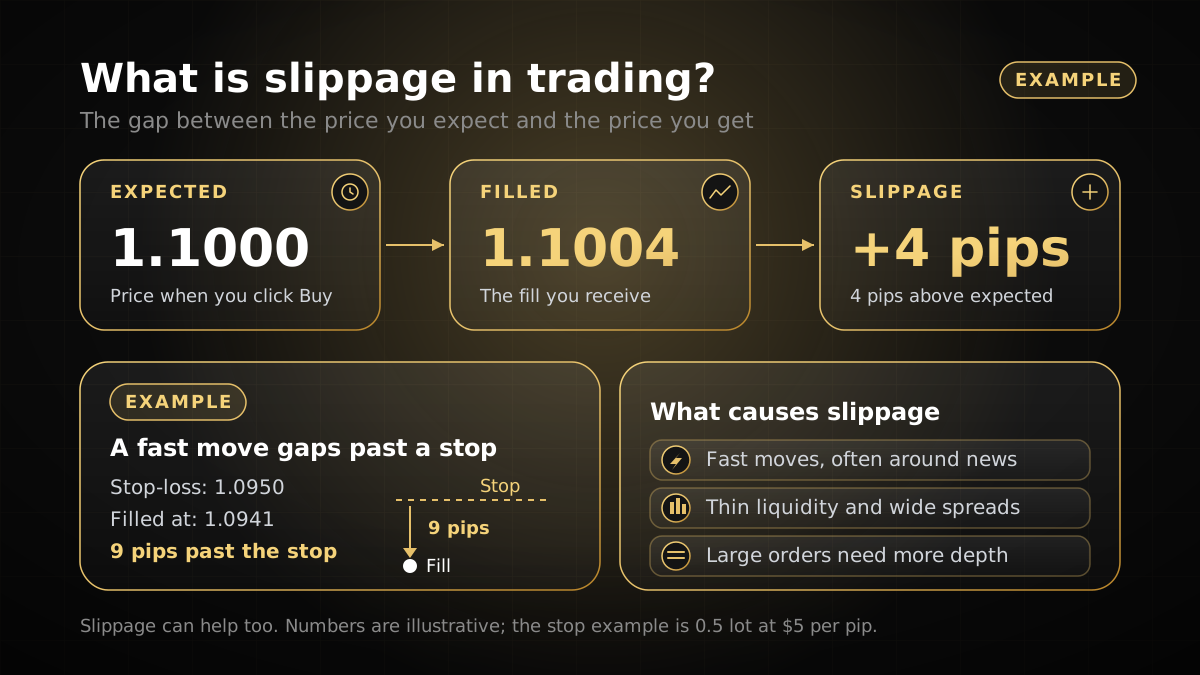
Every order has a reference price. For a market order, it is the price on your screen when you press the button: the ask for a buy and the bid for a sell. The fill is the price your broker or the venue actually executed at. Slippage is the difference between the two. It is measured in price, in pips or ticks, or in money once you multiply by position size.
Slippage can be positive. If you buy and the price drops before the order is matched, you get a better entry than you expected. Positive slippage is real, but it rarely prompts a review because it looks like a good outcome. Adverse slippage is the kind that hurts. You buy higher than your plan assumed, or sell lower, and the trade starts with a worse entry than the one you sized it for.
The term describes a gap, not a fault. A fill away from the quoted price does not always mean something went wrong. It usually means the market moved between the moment you sent the order and the moment it was matched. That is why the cause matters more than the label. For a broader view of how markets behave around the open and close, see our guide to forex trading.
Why slippage happens
Several conditions create slippage. They often overlap, and the worst fills tend to come when two or three of them are present together.
- Volatility. When prices move quickly, the quote can change between your click and the match. Scheduled news releases and sudden risk events are common triggers.
- Thin liquidity. Liquidity is the volume of resting orders available at each price. When there is little depth near the current price, an order can use up the best levels and fill at the next available ones.
- Order size. Even in a liquid market, a large order may not fit at one price. Part of it fills at the quoted price and the rest fills further away.
- Latency. There is a delay between sending an order and the venue processing it. The delay can come from your connection, your platform, the broker’s server or the venue itself, and the price can move during it.
- Gaps. Prices can jump from one level to the next with no trading in between. Gaps are common around market opens and weekend reopenings, when the first trade can be far from the last close.
- Dealing rules. Some brokers use dealing models where a quote can change or be offered again before a fill. How this works varies, so read the execution terms of the broker you use.
Scalping strategies depend on small moves and tight entries, so they feel slippage more than slower styles do. Our guide to scalping explains why fill quality matters so much for short holding periods.
How order types change your exposure
The order type decides how much slippage you can meet. A limit order sets the worst price you will accept, so it protects the fill price but may never execute. A market order fills now at the best available price, so it carries the most slippage risk. A stop order becomes a market order once its trigger price is hit, which means the fill can land beyond the stop.
| Order type | Price control | Slippage exposure | Main trade-off |
|---|---|---|---|
| Market order | None; fills at the best available price when executed | Highest in fast or thin markets | Fill is near certain, price is not |
| Limit order | Fills at the limit price or better | Little or none on price | Price is controlled, but the order may never fill |
| Stop-loss order | Triggers at the stop level, then fills at market | Can fill beyond the stop, especially in gaps | Exit is likely, but the exit price is not assured |
| Guaranteed stop, where offered | Exit at the stop level, subject to the broker’s terms | Designed to remove gap slippage on the stop | Usually costs more; terms vary by broker |
Check how your platform handles each order type before you rely on it. In MetaTrader 5, the MQL5 reference describes a deviation field on trade requests, which sets the maximum price change you will accept from the requested price. How a broker applies that field, or whether it rejects a fill outside it, depends on the broker, so test it on a demo account first.
Worked example: a market order and a stop in a gap
The numbers below are hypothetical and are not market data. They use EURUSD, where one pip is 0.0001 and a standard lot is 100,000 units. With USD as the quote currency, each pip on one standard lot is worth about $10, and each pip on a 0.5 lot is worth about $5. Spreads and commissions are left out to keep the arithmetic clear.
Example A: a market buy
You press buy when the quoted price is 1.1000, moments after a scheduled news release. The order fills at 1.1004 during a fast move. Slippage is 1.1004 minus 1.1000, which is 0.0004, or 4 pips. On one standard lot, the cost is 4 pips multiplied by $10, which is $40. Your entry is 4 pips worse than the price your plan assumed, and every pip of the stop distance is now measured from that worse entry.
Example B: a stop-loss in a gap
You buy 0.5 lots at 1.1000 with a stop-loss at 1.0950, which is 50 pips below entry. If the stop were hit exactly, the planned loss would be 50 pips multiplied by $5, which is $250. In a gap, the price jumps through the stop. The stop becomes a market order and fills at 1.0941. The actual loss is 1.1000 minus 1.0941, which is 0.0059, or 59 pips. At $5 per pip, that is $295. The extra $45 is the 9 pips of slippage beyond the stop, multiplied by $5.
Now add a prop firm account. Assume a $10,000 account on the 1-Step Pay Later programme, which has a 4% daily loss limit. If that limit works out to $400 on your account, the day can lose $400 before it is breached. The rules page does not set out the base for the limit, so check your dashboard to confirm the figure before you trade. Suppose the day already holds $120 of closed losses. With the planned stop-out, the day reaches $370, which is inside a $400 limit. With the slipped fill, the day reaches $415, which is over it. The same trade, the same stop and the same idea, but a different result because of the fill.
How to measure your own slippage
Slippage is tempting to ignore until you measure it. Many traders never check their fills against the price they saw, so they only find out about bad execution after it has cost them. A simple log fixes that.
- Record the reference price, the fill price and the time for every entry and exit. For stops, record the stop level as well as the exit fill.
- Calculate the difference in pips or ticks, and mark whether each fill was favourable or adverse.
- Group the results by session, by order type and by whether a scheduled release was within the hour. A pattern usually shows up quickly.
- Compare your average adverse slippage with your stop distance. If a typical gap uses a large share of the stop, your size or stop placement needs review.
Do not draw conclusions from a handful of fills. A short run can be unusual in either direction, so keep the log for long enough to see a pattern.
Be careful with any claim that a firm or broker has no slippage. Ask what the claim covers: fills at the quoted price in normal conditions, a guaranteed stop, or something else. Read the execution terms rather than a headline, and give more weight to your own log than to any promise.
Slippage and prop firm loss limits
Slippage matters more to a funded trader than the pip count suggests. Prop firm loss limits are set as a percentage of the account, and the way a firm counts losses decides how much of the buffer a bad fill uses. Under the Yo Pips rules page, the daily loss counts closed P/L, floating P/L, commissions and swaps for the current day, and the maximum loss is measured on equity. A stop that fills beyond your plan uses more of that buffer than you planned for, and it does so on the same day.
Checkout terms take precedence over the rules page, and rules can change, so confirm the current terms before you trade. Also check the current rules page for scalping, news and weekend rules before you trade around an event. Those permissions are set out there and are not repeated in this guide. A firm’s slippage policy is firm-specific, so read its terms for how it treats fills and stops rather than assuming a standard.
Position size is the main lever you control. A useful habit is to work out what a gap through your stop would cost, then check that figure against the remaining daily buffer before you enter. Our position size calculator guide shows how to turn a risk percentage into a lot size.
Ways to reduce the impact of slippage
You cannot remove slippage from market orders, but you can plan for it. These habits reduce the damage without relying on luck.
- Size to a realistic worst-case fill. Do not size to the planned stop alone. Include a gap through the stop in your calculation.
- Use limit orders where a missed trade is acceptable. You give up the certainty of a fill in exchange for control of the price.
- Be wary of market orders in thin conditions. The open, the close, weekend reopenings and the minutes around scheduled releases are common trouble spots.
- Check the calendar first. Our economic calendar lists scheduled releases, so known events can sit in your plan before the market moves.
- Decide in advance. Choose whether to reduce size or step aside around a known event before the release, not during the move.
- Treat a stop as a level, not a guarantee. It becomes a market order when hit, so the exit can be past the level you set.
Slippage is part of trading in live markets. The goal is not to eliminate it but to measure it, size for it and never let one bad fill decide whether your plan survives the day.
Frequently asked questions
01What is slippage in trading in simple terms?
02Can slippage be positive?
03Does a stop-loss always exit at the stop price?
04Why does slippage happen more around news?
05Does slippage affect prop firm evaluations?
06Can I avoid slippage completely?
Risk disclosure: Trading leveraged products such as forex and CFDs carries a high level of risk, and most traders lose money. Prop firm challenges are evaluations on simulated accounts; passing one does not guarantee account activation, profits or a payout. Nothing on this page is investment advice. Always read the current rules and terms before you buy or start a challenge.