FOMO in trading, short for fear of missing out, is the urge to enter a market because a move is already under way and you do not want to watch it run without you. The pull is strongest after a fast candle, a headline or a run of trades you did not take. Traders who give in usually chase price, add size or drop their plan. On a prop firm account, one chased trade can use up a daily loss limit in a single session. This guide defines the habit, names the common triggers, works through the arithmetic of a chased trade and gives a checklist to run before each entry.
What FOMO means in trading
In trading, FOMO describes a decision driven by the fear that someone else is already making a profit you will miss. It is not the same as a considered entry. A planned trade starts with a setup, then a stop, then a size. A FOMO trade starts with the price on the screen and works backwards to a reason.
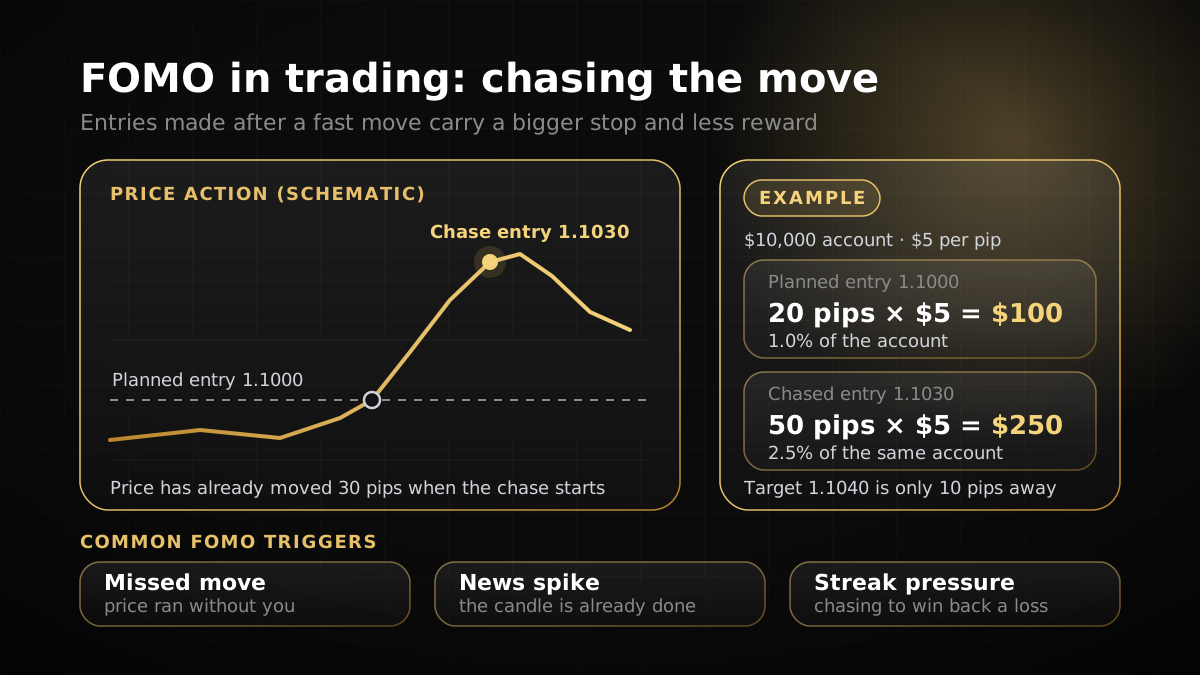
Price keeps moving whether you act or not, so the feeling that the chance is slipping away is strong. Often the move you fear missing has already used up part of its distance. The entry you take late tends to sit at a worse price, which puts your stop further away and your reward closer to the price you have already paid.
FOMO is not a character flaw. Most traders feel it, including experienced ones. The question is whether the feeling changes what you do. Understanding how it works gives you a way to notice it before you click, and that is where most of the control sits.
Three common FOMO triggers
Most chased trades start with one of three situations. They are worth naming in advance, because a trigger you can name is easier to pause on.
The missed move
You set an alert, watch the setup form and then step away for a few minutes. Price breaks out without you. The urge is to buy the breakout at whatever price you can get. By then the breakout is often extended, so your entry sits far from the level your plan named. The trade may still work, but it is no longer the trade you planned.
The news spike
A headline hits and candles jump. Spreads can widen, and fills can come at prices you did not expect. A trader who is not positioned feels they must join at once, and a trader who is positioned may add to a winner without re-checking the risk. Check the current Yo Pips rules page for news trading rules before you trade around an event, and decide your approach before the event rather than during it.
The streak pressure
After a losing trade, or after several setups you did not take, there is a strong wish to win back the ground quickly. That pressure pushes size up and moves stops, often wider than the plan allows. It is the most damaging trigger because it builds on itself. Each attempt to catch up adds risk, and each loss makes the next attempt feel more necessary.
| Trigger | What it looks like | Typical mistake | Counter |
|---|---|---|---|
| Missed move | Breakout happens while you are away from the screen | Buying far from the planned entry | Skip it, or wait for a retest that your plan already names |
| News spike | Fast candles and a widening spread after a headline | Entering with no stop, or with a size set for a calmer market | Decide the approach before the event, and check the rules page |
| Streak pressure | A wish to recover losses or missed setups quickly | Raising size or moving the stop to fit a result | Stop for the session after a set number of losses, and log the reason |
Worked example: a chased entry on a $10,000 account
Take a hypothetical $10,000 account on the 1-Step Pay Later programme. The published daily loss limit for that programme is 4%, which is $400 on this account. The rules page sets out exactly how the daily figure is measured, so check it before you trade.
The planned trade is a long at 1.1000 with a stop at 1.0980, which is 20 pips of risk, and a target at 1.1040, which is 40 pips of reward. For a pair quoted in US dollars, one standard lot moves about $10 per pip, so $5 per pip is 0.5 lot. At 0.5 lot the planned loss is 20 pips × $5 = $100, which is 1.0% of the account, and the target pays 40 pips × $5 = $200. That is the trade the plan describes.
Now the market rallies 30 pips to 1.1030 without a pullback, and you buy at 1.1030 with the same 0.5 lot. The stop is still at 1.0980, so it now sits 50 pips away. The loss at the stop is 50 pips × $5 = $250. That is two and a half times the planned $100, or 2.5% of the account, and it uses 62.5% of the $400 daily allowance on its own. The target at 1.1040 is now only 10 pips away, which pays $50 against $250 at risk.
Floating losses matter too. Under the Yo Pips rules, the daily loss counts open trades, so if price slips 30 pips from 1.1030 to 1.1000 before it recovers, that is $150 of floating loss the moment it happens, before any stop is hit. A chase that looks like a small mistake at the entry can use a large share of the daily allowance before you notice it.
The arithmetic gives the fix. To keep the planned $100 loss at the chase price, size down to 0.2 lot: 50 pips × $2 per pip = $100. The better choice is often to skip the trade. Skipping it keeps the plan intact, and the next setup can be taken on its own terms. Our position size calculator guide shows how to size a trade from a fixed risk amount.
Why prop firm rules make chasing more expensive
In a prop firm challenge, loss limits are hard stops. A breach ends the attempt, so a single chased trade can cost more than the trader gained from several good ones. This is why FOMO is a bigger problem on a funded evaluation than on a personal account with no limits. A personal account can absorb a bad entry. A challenge account may not.
On Yo Pips, the profit target counts closed profit only, so open profit does not help you reach it. Losses do count. The daily loss includes closed and floating P/L, commissions and swaps for the current UTC day, and the maximum loss is measured on equity. A breach is immediate and closes the account. Those rules shape how a chase plays out, so read the full text on the rules and regulations page before you start.
Time pressure works differently. The 1-Step and 2-Step Pay Later programmes have unlimited time, so there is no closing date forcing a trade. The pressure is more often internal: the wish to catch up after a red day, or to hit the target in a session that has not earned it. That is still FOMO, and it is still the reason many attempts fail. Our prop firm challenge guide explains how each programme’s limits fit together.
A checklist to run before every entry
Write these questions down and answer them before each trade. Each one takes a few seconds, and together they give the plan a say.
- Was this setup in my plan before price moved? If the answer is no, the trade is a chase, and the default is to skip it.
- How far is the current price from my planned entry? Write the distance in pips. If it is outside the zone you planned, do not enter.
- Does the stop still sit where the plan says? If you have to move it to make the trade work, the setup has changed.
- Does the size still give my planned loss? Recalculate the size from the real stop distance, not the one you hoped for.
- What is my remaining daily loss allowance, counting open trades? Include floating losses, commissions and swaps.
- Am I entering to catch up? Name the feeling out loud or in writing. If it is there, wait, then run the list again.
If you skip a trade and price moves the way you feared, that is the cost of the discipline, and it is a real cost. Keep a short log of skipped trades next to what happened to price. Over a few weeks, the log shows whether your checklist is helping or whether a particular trigger keeps catching you.
Practical controls that keep FOMO small
The checklist works best with a few standing controls in place before the market opens. None of them removes the urge. They limit how much damage one moment of it can do.
- Set alerts, not orders, for setups you are watching. An alert tells you the setup is forming. It does not tell you to enter at the price on the screen.
- Write a maximum number of losing trades per session. When the limit is reached, the session ends. This stops the streak pressure trigger from turning into a longer run of trades.
- Fix your size in advance. Decide the risk per trade before the session. A size chosen during a fast move tends to be too large.
- Step away after a stop. A short break after a stopped-out trade gives the urge time to fade before the next decision.
- Review the trades you took, not only the ones you missed. A review of chased entries shows the pattern more clearly than a review of wins.
A written trading plan gives all of these controls a home. Our trading plan template guide shows how to set one out. For the execution side of a chase, read our guide to slippage, because a late entry in a fast market often fills at a worse price than the one on the screen.
Frequently asked questions
01Is FOMO in trading the same as fear of loss?
02Can a late entry ever be a valid trade?
03How do I know if I am chasing?
04Does a daily loss limit stop FOMO?
05Are news trades allowed on Yo Pips?
06Does a checklist remove the urge?
Risk disclosure: Trading leveraged products such as forex and CFDs carries a high level of risk, and most traders lose money. Prop firm challenges are evaluations on simulated accounts; passing one does not guarantee account activation, profits or a payout. Nothing on this page is investment advice. Always read the current rules and terms before you buy or start a challenge.