If you have asked what is liquidity in trading, the short answer is this: liquidity describes how easily you can buy or sell a meaningful amount of an instrument at a price close to the last quote. A liquid market has many buyers and sellers waiting near the market, so an order fills quickly and moves the price very little. A thin market has few resting orders, so the same order can fill at a worse price or push the price further. This guide defines the term, shows how it reaches your spreads and fills, works through the arithmetic with a hypothetical trade, and explains the separate price-action meaning that many online courses use.
What liquidity means in a market
Liquidity is a property of a whole market, not of one trade. It is usually described along three dimensions. Tightness is the gap between the best buy price and the best sell price, which is the spread. Depth is how much size can trade at or near those prices before the price moves. Resilience is how quickly prices settle back after a large trade or a sudden shock.
A practical test is to ask what would happen if you traded ten times your usual size at this moment. In a liquid market the price barely moves and the fill is close to the quote you saw. In an illiquid market the same order walks through several price levels, and you pay for each one.
Liquidity is related to volume, but the two are not the same thing. Volume counts what has already traded over a period. A market can show high volume in one busy hour and still be thin ten minutes later. Liquidity describes what is available now, at the prices you care about.
Order book depth
On a centralised exchange the idea is easiest to see in the order book. It lists resting buy orders, called bids, below the market and resting sell orders, called asks, above it. Depth is the size stacked at each price level. A market order takes the best available price first, then the next level, and so on until it is filled. The more size near the top of the book, the less a given order moves the price.
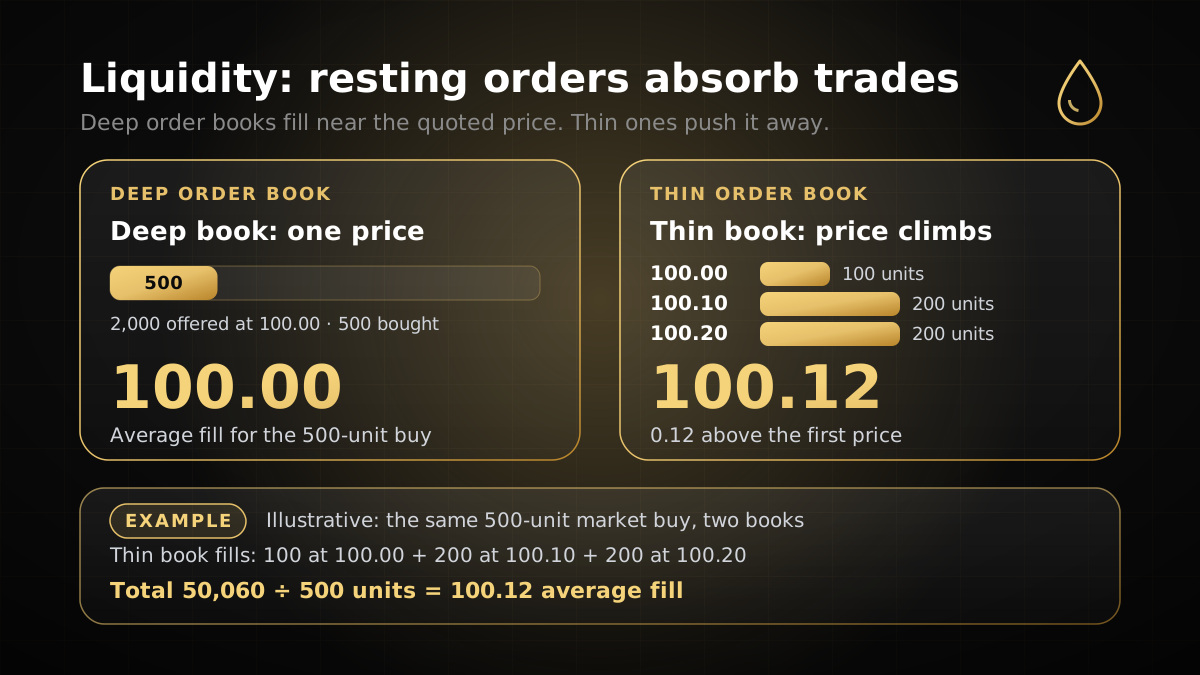
Spot forex has no single central order book. Prices come from banks, non-bank liquidity providers and trading venues that connect to your broker, and each broker’s feed can differ. The liquidity you see on your platform is therefore the liquidity your broker passes on. Treat any depth picture as one platform’s view of the market, not as a complete record of every order.
How liquidity shows up in spreads and fills
Three things on your trading screen reflect liquidity. The first is the spread. When few orders rest near the price, liquidity providers widen their quotes to protect themselves from sharp moves, so the gap between the buy and sell price grows. The second is slippage, the difference between the price you expected and the price you received. It appears when the market moves between your click and the fill, or when there is not enough size at your price. The third is a partial or delayed fill on a larger order, where only part of the size is matched at the first price.
Our slippage in trading guide covers the second effect in more detail, including how slippage affects stop-loss orders. The table below shows typical patterns. These are general tendencies, not guarantees, and your own broker’s spread history is the best evidence for your account.
| Market condition | Typical liquidity | Likely effect on your order |
|---|---|---|
| Overlap of two major trading sessions, major pair | Usually deep | Tighter spreads and fills close to the quote |
| Quiet hours or a public holiday in a key centre | Often thinner | Wider spreads and more slippage on market orders |
| Scheduled news release | Can thin sharply for a short time | Spreads may widen and fills may jump several levels |
| Around the daily rollover | Can thin briefly | Spreads may widen until activity returns |
| Exotic or less-traded pair | Usually thinner | Wider typical spreads and larger slippage risk |
Worked example: one trade, two markets
The figures below are hypothetical. They are not a quote from any broker. They assume a currency pair where one pip is worth $10 on one standard lot, and a trader who buys 2 standard lots. The only thing that changes between the two cases is the market.
The spread cost of a round trip, meaning an open and a close with no change in price, is:
Spread in pips x pip value per lot x number of lots
- Deep market, spread 0.6 pips: 0.6 x $10 x 2 = $12 of spread cost.
- Thin market, spread 1.8 pips: 1.8 x $10 x 2 = $36 of spread cost.
- Extra cost from the thin market alone: $36 - $12 = $24.
Now add slippage on a stop-loss order. Suppose the trader sets a stop 20 pips from entry. In the deep market the stop fills at its level, so the planned loss is 20 x $10 x 2 = $400. In the thin market the stop-market order fills 2 pips worse than the stop level. The actual loss is 22 x $10 x 2 = $440, which is $40 more than planned.
The position size did not change. Only the market did. A trader who sizes from a fixed risk amount has to allow for this, because the same stop distance can cost more in a thin market. Our position size calculator guide shows how to size a trade from a risk amount, and the buffer for thin conditions comes on top of that calculation.
When liquidity changes: sessions, news and rollover
Liquidity follows the clock. Spot forex trades around the clock on weekdays, but activity is not spread evenly across the day. When major financial centres are open together, more participants are active and spreads on major pairs tend to be tighter. When a major centre closes, activity drops and spreads can widen. Our forex market hours guide maps the sessions in more detail.
Scheduled news is the other large change. Before a release, liquidity providers often pull back or widen their quotes. In the first seconds after the release, price can jump through several levels. A stop placed close to the market is most exposed in that window. Whether a particular trade type is allowed around news is a question for the rules, not for the market. Check the current rules page for scalping, news and weekend rules before you trade. This guide does not state those permissions.
Liquidity in price action: stop clusters and sweeps
Many price-action and smart money writers use the word liquidity in a second sense. They mean pools of orders they believe sit above recent highs and below recent lows, where stop-loss orders and breakout entries are thought to gather. A move that takes price through one of those levels and then reverses is often called a liquidity sweep.
This is an interpretation, not a measured fact. No exchange or regulator publishes where retail stop orders sit. A level that looks obvious on a chart may hold very few orders in reality, and a sweep can happen for many reasons. Treat stop-cluster and sweep ideas as hypotheses to test on your own charts, with a defined risk. They are not predictions. The full framework, including terms such as order blocks and fair value gaps, is in our smart money concepts guide.
Thin liquidity and a prop firm challenge
Under the Yo Pips rules page, the daily loss figure counts closed and floating profit and loss, plus commissions and swaps, for the current day. A wider spread or a slipped fill makes an open trade show a larger floating loss sooner. Thin conditions therefore reduce the room you have under a daily limit, even when your trade idea has not changed. The daily reset uses UTC, which is not the same as the open of any trading session.
The same rules page lists prohibited practices. Latency arbitrage, high-frequency or feed-delay exploitation, account or device sharing, and strategies built to exploit the simulated environment are all prohibited. Whether a particular strategy is allowed is a question for the rules page, not for this guide, and checkout terms take precedence. Rules can change, so confirm the current version on the rules and regulations page before you buy or trade. For how the challenge limits fit together, see our prop firm challenge guide.
Common misreadings of liquidity
Most mistakes with liquidity come from a few habits. These are the ones that come up most often:
- Reading volume as liquidity. A busy bar tells you what traded. It does not tell you how much you could trade at a good price next minute.
- Taking one broker’s spread as the market spread. Quotes differ between brokers and feeds. Compare spreads on the same pair, at the same time of day, before you draw a conclusion.
- Ignoring the spread in a stop distance. A 20-pip stop on a wide spread is a shorter real distance than it looks. Build the spread into your plan.
- Trading a news release with a quiet-hour size. Thin conditions can turn the same stop into a larger loss than the one you sized for.
- Assuming a level must hold because it is obvious. A visible high or low is a reference point. It is not a guaranteed reaction zone.
Frequently asked questions
01Is liquidity the same as volume?
02Why does the spread get wider when liquidity drops?
03What is a liquidity sweep?
04Does liquidity matter in spot forex if there is no exchange?
05Which currency pairs are the most liquid?
06Does thin liquidity change my prop firm rules?
Risk disclosure: Trading leveraged products such as forex and CFDs carries a high level of risk, and most traders lose money. Prop firm challenges are evaluations on simulated accounts; passing one does not guarantee account activation, profits or a payout. Nothing on this page is investment advice. Always read the current rules and terms before you buy or start a challenge.