Swing trading vs day trading is one of the first decisions a new trader makes, and it shapes most of what follows: which charts you read, how often you check the screen, how wide your stops sit and how much risk stays open overnight. This guide compares the two styles side by side. It explains where each one fits, what changes on a prop firm account with daily and maximum loss limits, and how the same account behaves under each style, with the arithmetic shown. It does not argue that one style earns more. Results depend on the trader, the market and the plan.
Swing trading vs day trading: what separates them
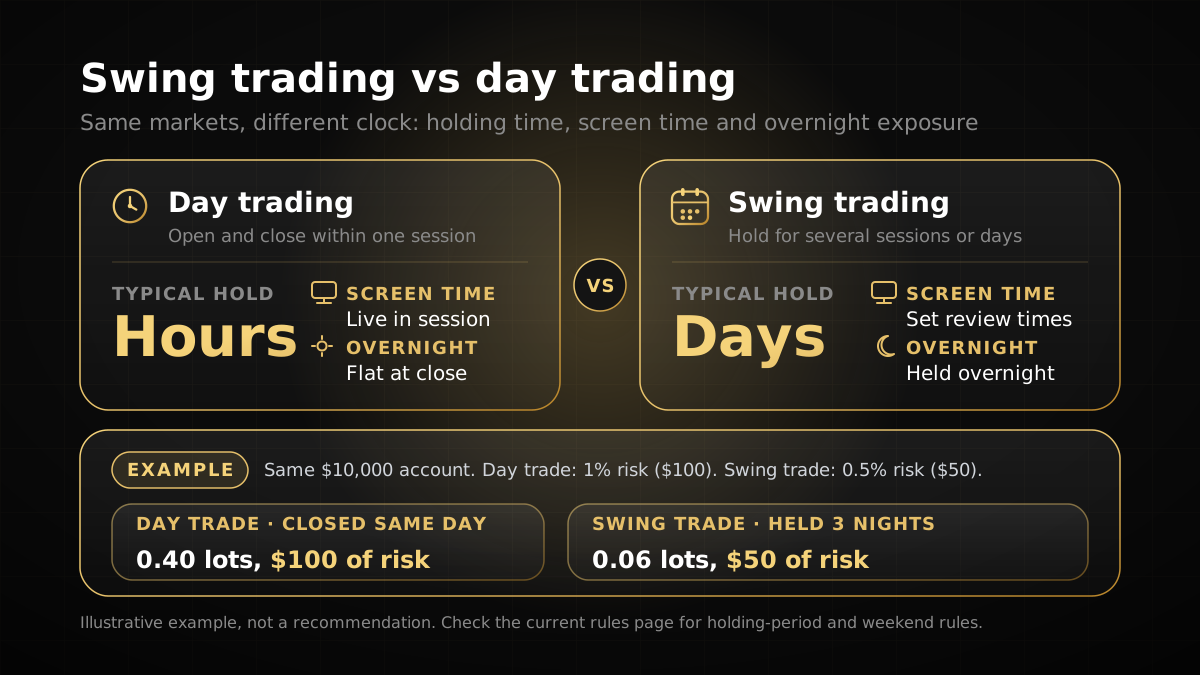
The main difference is how long you hold a position. A day trader opens and closes trades inside one trading session, so no position is carried overnight. A swing trader aims to capture a move that takes several sessions to play out, so the trade lives through nights and sometimes weekends. Everything else follows from that choice. Holding time sets the chart timeframe, the stop distance, the amount of screen time you need and the type of risk you carry.
If you are new to the general idea, our guide to day trading defines the style in detail. For the shortest holds, read our scalping guide, which sits at the far end of the same scale.
Side-by-side comparison
The table gives the general pattern for each style. Individual traders vary, and the rules of each firm can limit certain holding periods, so treat the table as a starting point rather than a rule.
| Factor | Day trading | Swing trading |
|---|---|---|
| Holding period | Minutes to hours, closed within the same session | Days to weeks, often through one or more nights |
| Chart timeframes | Lower timeframes, used for entries and timing | Higher timeframes, used for the main trend and the levels |
| Typical stop size | Tighter, set from recent intraday price structure | Wider, set to allow for ordinary swings over several sessions |
| Screen time | Active through the session | Checks a few times a day, plus a review at set times |
| Overnight exposure | None by design, since positions are closed before the session ends | Yes, positions carry risk through the night |
| Financing or swap charges | Usually not a factor | A factor on positions held past the broker’s rollover time |
| Main source of loss-limit pressure | Fast moves and a run of closed losses within one session | Floating losses that persist from one session to the next |
The pattern is clearer than any single number. Day trading concentrates risk into a session, while swing trading spreads it across time. Neither removes risk. Each one moves it to a different place in your week.
How day trading works in practice
A day trade usually starts from a level or pattern on a lower timeframe. The trader waits for a confirmed entry, places a stop at a level that proves the idea wrong and sets a target nearby. Because the holding time is short, the trade is judged quickly. Either the market moves in the expected direction within the session, or the stop is hit, or the trader closes the position before the session ends.
The strength of this style is that it gives a clear daily record. Each session starts with a flat book, so a bad trade does not follow you into the next morning. The weakness is pace. Good and bad decisions arrive in quick succession, and it is easy to take a second or third trade after a loss to win money back. That is how a single session can turn into a loss big enough to hit a daily limit.
How swing trading works in practice
A swing trade usually starts from a higher-timeframe view: a trend on the daily chart, a broken level, or a pullback to an area that buyers or sellers have defended before. The trader enters once the setup is confirmed, sets a stop beyond the level that invalidates the idea and sets a target based on the structure ahead. The trade may take days to play out, so the trader spends less time watching each tick and more time reviewing the position between sessions.
The attraction is that a trader does not need to be at the screen all day, and a well-chosen trade can run further than a day trade does. The cost is that the stop must be wider, which forces a smaller position size for the same cash risk. Overnight and weekend moves also add risk that a day trader never faces, because the market can open at a different price from where it closed.
The chart reading is different too. Some swing traders use indicators such as RSI on higher timeframes to judge momentum, and they give more weight to price structure than to short bursts of noise.
Overnight and weekend exposure
Overnight exposure is the biggest practical difference between the two styles. A position held through the night can open at a different price after the market has been closed or thinly traded. That gap can skip past a stop, so the loss can be larger than the planned amount. Day traders avoid this by design, because they close before the session ends.
Yo Pips allows overnight holding under its rules page, so a swing approach is possible on a Yo Pips challenge. Weekend holding is a separate question. Check the current rules page for weekend rules, and for any instrument or programme-specific rule, before you hold a position through a weekend. The same applies to scalping and news trading.
Financing charges are the second overnight cost. Many brokers charge a swap or financing amount on positions held past the rollover time, and the amount depends on the symbol, the side of the trade and the broker. Under the Yo Pips rules, swaps count toward the daily loss figure, so a charge that looks small on its own still reduces your buffer. Read the symbol specification in MetaTrader 5 before you hold a position overnight.
How loss limits affect each style
Prop firm rules were written with both styles in mind, so they look at losses from several angles. The Yo Pips figures in this section come from the Yo Pips rules page. Checkout and promotion terms take precedence, and rules can change, so confirm the current version on the rules and regulations page before you buy.
On Yo Pips, the daily loss limit covers closed and floating profit and loss, commissions and swaps for the current day, and the daily reset uses UTC. The maximum loss limit is measured on equity, so floating losses reduce the buffer whether or not you have closed the trade. The 1-Step Pay Later programme uses a 4% daily limit and an 8% maximum limit. Instant Funding uses 3% and 6%. The 2-Step Pay Later programme uses 5% and 10%.
What this means for each style is straightforward. A day trader can hit the daily limit in one session through a run of closed losses, a single oversized trade or a floating loss that grows quickly. A swing trader can also hit the same limit without a single bad close, because an open losing trade counts toward the figure while it stays open. Both styles need a daily stop and a position size set in advance, and both need to watch equity, not just closed results.
Worked example: the same account, two styles
Take a hypothetical $10,000 account on the 1-Step Pay Later programme. Applying the published percentages to the $10,000 starting balance gives these limits, assuming the base is the starting balance. The rules page’s compliance list says trailing drawdown applies, so the maximum-loss floor can rise as the account grows; check the figure on your dashboard before you rely on it:
- Daily loss limit: 4% of $10,000 = $400 of combined loss in one UTC day.
- Maximum loss limit: 8% of $10,000 = $800, so equity must stay above $9,200.
The day trade. The trader uses a 25-pip stop, which is the distance from entry to the level that proves the idea wrong. The risk is 1% of the account, or $100. On EURUSD with a USD account, one pip on a standard lot is worth $10, so the risk per lot is 25 x $10 = $250. The size is $100 / $250 = 0.40 lots. A full stop loss costs $100, which leaves $300 of the $400 daily room for the rest of the session.
The swing trade. The trader uses an 80-pip stop, set beyond a level on the daily chart. The risk is 0.5% of the account, or $50, chosen so the wider stop does not raise the cash risk. The risk per lot is 80 x $10 = $800. The size is $50 / $800 = 0.0625 lots, which rounds down to 0.06 lots. At 0.06 lots, a full stop costs 0.06 x $800 = $48, which is inside the planned $50.
The floating problem. Now suppose the swing trade is held overnight and is floating $300 down at the end of a UTC day. At 0.06 lots, a $300 loss means price has moved about 500 pips against the trade, far beyond the 80-pip stop. So the stop was either moved further away or missed in an overnight gap. Either way, the plan set at entry did not hold. The loss is 75% of the $400 daily room used before any other trade. If the trader also closes a separate $150 loss during the same UTC day, the daily figure is $300 + $150 = $450. That is above $400, so the account breaches, even though the closed loss on its own was only $150. The swing trade also uses $300 of the $800 maximum loss room, which leaves $500 of buffer above the $9,200 floor.
The lesson is not that swing trading breaches more often. It is that a swing trader needs a rule for a trade that goes deep into loss, decided before the trade is opened. Our position size calculator guide shows the formula in full, and our prop firm challenge guide explains the loss limits on each programme.
How to choose between them
Choose by the life you can actually sustain, not by which style looks more impressive. These questions are a practical way to decide.
- How much time can you spend at the screen? Day trading needs a block of time inside a session every trading day. Swing trading needs a review at set times, which can fit around a job.
- How do you handle a run of losses? A day trader can reach a daily limit quickly and may be tempted to trade again. A swing trader can sit with an open loss for days, which needs discipline of a different kind.
- Can you accept a wider stop with a smaller size? If the answer is no, swing trading will push you to take either more cash risk or too little exposure to matter.
- What does the account allow? Read the rules page for the programme you plan to trade, including overnight, weekend and style-specific rules, before you commit to a style.
- Can you test the style first? A free trial on a simulated account lets you run one style with no payment details, so you can see how overnight holds and floating losses feel before you pay for a challenge.
Many traders end up with a mix. They use a higher-timeframe view to pick the direction and a lower timeframe to time the entry. Whichever you choose, write down the holding period, the stop, the size, the daily loss budget and the rule you will follow if a trade goes against you. A plan that names those things is more useful than a label.
This guide is general education, not a recommendation to trade either style. The examples use hypothetical numbers, and no outcome is implied.
Frequently asked questions
01Is swing trading or day trading better for beginners?
02Can you swing trade on a prop firm account?
03Does a swing trade need a smaller position size?
04Do overnight holds cost more than intraday trades?
05Which style uses up a daily loss limit faster?
06Can I combine both styles?
Risk disclosure: Trading leveraged products such as forex and CFDs carries a high level of risk, and most traders lose money. Prop firm challenges are evaluations on simulated accounts; passing one does not guarantee account activation, profits or a payout. Nothing on this page is investment advice. Always read the current rules and terms before you buy or start a challenge.