What is VWAP in trading? VWAP stands for volume-weighted average price. It is the average price an instrument has traded at over a period, where each price counts in proportion to the volume traded there. Intraday traders use it as a reference line for the average price paid so far in the session. This guide defines VWAP, sets out the formula with a worked example, explains why it resets, and covers the main problem in spot forex: there is no central volume to weight by, so the figure most platforms show is a proxy.
What VWAP measures
A simple moving average gives every price in its window the same weight. VWAP does not. A price that traded on heavy volume pulls the average harder than one that traded quietly. That makes VWAP a better summary of where business was done than a plain average of closing prices, although it is still only a summary.
Because VWAP starts from one point and keeps adding to its totals, it answers a narrow question: what is the volume-weighted average price since the session began? It does not tell you what price will do next, how strong a move is, or whether a level will hold.
The VWAP formula
For each bar, such as a 5-minute candle, calculate the typical price. This is the high, low and close added together and divided by three. Multiply the typical price by the bar’s volume. Add those products from the session start to the current bar. Then divide by the total volume over the same bars.
VWAP = Σ(typical price × volume) ÷ Σ(volume)
Some platforms use the closing price instead of the typical price, so check the setting. Some versions also draw bands at set standard deviations above and below the line. Those bands show how far price has moved from the average. They do not show how likely a reversal is.
Worked example: three bars, one VWAP
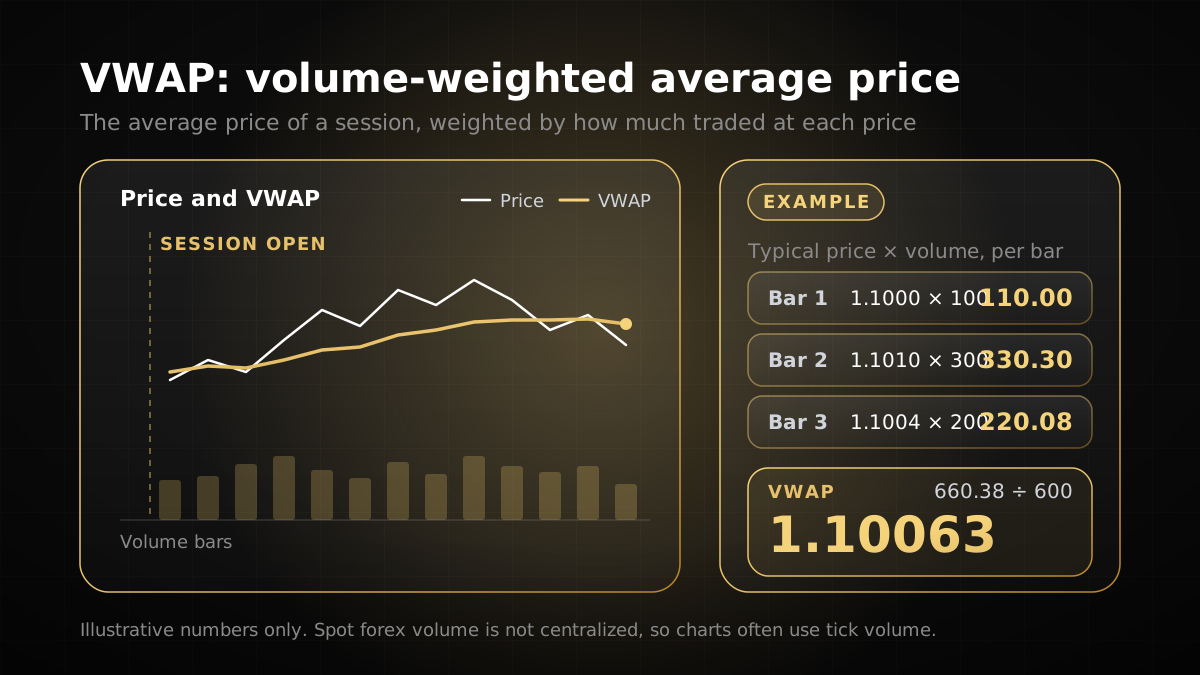
This example is hypothetical. The prices and volumes are invented to show the arithmetic, not taken from a real market. Suppose a session has produced three bars. The volumes are 100, 300 and 200 units, using whatever volume figure your platform gives you.
| Bar | High | Low | Close | Typical price | Volume | Typical price × volume |
|---|---|---|---|---|---|---|
| 1 | 1.1010 | 1.0990 | 1.1000 | 1.1000 | 100 | 110.00 |
| 2 | 1.1020 | 1.1000 | 1.1010 | 1.1010 | 300 | 330.30 |
| 3 | 1.1010 | 1.0998 | 1.1004 | 1.1004 | 200 | 220.08 |
| Total | 600 | 660.38 |
Typical price for bar 1 is (1.1010 + 1.0990 + 1.1000) ÷ 3 = 1.1000. Bars 2 and 3 work the same way, giving 1.1010 and 1.1004. The VWAP is then:
- Sum of typical price × volume: 110.00 + 330.30 + 220.08 = 660.38
- Sum of volume: 100 + 300 + 200 = 600
- VWAP: 660.38 ÷ 600 = 1.10063
The simple average of the three typical prices is (1.1000 + 1.1010 + 1.1004) ÷ 3 = 1.10047. VWAP sits higher, at 1.10063, because the bar that traded at 1.1010 carried half of the total volume (300 out of 600). The volume weighting is the only difference between the two figures.
Why VWAP resets each session
Because VWAP is a running total, it needs a starting point. The usual choice is the start of the trading session, so each day begins a fresh calculation. Without a reset, the line would average prices from days or weeks ago and stop describing the current session.
In spot forex, the session start is a setting rather than a fixed market fact. A platform may use a fixed server time, a time zone you choose, or a session window you define. Write the start time down, because two traders who use different start times will see different lines for the same chart.
An anchored VWAP starts from a point you choose, such as a swing high, a swing low or a scheduled news release. It is useful for studying what has happened since that event. It is still a backward-looking average, not a level the market has to respect.
Why spot forex has no central volume
In exchange-traded markets, such as many stock and futures markets, trades print on a central venue, so a consolidated volume figure exists. Spot forex works differently. It is traded over the counter, through banks, brokers and other participants who deal with each other directly and at different prices. No single venue records every trade, so there is no complete, market-wide volume figure for a currency pair. Spot forex also trades around the clock on weekdays, and activity changes through the day. Our forex market hours guide explains how the sessions overlap.
| Market | Central venue? | Volume figure you may see | What VWAP weights by |
|---|---|---|---|
| Exchange-traded stocks and futures | Yes, trades print on the exchange | Consolidated exchange volume | Traded volume |
| Spot forex | No, over the counter | Tick volume, or a broker’s own real volume | An activity proxy, or one broker’s flow |
Tick volume counts how many price changes occurred during a bar. A busy minute produces more price changes than a quiet one, so tick volume tracks activity. It is a count of updates, though, not a count of currency units traded. A bar with twenty ticks and a bar with two hundred ticks may reflect quite different amounts of trading, and the number can depend on the feed of the broker you use.
Some brokers publish a real volume figure from their own execution. That figure covers only that broker’s flow, so it is not the whole market either.
A forex VWAP built on tick volume is still a usable reference line. Treat it as a broker-specific estimate of the volume-weighted average price, not as the market’s volume-weighted average price. Two platforms with different feeds can draw slightly different lines for the same pair and the same session. This is the main reason spot forex VWAP needs more care than VWAP on a centrally traded future or stock.
How intraday traders use VWAP
Traders mostly use VWAP as a reference. Three common uses are:
- Comparing price with the session average. Price above the line means recent buying has happened at prices above the average traded so far, and the reverse for price below it.
- Judging fill quality. Some traders compare the price they received with the VWAP for the same period. Slippage, the gap between expected and actual fill price, is a separate question, and our slippage guide covers it.
- Adding context to other tools. Momentum and volatility indicators, such as the RSI indicator, measure different things. VWAP tells you where the average is, while those tools tell you how fast price is moving and how far.
This guide does not give entry or exit rules. A VWAP line describes past trades. Any decision to act on it needs a written plan, a stop, and a position size you have worked out in advance. Our technical analysis for day trading guide places VWAP alongside the other common tool families.
Limits and common mistakes
VWAP is simple to draw and easy to misread. These are the mistakes that come up most often:
- Treating it as a signal. Price can sit above VWAP for hours and then fall through it on a news release. The line describes the average; it does not promise a direction.
- Ignoring the start time. Changing the session start changes the whole line. Compare lines only when the settings match.
- Reading early bars too much. Early in a session, each new bar moves VWAP a lot, because few bars carry the total. Later, the line moves slowly. Early readings are less stable than late ones.
- Trusting the volume blindly. In spot forex, tick volume is a proxy. Check what your platform shows before you weight a decision by it.
- Ignoring scheduled news. A release can move price far from VWAP in seconds, and the line will take time to catch up. The line is a lagging average.
VWAP and prop firm evaluations
If you trade a prop firm evaluation, a reference line does not change your limits. Under the Yo Pips rules page, indicators such as VWAP are allowed unless they break a prohibited-practice rule. Those rules include latency arbitrage and strategies built to exploit the simulated environment. The daily loss figure includes floating P/L, commissions and swaps for the current day, and the maximum loss is measured on equity. A trade that moves against you, whether it sits above or below a VWAP line, counts against those limits from the moment it is open.
Yo Pips daily figures reset at UTC. That is a separate matter from a session-based VWAP, so do not assume the two start at the same time. Check the scalping, news and weekend rules on the current rules page before you trade. Checkout terms take precedence, and rules can change, so confirm the rules on the rules and regulations page before you buy. For how the challenge limits fit together, see our prop firm challenge guide.
Frequently asked questions
01Is VWAP the same as a moving average?
02Can VWAP be used on spot forex?
03Is VWAP a buy or sell signal?
04Why does my VWAP line look different from a friend’s?
05Does VWAP change my rules in a prop firm challenge?
Risk disclosure: Trading leveraged products such as forex and CFDs carries a high level of risk, and most traders lose money. Prop firm challenges are evaluations on simulated accounts; passing one does not guarantee account activation, profits or a payout. Nothing on this page is investment advice. Always read the current rules and terms before you buy or start a challenge.