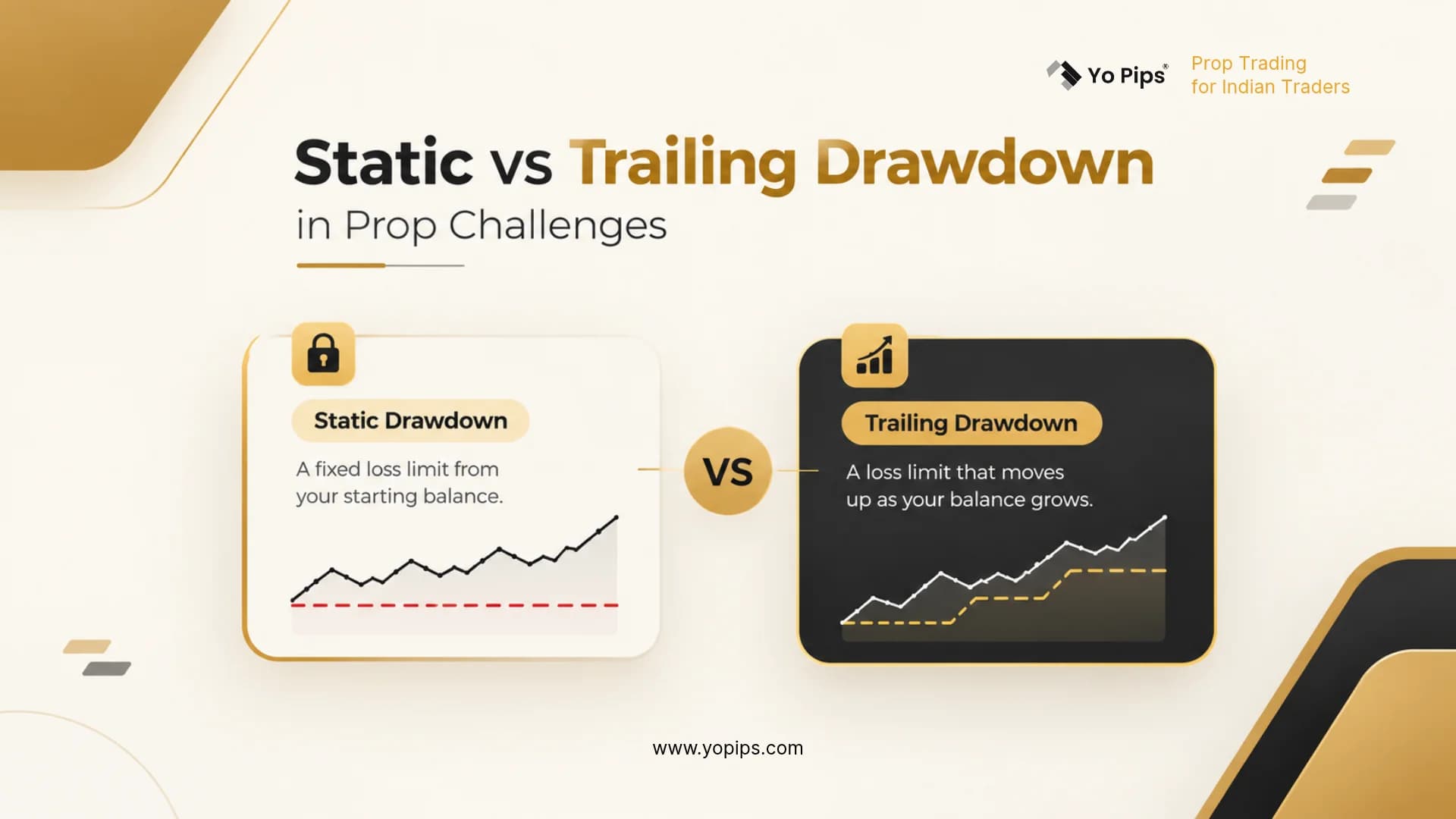
Choosing between static vs trailing drawdown in prop challenges determines how your account loss floor behaves throughout a funded evaluation. Static models enforce a fixed loss limit from your initial starting account balance, whereas trailing models move upward as account profits increase. Your trading style decides.
Static vs trailing drawdown in prop challenges: definition and decision context?
The core distinction between static vs trailing drawdown in prop challenges lies in whether your maximum loss threshold stays anchored or moves higher as you book gains. Static rules establish a fixed loss limit measured from your initial balance, whereas a trailing rule follows your account's highest balance upward and locks in gains.
Because a static floor remains stationary regardless of subsequent wins or losses, it creates a predictable boundary for position sizing during multi-day swings. According to Pivex's comparison, static drawdown gives a simpler buffer that fits traders who hold positions for hours or days and rely on wider protective stops. That stability keeps risk calculations consistent from the first trade through the final profit target.
Trailing limits operate under a stricter progression model that rewards steady, incremental profit-taking over large unrealized swings. As Pivex explains, trailing rules suit scalpers who close trades quickly and bank small, consistent gains rather than riding deep retracements. For instance, Pivex's own challenge structure uses a static 6% maximum loss paired with a 4% daily loss limit, though rules vary widely across providers. Reviewing How it works on YoPips helps you confirm how challenge mechanics align with your execution habits before starting.
Who should consider static vs trailing drawdown in prop challenges?
Swing traders and position traders generally fit static limits, while disciplined short-term scalpers are the primary audience for trailing rules. In prop evaluations, a drawdown measures the maximum decline an account can experience before disqualification or termination, tracking the dip between a peak balance and a subsequent trough.
Matching this threshold to your trade duration prevents avoidable rule violations during ordinary market pullbacks. Audacity Capital notes that static drawdown allows larger trades under a less stressful risk management routine because profitable weeks expand your cushion above the starting floor. Traders who scale into setups or tolerate multi-session volatility benefit from knowing their disqualification line will not creep closer while a trade breathes.
By contrast, trailing thresholds appeal to traders who prefer strict guardrails that protect realized equity from sudden givebacks. Audacity Capital observes that trailing drawdown enforces disciplined risk management and suits scalping strategies, even though the rising floor can make passing an evaluation harder. Whichever model fits your playbook, checking payment and rule terms upfront—such as YoPips' Pass first pay later structure—clarifies what is expected before you commit capital or time.
Benefits and practical limitations
Static rules prioritize breathing room and straightforward math, whereas trailing rules emphasize profit preservation and tight loss control. As Audacity Capital summarizes, both models protect prop firm capital while producing markedly different day-to-day constraints on position sizing and trade management.
Understanding these trade-offs prevents traders from mistaking a generous headline percentage for an easy evaluation rule. Below is a direct comparison of how each mechanism functions based on Audacity Capital's risk framework, followed by the core advantages and drawbacks traders weigh when choosing an evaluation account such as a $1000 funded challenge.
| Feature | Static Drawdown | Trailing Drawdown |
|---|---|---|
| Loss floor movement | Remains fixed throughout trading | Moves upward as profits increase |
| Primary risk focus | Offers wider trading flexibility | Protects accumulated account profits |
| Strategy fit | Supports larger position sizing | Suits disciplined scalping workflows |
| Evaluation pressure | Less stressful risk management | Harder to pass evaluations |
Static Drawdown: Pros and Cons
- Pro: A fixed loss limit never shifts upward, keeping risk math predictable across winning and losing streaks.
- Pro: Greater position flexibility accommodates wider stops and multi-day holding periods without tightening your margin for error.
- Con: Because the floor never trails higher, it does not automatically lock in prior gains against a severe reversal toward the starting floor.
Trailing Drawdown: Pros and Cons
- Pro: Rising loss thresholds actively protect accumulated profits and reinforce strict risk discipline on every trade.
- Con: Evaluation pass difficulty increases because normal pullbacks after strong gains can breach the newly elevated floor.
- Con: Traders who hold through intraday volatility face tighter operational pressure whenever open or closed equity sets a new peak.
Free $1k prop firm challenge and the reader decision
Even on an entry-level evaluation or a free $1k prop firm challenge, misunderstanding how the maximum loss limit moves causes more preventable failures than weak trade entries. Treydly notes that traders often blame their strategy for failed challenges when the actual culprit is overlooking how maximum drawdown is calculated.
While challenges include profit targets, daily drawdown caps, and trading restrictions, violating the maximum loss rule terminates the account immediately with no second chances. Treydly illustrates this gap using a $100,000 evaluation with a 5% limit: the initial floor sits at $95,000, and growing the balance to $105,000 expands your static buffer to $10,000.
Under a trailing framework, reaching a higher equity peak pulls the termination line upward toward your active balance, creating a hidden trap when position sizes stay unchanged. Whether you are testing a smaller entry path like YoPips' $1000 funded challenge or comparing account tiers on the Pricing page, verifying the loss-floor rule before your first order protects your progress. This example is purely structural and does not reflect typical trader outcomes; always inspect the exact drawdown percentage and floor calculation in a firm's rulebook.
Pay after you pass prop firm and the reader decision
Choosing a pay after you pass prop firm model reduces upfront fee exposure, yet trailing drawdown mechanics still account for more challenge breaches than static rules. Tradzu explains that trailing drawdown drives more failures because the rising floor shrinks your margin for error right when early profits tempt traders to increase risk.
Headline dollar caps can mislead traders who skip the underlying calculation rules. As Tradzu points out, two firms advertising a $4,000 drawdown on a $100,000 account can deliver completely different trading experiences depending on whether the limit is static, end-of-day trailing, or intraday trailing. For example, end-of-day trailing updates at close, whereas tick-by-tick intraday trailing reacts to unrealized equity spikes and leaves far less room for fluctuations.
Industry rules illustrate how varied these setups are across providers: Tradzu notes that FTMO and FundedNext use static rules alongside E8 Signature's locked phase, while E8 One, E8 Classic, and E8 Track apply dynamic trailing during active phases. Before starting an evaluation—including deferred-fee programs like YoPips' Pass first pay later challenge—run through this verification sequence alongside How it works:
- Confirm whether the maximum loss limit stays fixed from starting balance or rises with highest equity.
- Check whether trailing calculations update at market close or tick-by-tick during open trades.
- Verify whether the trailing floor stops moving once it reaches your initial account balance or continues climbing indefinitely.
- Size each trade's stop loss against the remaining buffer rather than your total account equity.
Conclusion
Matching your drawdown model to your execution style protects your evaluation consistency far more effectively than chasing larger profit targets. Traders who hold positions across multiple sessions and rely on wider stops generally find a stationary loss threshold easier to manage within a disciplined risk plan. Conversely, traders who lock in modest intraday gains and exit quickly can operate comfortably inside a rising limit if they keep position sizes conservative after profitable streaks.
Before placing your first trade on any evaluation, verify how the loss floor updates, whether unrealized equity triggers recalculations, and how daily limits interact with the overall cap. Taking time to align those rules with your natural stop distance reduces avoidable breaches caused by normal market noise. When you are ready to map out long-term account growth and rule progression, review the YoPips Scaling plan to understand how funded milestones fit into your broader trading routine.
- Static Drawdown
- A fixed maximum loss threshold measured once from the starting account balance that never moves upward as profits accrue.
- Trailing Drawdown
- A dynamic loss floor that rises alongside your highest achieved balance or equity, narrowing your available buffer as gains grow.
- End-of-Day (EOD) Trailing
- A trailing drawdown calculation that updates only at market close rather than tracking unrealized intraday equity spikes.
Sources
- Trailing vs Static Drawdown: A Comprehensive Comparison — 2026-08-06T00:00:00.000Z — pivexfunded.com (Published August 6, 2026)
- Static Drawdown vs Trailing Drawdown: Which Is Better? | Audacity Capital — 2026-02-26T11:30:00.000Z — audacity.capital (Published February 26, 2026)
- Static vs Trailing Drawdown in Prop Firm Challenges | Treydly — 2026-03-12T02:40:28.000Z — treydly.com (Published March 12, 2026)
- Static vs Trailing Drawdown: Which Costs More Challenges? (2026) | Tradzu Blog | Tradzu — 2026-06-22T04:07:42.000Z — tradzu.com (Published June 22, 2026)