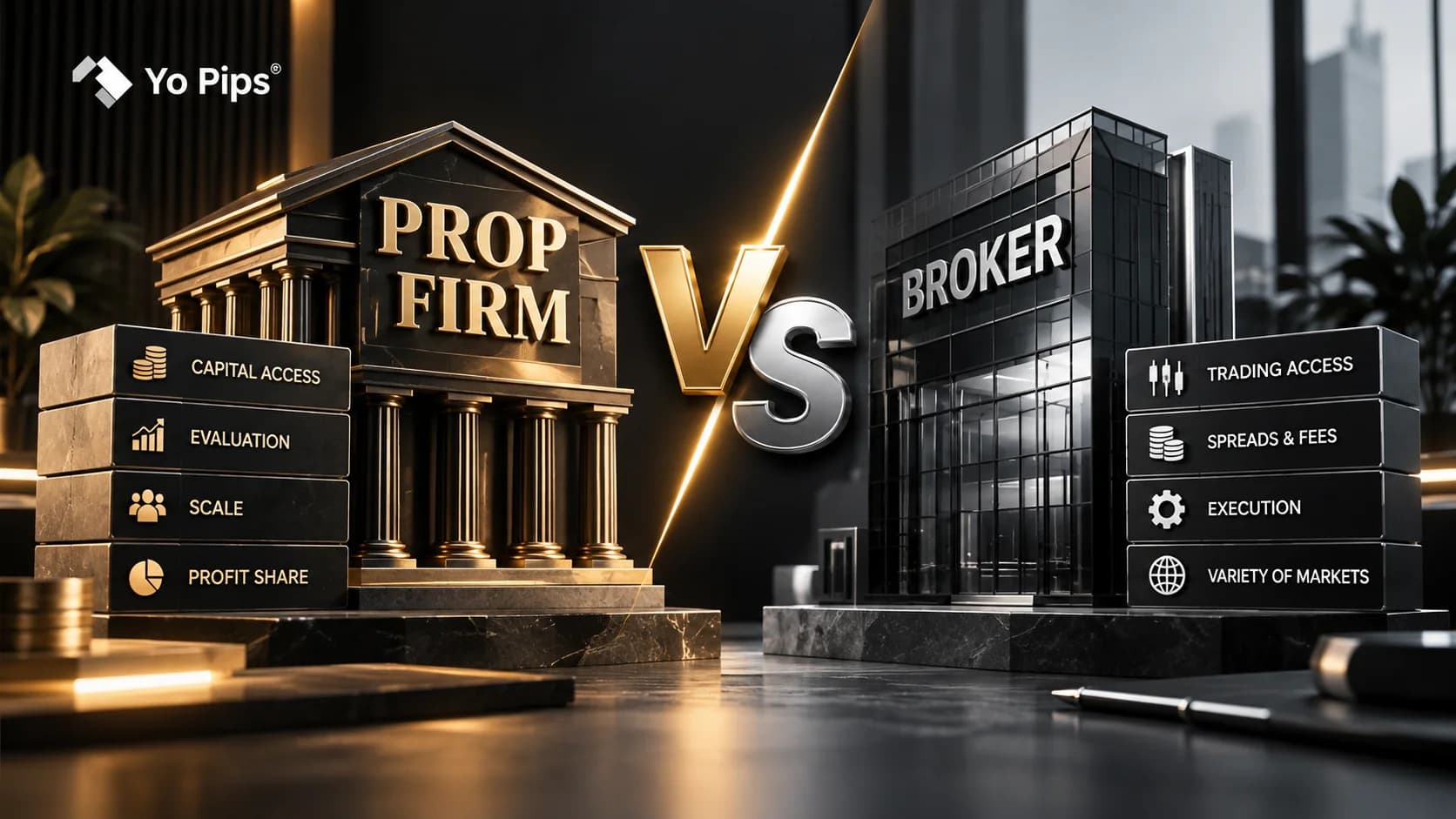
Prop firm vs broker decisions center on who supplies trading capital and under what rules. Prop firms generally allocate firm capital after evaluations, while brokers require your own funds. Match the choice to risk tolerance, style and goals. This overview is educational only.
prop firm vs broker: definition and decision context?
Prop firm vs broker comparisons start with a simple structural split: who owns the capital being traded and how access is granted. Market overviews that place both options side by side usually also surface tools for tracking risk, sentiment and account metrics so traders can judge fit.
A proprietary trading firm typically lets participants trade firm capital once they clear evaluation rules. A traditional broker account lets you trade only the capital you deposit. That difference shapes flexibility, cost timing and long-term opportunity, so the decision must align with trading style, risk tolerance and goals. See How it works for a plain overview of evaluation flows.
Readers comparing the two models often review pages that list both prop firms and brokers together with risk calculators and analysis dashboards. Those side-by-side views help clarify whether an aggressive growth route or a more defensive personal-capital route matches the trader’s situation. Always treat such comparisons as starting points rather than guarantees of outcome, and verify current rules directly with any provider.
Decision context also includes drawdown handling, consistency expectations and payout timing. Because many evaluation programs use simulated environments, confirm whether the capital you later manage is simulated or live and what that means for payouts. Keep a written checklist of your own risk limits before choosing either path.
Who should consider prop firm vs broker?
Traders who want to scale without depositing large personal capital often examine prop-firm routes first, while those who prefer full ownership of every dollar tend toward brokers. One published comparison weighed leverage, payout splits and evaluation rules when reviewing available options for smaller accounts.
Consider a prop firm path if you already have a documented strategy, can follow strict risk rules, and accept that failing an evaluation usually means losing the fee rather than trading capital. The model suits traders who treat challenge rules as a filter and who want access to larger notional size once funded. Review Pass first pay later options if fee timing is a constraint.
A broker account is often the clearer fit when you want unrestricted strategy choice, overnight holding without firm-specific consistency rules, or when you already hold sufficient personal capital. Broker accounts keep you as the sole risk owner; profits and losses stay fully yours after spreads and commissions.
Neither path removes market risk. The same comparison that looked at leverage and payouts also framed prop trading as an aggressive growth route and brokerage as a defensive route. Use that framing only as a decision aid: list your maximum acceptable drawdown, monthly time budget and fee tolerance, then map each model against those constraints. Avoid any program that markets guaranteed outcomes.
Benefits and practical limitations
Both models offer clear benefits and equally clear limitations that turn on legal classification and regulatory risk. A focused comparison of proprietary trading firms and forex brokers highlights how capital structure and execution model create different obligations.
- Prop firms can give access to larger notional capital after a successful evaluation without requiring a matching personal deposit.
- Brokers give full ownership of capital, strategy freedom and direct regulatory protections that apply to client funds in many jurisdictions.
- Evaluation programs can create a structured proving ground with defined risk rules that some traders find useful for discipline.
- Prop-firm capital is usually subject to firm-specific drawdown, consistency and payout rules that can end an account quickly.
- Broker accounts require you to risk personal capital from the first trade; losses are real and immediate.
- Misclassification risk exists if a firm accepts client deposits or executes client trades while calling itself a prop firm.
| Dimension | Prop firm | Broker |
|---|---|---|
| Capital source | Firm capital after evaluation | Trader’s own deposited funds |
| Typical fees | Evaluation or access fees | Spreads, commissions, swaps |
| Risk ownership | Shared under firm rules | Fully the trader’s |
| Regulatory lens | Often proprietary trading entity | Intermediary requiring licensing |
Understanding the legal difference between a prop firm and a forex broker matters for correct classification. A broker executes client trades; a prop firm executes trades for the firm’s own account. In most jurisdictions, prop firms do not require a brokerage license when they stay within proprietary trading and do not provide client market access or hold client trading deposits. For regulators and payment providers that distinction drives licensing and risk assessment as the sector evolves. Always read the exact terms of any program you join and treat the comparison above as educational context only. Explore a concrete low-size example via the $1000 funded challenge.
free $1,000 prop firm account and the reader decision
Low-entry or deferred-cost funded accounts can lower the cash barrier compared with depositing the same size at a broker, yet they still require the trader to satisfy risk rules. Industry examples of longer-horizon firms illustrate why structure and shared risk matter more than headline size.
One established firm founded in 2007 describes itself as a selective, partnership-led operation focused on long-term development, structured training and shared risk. It has operated through major cycles including the 2008 financial crisis and the COVID period, combining physical offices with remote traders. That history underscores the value of operational discipline when capital access is offered at modest entry points.
A free or low-cost $1,000-style challenge is therefore best viewed as a rules test rather than free money. Confirm whether the account remains simulated, how trailing or static drawdown is calculated, and what payout proof process applies after funding. Compare those terms against simply depositing personal capital at a broker where you keep 100 percent of net results but also absorb 100 percent of losses.
Use a simple decision filter: if you need larger notional size and can follow strict daily and overall loss limits, a modest funded challenge may be worth testing. If you prefer absolute control and already have the capital, a broker account may be cleaner. Check current Pricing and scaling terms before committing any fee. Past challenge results never predict future performance.
pay after you pass prop firm and the reader decision
Pay-after-you-pass or pass-first-pay-later models shift the fee timing so that unsuccessful evaluations cost less or nothing up front, yet the underlying regulatory and risk distinctions between prop firms and brokers remain unchanged. Correct classification still matters for licensing and risk assessment.
For regulators, payment service providers and compliance teams, understanding whether a firm trades only its own capital or executes client trades is critical as forex prop trading firms continue to evolve. A model that defers payment until after a pass does not convert a proprietary arrangement into a brokerage relationship, nor does it remove the need to verify that client deposits are not being accepted under the guise of evaluation fees.
From a trader’s perspective the decision is practical: does deferring the fee improve your ability to test a strategy under realistic risk rules without depleting personal capital? If yes, map the exact pass criteria, the trailing versus static drawdown definition, and the post-funding payout schedule. If the rules feel opaque or the firm’s legal status is unclear, a standard broker account may be the more transparent defensive choice.
Always keep a written record of the rules you accepted. Confirm whether the evaluation environment is simulated and whether funded-stage rewards are discretionary. Link that review to your own risk plan rather than to any marketing claim of easy scaling. Further detail on deferred-fee structures appears on the Pass first pay later page and related Scaling plan materials.
Conclusion
Choosing between a prop firm and a broker comes down to capital source, rule tolerance and personal risk ownership. Prop-firm routes can open larger notional size after evaluations; broker routes keep full ownership and usually simpler regulatory clarity for client funds.
Use the structural and legal distinctions outlined above as a checklist, not a recommendation. Verify every drawdown definition, payout policy and simulation disclosure yourself. Match the model to your documented strategy and maximum loss limit. Educational content cannot replace that personal due diligence.
If you decide to explore an evaluation path, start with transparent rules and modest size, then review how any later scaling would work. If you prefer to stay with personal capital, focus on broker cost transparency and risk controls. Either way, treat trading as high-risk activity that can produce rapid losses. For next steps see the site FAQ, Platforms overview, and Blog for additional rule-focused explainers.
Sources
- Prop Firm vs. Broker: Which is Best for Scaling a Small Trading Account? - A1 Trading — a1trading.com
- Prop Firm vs Broker: Which is Better for Traders? - Phillip Nova — phillipnova.com.sg
- Prop Firm vs Forex Broker | Legal and Regulatory Differences — kenmoredesign.com
- Prop Firm Seven Points Capital Expands into London | LeapRate — leaprate.com