For most proprietary traders, passing an evaluation challenge is only half the battle. The real focus is always on the payoff: how much of your hard-earned trading profit actually lands in your bank account?
When browsing through modern prop firms, you will constantly see headlines flashing enticing numbers: “80% Profit Split!”, “Get a 90% Payout!”, or even “Keep 100% of your earnings!”
On paper, a 10% or 20% variance might look like a minor adjustment. But when scaled over a funded account, that gap represents thousands of dollars left on the table. Let’s break down exactly how prop firm profit sharing works, compare the standard tiers, and analyze the catch behind a "100% split" so you can pick the model that serves you best.
How Profit Sharing Works in a Prop Firm
When you trade with a proprietary firm, you aren't trading your personal capital. The firm provides you with a simulated or live-funded account environment, absorbing the ultimate downside risk. In return for setting up this infrastructure, the firm acts as your capital partner.
When your funded account secures a net profit during a specific payout cycle, those earnings are split according to a predetermined percentage.
The Math in Action: If your trading strategy gains $10,000 during a bi-weekly cycle on a funded account, an 80% split means you receive $8,000, while the firm retains $2,000 to cover operational costs, data feeds, and underlying risk.
What is a Tiered Profit Split?
Most firms do not start you at their highest advertised rate right away. Instead, they implement a tiered profit split on funded accounts.
You will typically begin your journey at a baseline percentage (such as 80%). As you demonstrate consistent risk management, hit milestone gains, or progress along the firm's scaling plan, your payout share automatically steps up to 90% or higher.
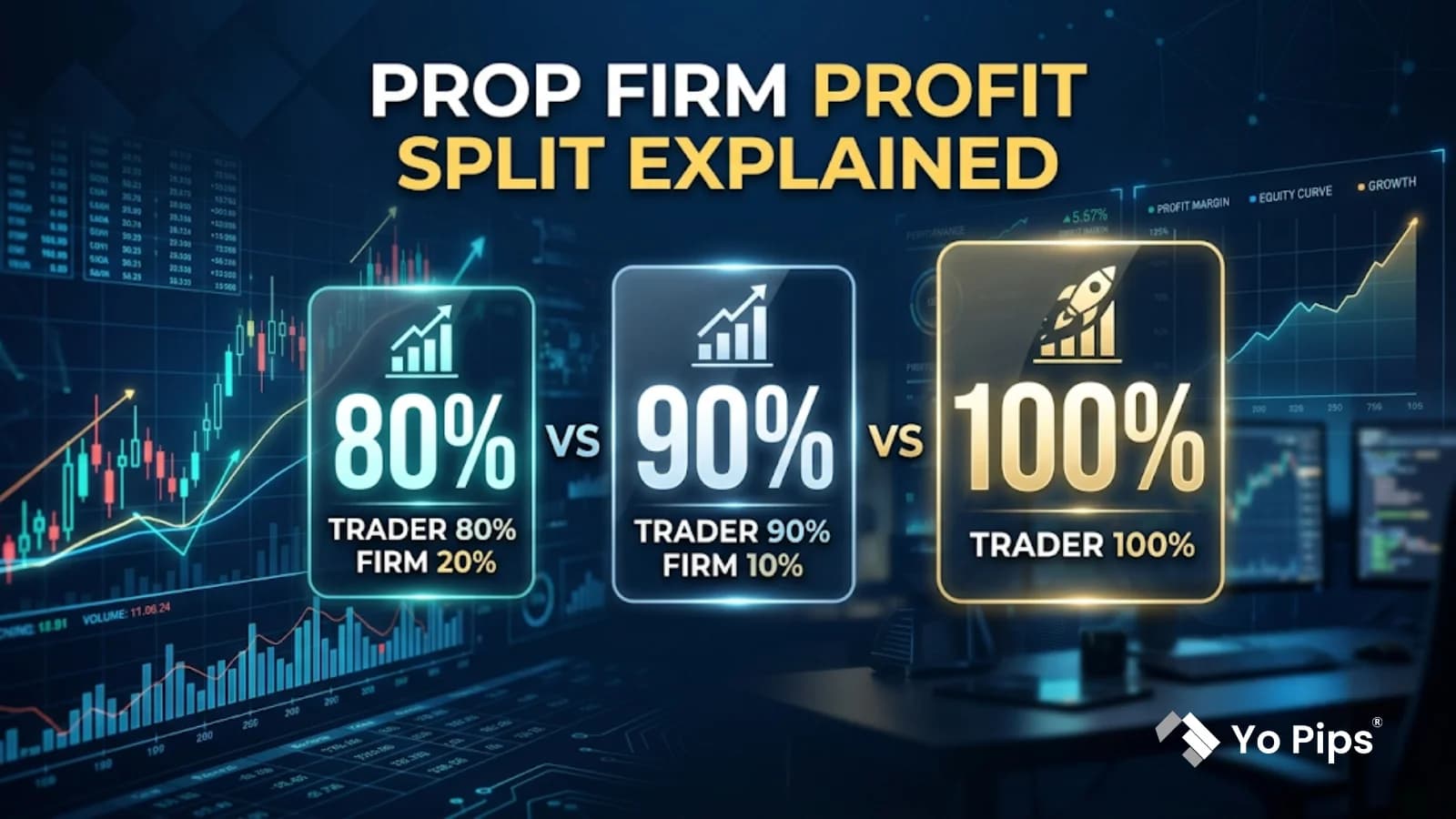
80% vs. 90% vs. 100%: The Long-Term Financial Impact
To visualize how profit split vs. account size dictates your final compensation, let's look at a concrete data comparison. Assume a trader is actively managing a standard $100,000 funded account and maintains a steady, disciplined average return of 5% per month ($5,000 in raw profits).
Here is how those earnings divide over a 12-month timeline:
| Profit Split Tier | Monthly Trader Payout | Annual Trader Payout | Capital Kept by the Firm (Yearly) |
| 80% Split (Industry Baseline) | $4,000 | $48,000 | $12,000 |
| 90% Split (Premium Tier) | $4,500 | $54,000 | $6,000 |
| 100% Split (Promotional Max) | $5,000 | $60,000 | $0 |
As the metrics show, moving from an 80% tier to a 90% tier scales your yearly earnings by $6,000 for the exact same market execution. Over time, choosing the right prop firm reward structure becomes just as vital to your bottom line as fine-tuning your win rate.
The Core Payout Tiers Explained
1. The 80% Profit Split: The Safe, Reliable Baseline
An 80/20 division is the standard structural benchmark for top-tier prop firms. It provides a balanced ecosystem: the trader takes the lion's share of the reward, while the 20% retained by the firm allows them to sustain lightning-fast payout processing, fund reliable 24/7 customer support, and keep evaluation challenge entry prices highly competitive.
2. The 90% Profit Split: The High-Performer Incentive
A 90% split is usually unlocked as an elite tier. Firms offer this as a reward for capital scaling or via premium account upgrades. For a disciplined trader, this is often the "sweet spot" it offers maximum payout leverage while ensuring the prop firm remains financially healthy and capable of backing your trades.
3. The 100% Profit Split: Marketing Hype vs. Reality
Can a firm actually give you 100% of your earnings?
Yes, but always read the fine print.
Firms cannot survive by giving away all their revenue for free. When a prop firm advertises a 100% profit split, it is almost always structured under one of three specific conditions:
Temporary Promotions: The 100% split only applies strictly to your very first payout, after which your account reverts to a standard 80% or 85% tier.
Hidden Fees: The firm may offer a 100% payout but balance it by charging steeper monthly platform access fees, wider asset spreads, or higher commissions per lot traded.
Strict Evaluation Add-ons: It requires purchasing an expensive customized "add-on" package during your initial challenge registration phase.
Beyond the Numbers: The "Zero Reward Denial" Factor
When you are weighing an 80% vs. 90% vs. 100% profit structure, it is incredibly easy to get blinded by the highest percentage. However, experienced traders know that a 90% split is completely worthless if the firm finds a loophole to deny your payout entirely.
This is where understanding the backend policy of a prop firm becomes more critical than the headline percentage. Leading entities across the modern prop space are moving toward a standard known as Zero Reward Denial.
What is Zero Reward Denial?
It is an operational guarantee that as long as a trader strictly follows the clearly written, objective rules of their challenge (like daily drawdown limits), the firm cannot and will not arbitrarily reject or delay a payout request based on vague, subjective rule interpretations.
When evaluating a firm's profit split structure, always look for these operational pillars alongside a high payout percentage:
Rule Transparency: The parameters applied on your first evaluation day should be the exact same parameters used to evaluate your payout request. Look out for firms with "moving goalposts."
Real-Time Compliance Tools: Top-tier firms use advanced dashboards that track your parameters in real time, alerting you to errors before you reach payout day, preventing unexpected surprises.
Publicly Verifiable Payout Data: Reliable firms back up their claims by pointing to independent third-party platforms (like Prop Firm Match) or live, public payout certificates to prove their community is being paid consistently.
Flexible Withdrawal Cycles: Look for firms that allow you to request your split on your own schedule—whether that is weekly, bi-weekly, or completely on-demand.
Final Takeaway: How to Choose Your Model
If you are a beginner looking to get your feet wet, focus on firms offering a highly accessible, stable 80% baseline with competitive challenge entry prices.
If you are a consistent, scaling professional, look for a platform that establishes a clear path to a 90% tiered profit split via scaling, ensuring your long-term volume is fully compensated.
Ultimately, remember to look past the marketing. A slightly lower, verified payout tier backed by clear rules and a transparent track record will always out-earn a flashy "100% promotion" that comes buried under hidden restrictions. Focus on consistency, secure your risk, and let the scaling plans build your capital over time.
Frequently Asked Questions (FAQ)
Can a prop firm lower my profit split percentage if my trading performance drops?
No, reputable prop firms will not lower your baseline profit split percentage if you experience a temporary drawdown or a losing week, provided you do not violate the hard daily or maximum loss limits. Once you unlock a premium tier (like 90%) through a scaling plan or a specific account type, that percentage remains locked to your account for as long as it remains active and compliant.
What is the difference between a profit split and an account scaling plan?
A profit split dictates the percentage of net earnings you can withdraw at the end of a payout cycle (e.g., keeping 80% of your gains). An account scaling plan, on the other hand, increases your actual account size (e.g., bumping a $100,000 account to $150,000) when you hit specific profit milestones over a set period. Many top firms will simultaneously increase both your account size and your profit split percentage as you successfully scale.