
Introduction
Effective stop loss placement stands as one of the most critical skills for intermediate forex traders seeking consistent capital preservation. Without properly positioned stops, even well-researched trades can erode account equity through sudden adverse moves. This topic matters because poor stop loss decisions frequently lead to premature exits or excessive drawdowns that undermine long-term profitability. Market participants who master disciplined placement techniques maintain better control over risk while allowing positions sufficient room to develop.
The forex market operates with high volatility driven by economic releases, geopolitical events, and liquidity shifts. Intermediate traders often struggle to balance protection against normal price fluctuations with the need to avoid being stopped out too early. Understanding placement strategies helps address this challenge directly. This article examines core principles, volatility-adjusted methods such as the ATR stop loss method and volatility-based stop loss techniques, risk management frameworks, and practical steps to avoid stop hunting forex scenarios.
Readers will gain clear guidance on integrating these elements into daily trading routines. Emphasis remains on direct application rather than theoretical concepts alone. The discussion covers real-world examples, calculation approaches, and adjustments based on market conditions. By the conclusion, traders should possess actionable frameworks for setting stops that safeguard capital without sacrificing opportunity. Professional execution of these strategies supports sustained account growth over multiple market cycles.
Capital protection begins with recognizing that every trade carries inherent uncertainty. Intermediate traders benefit from moving beyond arbitrary stop distances toward systematic methods grounded in market data. The following sections provide detailed explanations and examples to support implementation. Focus stays on measurable outcomes such as reduced drawdowns and improved trade longevity. This structured approach aligns with commercial investigation goals for traders evaluating practical tools.
Fundamentals of Effective Stop Loss Placement
Stop loss orders function as predefined exit points that limit losses on individual trades. In forex markets, these orders execute automatically once price reaches the specified level, preventing further capital erosion. Intermediate traders must first establish the rationale behind each placement rather than relying on round numbers or emotional responses. Proper fundamentals reduce the frequency of avoidable losses during routine market noise.
Position sizing directly influences stop loss effectiveness. Traders calculate lot sizes based on the distance from entry to stop and the maximum acceptable risk per trade, typically one to two percent of account equity. This calculation ensures that a single adverse move does not disproportionately damage overall capital. Consistent application across multiple trades supports steady equity curves even during losing streaks.
Market structure analysis provides context for placement decisions. Support and resistance levels, recent swing highs and lows, and trend lines offer logical reference points. Placing stops beyond these structural elements accounts for normal price testing without immediate exit. Intermediate traders who incorporate structure reduce the chance of stops triggering during brief liquidity grabs.
Timeframe alignment further refines placement accuracy. Stops derived from higher timeframe analysis tend to withstand intraday volatility better than those based solely on lower timeframe signals. This multi-timeframe perspective helps maintain positions through temporary retracements while still protecting against genuine reversals. Documentation of each trade's rationale reinforces disciplined habits over time.
Review processes complete the fundamentals. Traders should log stop distances, market conditions at entry, and subsequent price behavior to identify patterns in their decision-making. Regular review reveals whether stops are consistently too tight or too wide relative to actual volatility. Adjustments based on this data lead to progressive improvement in placement precision.
Applying the ATR Stop Loss Method and Volatility-Based Approaches
The ATR stop loss method measures average true range over a defined period to establish dynamic stop distances. This volatility-based stop loss technique adapts automatically to changing market conditions rather than using fixed pip values. Intermediate traders calculate ATR on their chosen timeframe and multiply the value by a factor such as one and a half or two to determine stop distance from entry. The resulting placement reflects current volatility levels and reduces premature exits during expanded ranges.
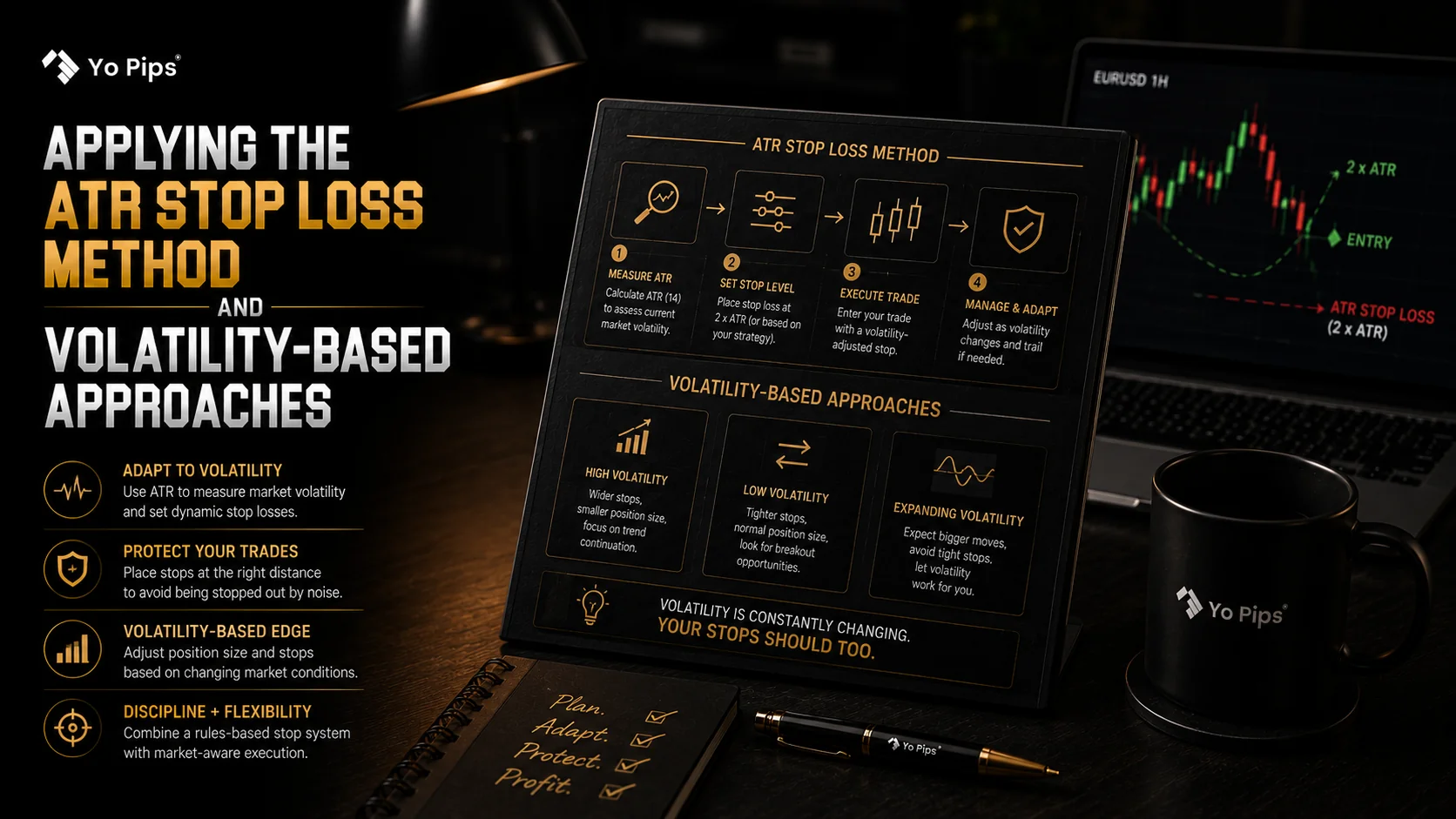
Implementation begins with selecting an appropriate ATR period, commonly fourteen periods for daily or four-hour charts. Traders then apply the multiple to the ATR reading to set the stop. For example, an ATR of fifty pips multiplied by two yields a one-hundred-pip stop distance. This approach accommodates both quiet and active market phases without manual recalibration each session.
Volatility-based stop loss placement extends beyond ATR to include other indicators such as Bollinger Band width or standard deviation measures. These tools quantify expected price movement and help position stops outside normal fluctuation zones. When volatility contracts, stops tighten accordingly; when it expands, stops widen to provide breathing room. Such adaptability supports consistent risk parameters across diverse currency pairs.
Practical examples illustrate the method's value. During high-impact news events, ATR readings rise sharply, prompting wider stops that prevent exit from temporary spikes. Conversely, in ranging markets with compressed ATR values, tighter stops protect capital without exposing positions to extended adverse moves. Intermediate traders who combine ATR with structural levels achieve balanced placement that respects both volatility and market context.
Backtesting validates the ATR stop loss method before live deployment. Traders apply historical data to compare outcomes between fixed stops and ATR-adjusted stops across multiple pairs and sessions. Results typically demonstrate fewer premature exits and improved risk-adjusted returns when volatility measures guide placement. Ongoing monitoring ensures the chosen multiplier remains suitable as market regimes shift.
Integration with existing strategies requires minimal additional effort. Traders simply replace static stop rules with ATR calculations at the point of trade entry. This substitution maintains overall strategy logic while enhancing adaptability. Documentation of ATR values at entry supports later performance analysis and refinement of the multiplier factor.
Balancing Risk Reward Ratio Stop Loss and Strategies to Avoid Stop Hunting Forex
The risk reward ratio stop loss framework requires traders to define acceptable loss relative to potential gain before entry. A common minimum ratio stands at one to two, meaning potential profit must equal at least twice the distance to the stop. This discipline ensures that winning trades compensate for multiple losses, supporting positive expectancy over a series of trades. Intermediate traders calculate both stop distance and target levels simultaneously to confirm the ratio meets their criteria.
Placement adjustments maintain the ratio while respecting market structure. When structural levels suggest a wider stop, traders may reduce position size to keep risk within limits rather than moving the stop closer. This preserves the intended reward potential and avoids compromising the ratio. Consistent ratio enforcement prevents the gradual erosion of edge that occurs when stops are tightened arbitrarily.
Avoid stop hunting forex situations demands awareness of common liquidity cluster points. Stops placed exactly at round numbers, previous swing lows, or obvious support levels often attract targeted price moves designed to trigger clusters of orders. Shifting stops slightly beyond these levels, while still respecting volatility measures, reduces exposure to such activity. Intermediate traders monitor order flow patterns and typical stop locations to anticipate and sidestep these zones.
Layered exit strategies provide additional protection. Rather than a single stop, traders may employ a primary stop at the volatility-adjusted level and a secondary mental or alert-based exit at a further distance. This layered approach allows partial position management if price approaches the initial stop without fully exiting the trade. It balances capital protection with the flexibility to remain in trades showing temporary weakness.
Broker selection and order type usage influence stop hunting vulnerability. Accounts with reputable brokers offering guaranteed stops or negative balance protection add safeguards. Pending order placement slightly away from obvious levels and avoidance of excessive leverage further decrease the probability of engineered stop runs. Intermediate traders who combine these operational practices with sound placement methodology achieve more reliable execution.
Performance tracking confirms the effectiveness of combined approaches. Metrics such as win rate, average loss size, and maximum drawdown reveal whether risk reward ratio stop loss rules and anti-hunting measures produce the intended results. Adjustments based on tracked data refine the overall process without introducing emotional overrides during live trading.
Conclusion
Mastering stop loss placement through volatility measures such as the ATR stop loss method, maintaining favorable risk reward ratio stop loss parameters, and implementing techniques to avoid stop hunting forex collectively protect trading capital while preserving opportunity. Intermediate traders who apply these frameworks consistently experience fewer disruptive exits and improved long-term account stability. Start Trading With Capital.